SKILLED NURSING SERVICES PROVIDER IN MARYLAND
By Fatumata Kaba · 2025-09-03 · 5 min read
Skilled Nursing Services in Maryland provide critical clinical care to individuals with complex health needs, allowing them to remain in their homes rather than institutional settings. By delivering medical assessments, treatments, and ongoing monitoring through licensed Registered Nurses (RNs) and Licensed Practical Nurses (LPNs), these services ensure participants receive professional support tailored to their Person-Centered Plan (PCP) within the framework of Medicaid Home and Community-Based Services (HCBS) waivers.
What Are the Roles and Responsibilities of Maryland Oversight Agencies?
The delivery of skilled nursing in the community is governed by a multi-layered regulatory environment designed to ensure high standards of care and fiscal accountability. The Maryland Department of Health (MDH) serves as the primary authority, overseeing the Medicaid program, the Developmental Disabilities Administration (DDA), and Community First Choice (CFC) services. Coordination between these branches ensures that the services authorized meet both state clinical standards and federal mandates.
To operate legally, providers must engage with specific regulatory bodies that manage licensure, oversight, and federal compliance. The Office of Health Care Quality (OHCQ) is the central agency responsible for licensing Residential Service Agencies (RSAs), which is the mandatory designation for any entity providing skilled nursing in the community. Simultaneously, the DDA provides authorization for participants with intellectual or developmental disabilities, while the Centers for Medicare & Medicaid Services (CMS) maintains the overarching federal guidelines for HCBS waivers.
- Maryland Department of Health (MDH): Primary oversight for Medicaid, DDA, and CFC nursing.
- Office of Health Care Quality (OHCQ): Licenses RSAs and monitors compliance with COMAR 10.07.05.
- Developmental Disabilities Administration (DDA): Authorizes specific skilled nursing for eligible participants.
- Centers for Medicare & Medicaid Services (CMS): Sets federal standards for clinical care and waiver operations.
How Do Skilled Nursing Services Function in the Community?
Skilled nursing is defined as intermittent or continuous care that requires the expertise of a licensed clinician. These services are not merely supportive but are specifically clinical in nature, requiring a medical plan of care that is regularly reviewed. By integrating these services into the participant’s home, schools, or community settings, providers can manage chronic conditions that would otherwise necessitate hospitalization or nursing facility placement.
The scope of these services is broad, encompassing complex medical procedures such as wound care, ventilator support, and enteral feeding. Beyond direct treatment, skilled nurses also act as educators, training family caregivers on medical tasks to foster independence, and as reporters, relaying vital health data to the participant’s physician. Every procedure must be meticulously documented and align with the participant’s approved Person-Centered Plan to ensure medical necessity is met.
- Wound care and dressing changes.
- Medication administration and injection.
- Enteral (tube) feeding support.
- Catheter care and bowel programs.
- Tracheostomy or ventilator support.
- Chronic condition monitoring (e.g., diabetes, seizures).
- Training caregivers on medical tasks.
- Health assessment and reporting to physicians.
What Are the Licensing and Provider Enrollment Requirements?
Launching a skilled nursing agency requires strict adherence to state business and healthcare regulations. An agency must first be properly registered with the Maryland Department of Assessments and Taxation (SDAT) and obtain the necessary federal identifiers, including an Employer Identification Number (EIN) and a Type 2 National Provider Identifier (NPI). This foundational step is critical for all subsequent licensing applications.
Once the business entity is established, the agency must seek licensure as a Residential Service Agency (RSA) through the OHCQ. This process involves a rigorous review of organizational policies, staff credentials, and operational workflows under the standards set by COMAR 10.07.05. Following OHCQ licensure, providers must complete the Medicaid enrollment process via the ePREP portal, which grants the authority to bill for services under programs like the Community Pathways Waiver, CFC, or the Community Options Waiver.
What Is the Step-by-Step Process for Agency Authorization?
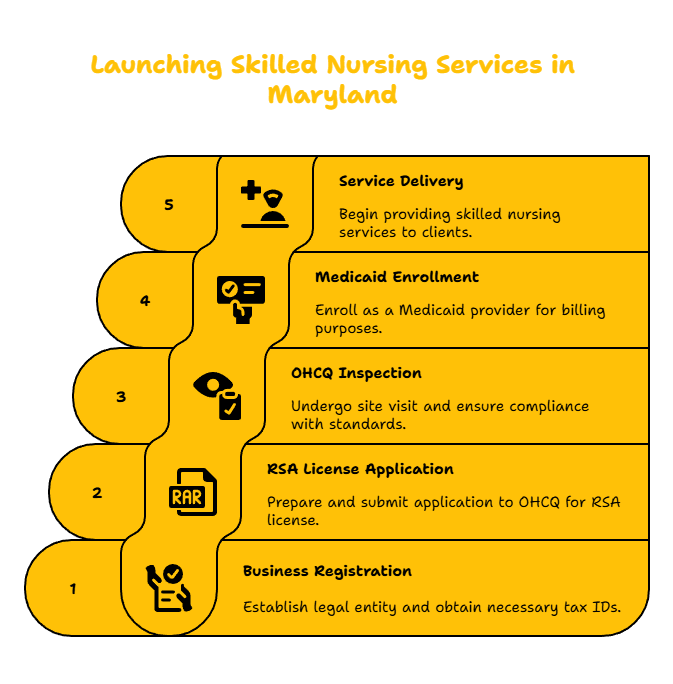
The path to becoming a provider is a sequenced progression of administrative and clinical tasks. The process begins with business setup, followed by the submission of a detailed RSA application to the OHCQ. This application must include the agency’s program description, the qualifications of the designated Nurse Administrator, comprehensive policy manuals, and plans for infection control and emergency management.
After the application is submitted, the agency will undergo an OHCQ inspection. During this site visit, state regulators review staff files, clinical documentation, quality assurance protocols, and supervisory procedures to ensure full compliance with COMAR standards. Once licensure is granted and Medicaid enrollment via ePREP is finalized, the provider can begin accepting referrals and documenting care through the LTSS Maryland system to initiate billing for services rendered.
How Do Staffing and Clinical Documentation Requirements Shape Service Delivery?
High-quality clinical care depends on the competence and oversight of the nursing staff. Agencies must employ or contract with licensed Registered Nurses (RNs) and Licensed Practical Nurses (LPNs) who are in good standing with the Maryland Board of Nursing. The Nursing Administrator or Clinical Supervisor holds the ultimate responsibility for ensuring that care is delivered according to the physician’s orders and that all delegated nursing tasks are performed safely and competently.
Documentation is the backbone of compliance. Every clinical activity must be captured in the participant's records, including medication administration, wound care logs, and incident reports. Agencies are required to maintain a robust clinical policy and procedure manual that covers everything from HIPAA protocols to emergency response plans. Regular competency checks and ongoing education for staff are not just requirements; they are essential for maintaining the standard of care required under Medicaid waiver programs.
Frequently Asked Questions
What waivers allow for skilled nursing in Maryland?
Skilled nursing is authorized under several HCBS waivers, including the Community Pathways Waiver (DDA), Community First Choice (CFC), the Community Options Waiver (CO), the Model Waiver for Medically Fragile Children, and the Increased Community Services (ICS) program.
How long does the provider enrollment process typically take?
The timeline varies by agency, but generally involves 1–2 weeks for business registration, 4–6 weeks for the RSA application, 6–8 weeks for the OHCQ inspection, and an additional 4–6 weeks for Medicaid enrollment through ePREP.
What does the OHCQ review during a site visit?
During the OHCQ inspection, regulators evaluate the agency’s staff files, clinical documentation practices, quality assurance protocols, supervision of nursing staff, and overall compliance with COMAR 10.07.05 regulations.
Key Takeaway for New Agencies
Success as a skilled nursing provider in Maryland is predicated on the ability to balance rigorous clinical standards with meticulous administrative compliance. By focusing on the foundational requirements—securing the RSA license through the OHCQ, maintaining accurate documentation in the LTSS system, and ensuring that all nursing staff are properly supervised—providers can successfully navigate the complexities of the Medicaid waiver landscape to deliver essential care to the community.
Last verified: May 2024. This information is intended for educational purposes only and does not constitute legal or professional consulting advice. Please consult with the Maryland Department of Health or the Office of Health Care Quality for the most current regulatory updates and specific licensure requirements applicable to your agency.