SKILLED NURSING SERVICES PROVIDER IN MAINE
By Fatumata Kaba · 2025-08-12 · 5 min read
Skilled Nursing Services in Maine provide essential, high-acuity clinical care to individuals residing in their own homes, ensuring they can manage complex medical conditions while maintaining independence. These services, which are critical for preventing unnecessary hospital readmissions and promoting long-term health, are authorized and reimbursed through a combination of MaineCare (Medicaid), Medicare, private insurance, and various Home and Community-Based Services (HCBS) Waivers including Sections 19, 21, and 96.
For healthcare entrepreneurs and clinical leaders, establishing a skilled nursing agency requires strict adherence to regulatory oversight from the Maine Department of Health and Human Services (DHHS). By integrating clinical excellence with administrative compliance, providers play a vital role in Maine’s healthcare infrastructure, bridging the gap between facility-based care and the comfort of the patient’s personal residence.
What Are the Primary Regulatory Bodies Governing Skilled Nursing in Maine?
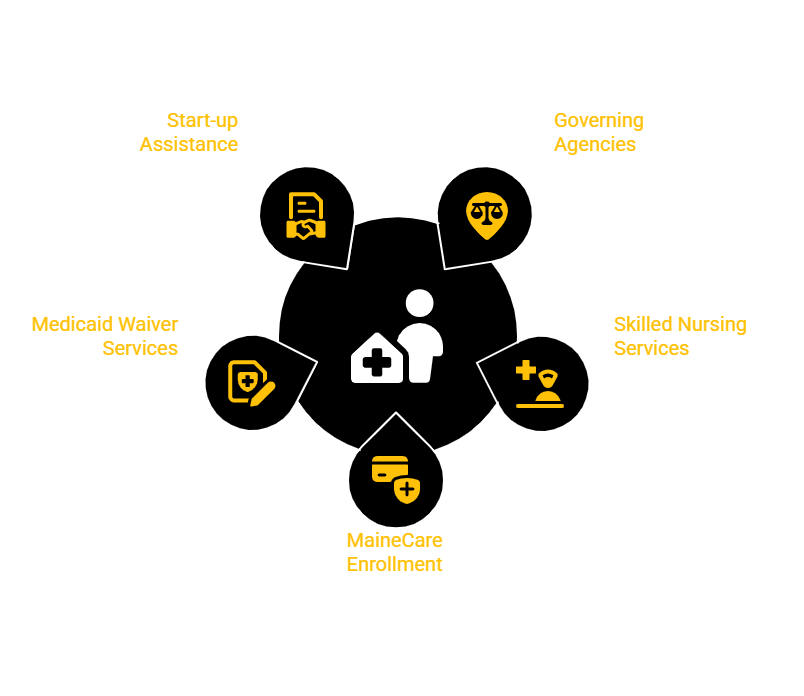
The regulatory landscape for home-based clinical care in Maine is multifaceted, involving federal and state oversight to ensure patient safety and fiscal responsibility. The Maine Department of Health and Human Services (DHHS) serves as the primary entity responsible for the statewide regulation of home health and private duty nursing services. Within the DHHS, the Division of Licensing and Certification (DLC) holds the authority to issue the necessary Home Health Agency (HHA) and Private Duty Nursing (PDN) licenses required to legally operate within the state.
Fiscal and programmatic oversight is managed by the Office of MaineCare Services (OMS), which handles provider enrollment, reimbursement structures, and the administration of specific service sections, including Sections 19, 21, 96, and 40. At the federal level, the Centers for Medicare & Medicaid Services (CMS) sets the overarching standards for clinical care and HCBS waiver participation, ensuring that all providers meet national benchmarks for quality and compliance in home-based settings.
What Clinical Interventions Are Authorized Under Skilled Nursing Services?
Skilled Nursing Services consist of medically necessary interventions that must be performed by a licensed nurse to ensure the health and safety of the individual. These services are initiated only upon the order of a licensed physician and must be clearly defined within a formal Plan of Care or Person-Centered Plan (PCP). Common clinical tasks include complex medication management, specialized wound care, post-surgical recovery support, and the management of medical equipment such as tracheostomies, ostomies, and catheters.
Beyond direct clinical procedures, skilled nursing encompasses ongoing disease monitoring and management for chronic conditions like diabetes or COPD. Nurses are also responsible for conducting regular health assessments, monitoring vital signs, coordinating care with the broader medical team—including primary care physicians and therapists—and providing essential education to patients and their caregivers to bolster emergency preparedness and daily health maintenance.
How Do You Obtain Licensure and Prepare for MaineCare Enrollment?
The launch process begins with formalizing the business entity with the Maine Secretary of State, followed by securing an Employer Identification Number (EIN) and a Type 2 National Provider Identifier (NPI). Once the business is established, the provider must apply for the appropriate state license through the DLC. This application necessitates the submission of detailed operations manuals, a comprehensive clinical staffing plan, and robust infection control policies. Agencies must also demonstrate proof of adequate professional and liability insurance coverage before commencing operations.
After achieving licensure, the provider must navigate the MaineCare enrollment process via the Health PAS Online portal. Providers must strategically select the service sections relevant to their business model, such as Section 96 for Private Duty Nursing, Section 40 for Home Health Services, or Sections 19 and 21 for waiver-related nursing. Success in this phase relies heavily on the quality of the agency’s internal documentation, including standardized nursing care plans, HIPAA compliance protocols, and formalized emergency response procedures.
What Are the Staffing and Training Requirements for Clinical Personnel?
High-quality patient care is contingent upon a well-credentialed clinical team. The Director of Nursing (DON) or Clinical Supervisor must be a Registered Nurse (RN) with sufficient management experience to oversee regulatory compliance, care coordination, and clinical quality assurance. The nursing staff itself consists of RNs, who must hold an active Maine license and possess at least one year of clinical experience, and Licensed Practical Nurses (LPNs), who provide care under the supervision of an RN and are specifically trained in delegated tasks.
Training is an ongoing requirement for all clinical staff to ensure service delivery remains compliant with state and federal standards. Essential training modules include:
- HIPAA compliance and patient confidentiality protocols.
- Comprehensive infection control and the use of universal precautions.
- Standardized medication administration procedures.
- Emergency response, safety planning, and disaster preparedness.
- Mandatory continuing education as required by the Maine State Board of Nursing.
Frequently Asked Questions About Skilled Nursing in Maine
What is the typical timeline for launching a skilled nursing agency?
The launch timeline is segmented by regulatory milestones. Business registration generally takes 1–2 weeks, while the development of clinical policies and procedure manuals typically requires 2–3 weeks. The licensure application process through the DLC can take 30–90 days, and subsequent MaineCare enrollment and onboarding usually spans 4–6 weeks.
How are Skilled Nursing Services reimbursed under Medicaid waivers?
Services are reimbursed through specific sections of the MaineCare program. Section 96 governs Private Duty Nursing, while Section 40 covers traditional Home Health Services. For populations served under the Section 19 or 21 Waivers, nursing services are integrated into the individual’s authorized plan to support adults with disabilities or the elderly, covering everything from intermittent visits to 24-hour nursing support.
What documentation is required to maintain agency compliance?
Agencies must maintain a rigorous documentation trail, including physician-signed Plans of Care, detailed nursing care logs, medication administration records, and wound care assessments. Additionally, administrators must keep thorough staff training records, RN supervision logs, incident reports, and up-to-date client service agreements to ensure readiness for state-conducted surveys and audits.
Key Takeaway
Launching a skilled nursing provider agency in Maine is a precise, multi-staged process that requires deep alignment between clinical expertise and administrative adherence. By prioritizing the rigorous development of operating manuals, maintaining active staff credentials, and staying current with MaineCare's Health PAS portal requirements, agency founders can build a sustainable, high-impact organization capable of delivering essential medical care to vulnerable populations across the state.
Last verified: May 2024. This content is provided for informational purposes only and does not constitute legal or professional advice. Always consult with the Maine Department of Health and Human Services (DHHS) or qualified legal counsel to ensure your agency meets all current statutory requirements and state regulations.