SKILLED NURSING SERVICES PROVIDER IN KANSAS
By Fatumata Kaba · 2025-07-24 · 5 min read
DELIVERING CLINICALLY COMPLEX, MEDICALLY NECESSARY CARE TO INDIVIDUALS IN THEIR HOME OR COMMUNITY SETTING
Skilled Nursing Services in Kansas provide high-level, medically necessary care administered by licensed nurses to individuals with acute or chronic health conditions. These services, offered under the Kansas Medicaid (KanCare) State Plan and various Home and Community-Based Services (HCBS) waivers, are essential for managing health, promoting recovery, and preventing unnecessary institutionalization for residents across the state.
Understanding the Governance and Oversight of Skilled Nursing in Kansas
The delivery of skilled nursing care within the Kansas Medicaid framework is governed by a multi-layered regulatory environment designed to ensure participant safety and fiscal integrity. The Kansas Department of Health and Environment (KDHE), specifically the Division of Health Care Finance, serves as the primary entity for managing Medicaid eligibility, provider enrollment, and billing oversight. Their role is critical in ensuring that agencies meet the state’s rigorous standards for clinical service delivery.
Complementing this, the Kansas Department for Aging and Disability Services (KDADS) coordinates the integration of these services into HCBS waiver programs. They play a vital role in monitoring ongoing provider compliance and ensuring that care is delivered in accordance with state and federal guidelines. At the federal level, the Centers for Medicare & Medicaid Services (CMS) establishes the overarching standards, while the Managed Care Organizations (MCOs) under the KanCare program—Sunflower Health Plan, Aetna Better Health, and UnitedHealthcare—handle individual service authorizations, care planning, and localized provider monitoring.
Defining the Scope of Skilled Nursing Services
Skilled Nursing Services encompass a wide array of clinical interventions performed by Registered Nurses (RNs) or Licensed Practical Nurses (LPNs). All care must be provided under the direct orders of a licensed physician. These services are intended to treat, monitor, or manage health conditions that are otherwise too complex for non-clinical caregivers to handle, thereby allowing individuals to remain in their own homes or community settings.
Approved providers must be prepared to deliver a comprehensive suite of medical tasks, including:
- Medication administration, injections, and complex IV therapies.
- Wound care, catheter maintenance, and tracheostomy management.
- Ventilator monitoring and comprehensive respiratory support.
- Gastrostomy tube feeding and specialized nutritional support.
- Management of chronic conditions such as diabetes, heart disease, and seizure disorders.
- Proactive health education and training for primary caregivers.
- Frequent medical assessments and ongoing health status monitoring.
Every clinical activity must be meticulously documented in the participant’s physician-approved Plan of Care (POC). This documentation is not merely a clinical requirement but a foundational element for ensuring that services remain aligned with the specific authorizations granted by KanCare or the applicable HCBS waiver program.
Navigating Licensing and Provider Approval Requirements
Becoming an approved provider of Skilled Nursing Services in Kansas is a rigorous process that demands high administrative and clinical readiness. Before a provider can begin billing, they must satisfy several core prerequisites. This includes formal business registration with the Kansas Secretary of State, acquisition of an Employer Identification Number (EIN) from the IRS, and securing a Type 2 National Provider Identifier (NPI).
Additionally, prospective providers must hold the appropriate licensure as a Home Health Agency from the KDHE if they intend to provide care outside of a facility setting. Compliance is not static; it requires maintaining robust professional, general, and malpractice liability insurance. Organizations must also develop comprehensive, written internal policies covering clinical care protocols, infection control, emergency response, and detailed documentation standards. Ensuring that all nursing staff are properly licensed, trained, and have cleared mandatory background checks is a non-negotiable operational requirement.
The Enrollment and Billing Workflow for KanCare Providers
The provider enrollment process is sequential and requires precise coordination between state agencies and the three KanCare MCOs. The first step involves achieving state licensure as a Home Health Agency, which may require site surveys or inspections. Once licensure is secured, the organization must apply for Medicaid enrollment through the Kansas Medical Assistance Program (KMAP) portal. Simultaneously, the agency must initiate the credentialing process with Sunflower Health Plan, Aetna Better Health, and UnitedHealthcare.
After successfully navigating the credentialing phase, the organization must establish a structured billing and authorization system. This includes:
- Securing signed physician’s orders and a comprehensive, individualized Plan of Care.
- Submitting initial and ongoing service authorization requests to the relevant MCO.
- Implementing a standardized billing system to submit claims using the correct CPT/HCPCS codes.
- Maintaining an audit-ready filing system for all clinical progress notes and service logs.
Ensuring Clinical Compliance and Staffing Standards
Success in this field relies heavily on the quality of the clinical team and the strength of the administrative oversight. A Skilled Nursing agency must designate a Director of Nursing or a Skilled Nursing Supervisor who possesses an active Kansas RN license and demonstrated supervisory experience. This individual is responsible for ensuring that all staff—whether RNs or LPNs—adhere to clinical best practices and state regulations.
All clinical personnel must maintain active licensure, CPR/BLS certification, and undergo specialized training in home-based clinical procedures. Furthermore, agencies must implement a mandatory training program that covers HIPAA compliance, universal infection control precautions, medication administration protocols, and effective emergency response techniques. Ongoing skills evaluations and continuing education are essential to maintain compliance with both state mandates and the evolving needs of the waiver populations served.
Frequently Asked Questions
What types of HCBS waivers commonly cover skilled nursing?
Skilled nursing is authorized based on clinical necessity and may be covered under the Technology Assisted (TA) Waiver, Brain Injury (BI) Waiver, Physical Disability (PD) Waiver, Frail Elderly (FE) Waiver, and in specific circumstances, the Intellectual/Developmental Disability (IDD) Waiver.
How long should an organization expect the launch process to take?
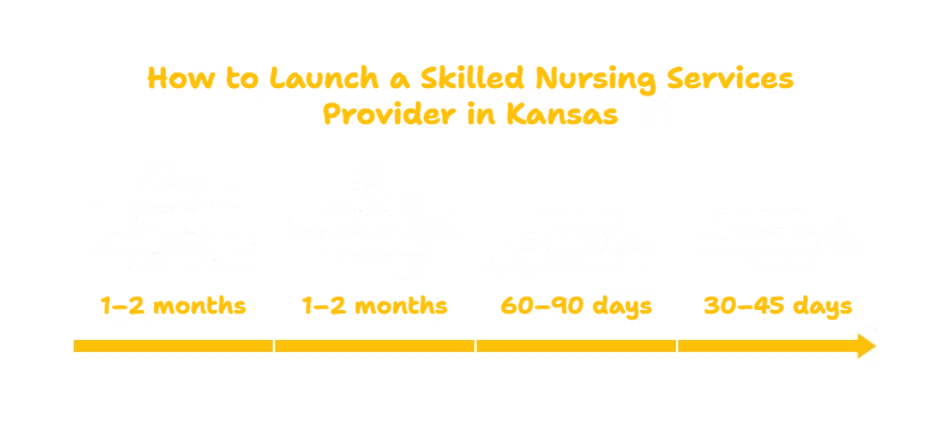
The total timeline varies, but generally, business registration and policy development take 1–2 months, staff hiring and credentialing take 1–2 months, Medicaid enrollment and MCO credentialing take 60–90 days, and billing system setup requires 30–45 days.
Are MCOs responsible for all skilled nursing service authorizations?
Yes, under the KanCare model, the Managed Care Organizations (Sunflower Health Plan, Aetna Better Health, and UnitedHealthcare) are responsible for authorizing and reimbursing these services based on the member’s medical necessity and their individualized Plan of Care.
Key Takeaways for Prospective Providers
Launching a Skilled Nursing agency in Kansas requires a steadfast commitment to regulatory compliance and clinical excellence. By focusing on the integration of KDHE licensure requirements, KMAP enrollment, and MCO credentialing, agencies can build a sustainable foundation. Success depends on maintaining detailed, audit-ready documentation, adhering to physician-ordered Plans of Care, and investing in the ongoing training and supervision of licensed nursing staff to meet the high standards expected by Kansas Medicaid.
Last verified: 2024. This content is for informational purposes only and does not constitute legal or professional regulatory advice. Always consult directly with KDHE, KDADS, or relevant MCOs for the most current program requirements and state statutes.