SKILLED NURSING SERVICES PROVIDER IN IDAHO
By Fatumata Kaba · 2025-07-17 · 5 min read
Skilled Nursing Services in Idaho are essential, medically necessary interventions provided by licensed professionals to individuals with disabilities or complex medical conditions who choose to reside in their own homes or community settings. These services, authorized through the Idaho Department of Health and Welfare (IDHW) Medicaid State Plan and Home and Community-Based Services (HCBS) waivers, are critical for maintaining health stability, facilitating recovery, and ensuring participant independence. By delivering clinical oversight in a home environment, these providers bridge the gap between acute medical care and long-term community support.
How Do Skilled Nursing Services Integrate with Idaho Medicaid Programs?
Skilled Nursing Services are structured to support participants across various Idaho Medicaid programs. Whether under the Medicaid State Plan Home Health Benefit or through specific HCBS waivers like the Aged and Disabled (A&D) Waiver and the Developmental Disabilities (DD) Waiver, these services are governed by a strict requirement of medical necessity. Every intervention must be clearly outlined within the participant’s Individualized Service Plan (ISP) or Plan of Care (POC), serving as the clinical roadmap for the nurse’s visit.
The delivery of these services requires constant coordination among the participant, their primary physician, and the nursing staff. This collaborative approach ensures that clinical monitoring, medication management, and specialized procedures like wound care or IV therapy are consistently aligned with the patient’s evolving health needs. Because these services are funded through Medicaid, maintaining compliance with both state and federal oversight agencies is not merely operational—it is a condition of program participation.
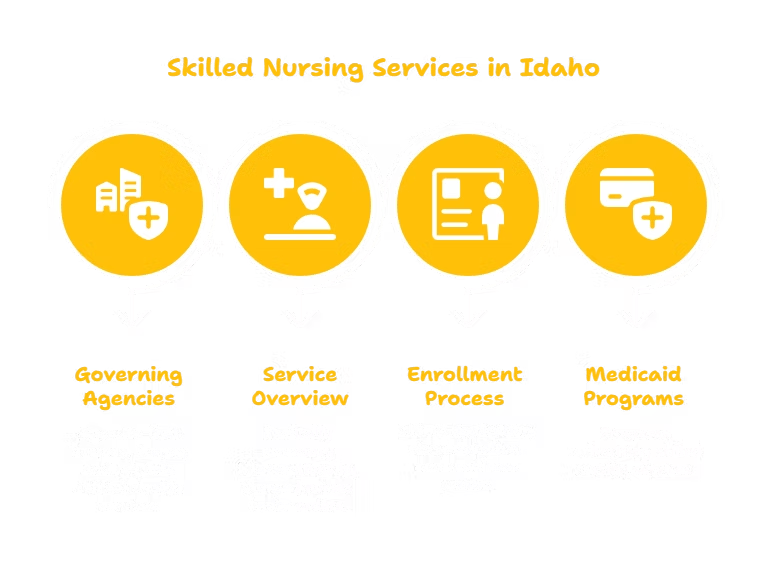
What Are the Governing Agencies and Regulatory Requirements?
Operating as a Skilled Nursing Services provider in Idaho requires alignment with three primary regulatory tiers. At the state level, the Idaho Department of Health and Welfare (IDHW) Division of Medicaid serves as the central authority for provider enrollment, service authorization, and the administration of reimbursement. Simultaneously, all nursing personnel must remain in full compliance with the Idaho Board of Nursing, which governs the licensure, scope of practice, and professional conduct of the clinicians providing care.
On the federal level, the Centers for Medicare & Medicaid Services (CMS) sets the standards for quality, safety, and operational integrity. Providers must adhere to these overarching federal mandates while navigating Idaho-specific policies. This dual-layer oversight ensures that every nursing visit, medication administration, and health education session meets established clinical benchmarks, protecting the participant while maintaining the integrity of the Medicaid program.
What Steps Are Required for Provider Enrollment and Business Setup?
Before beginning the enrollment process, a provider must establish a solid business infrastructure. This involves registering the business with the Idaho Secretary of State, obtaining a federal Employer Identification Number (EIN), and securing a Type 2 National Provider Identifier (NPI). These foundational steps provide the legal and administrative framework necessary to apply for Medicaid participation within the Idaho Medicaid Management Information System (MMIS).
Following initial registration, the provider must curate a robust administrative system that includes proof of general liability, professional liability, and malpractice insurance. The enrollment process involves a rigorous Readiness Review conducted by the IDHW. During this phase, the agency evaluates the provider’s clinical policies, participant safeguards, billing systems, and documentation standards to confirm the provider is capable of delivering consistent, compliant care from the first day of operation.
What Documentation Is Necessary to Maintain Compliance?
Effective documentation is the backbone of a successful Skilled Nursing Services agency. Beyond the standard business filings like the EIN and NPI, a provider must maintain a comprehensive Policy & Procedure Manual that reflects the reality of home-based clinical care. This manual acts as an internal audit tool, ensuring that staff members have clear, consistent instructions for every medical contingency they might encounter in a participant's home.
- Participant Intake & Planning: Protocols for initial assessment, physician order tracking, and ongoing service planning.
- Clinical Standards: Specific procedures for medication administration, wound care, ostomy maintenance, and emergency response.
- Operational Policies: Detailed processes for HIPAA compliance, participant rights, grievance management, and incident reporting.
- Staff Management: Systems for verifying credentials, conducting background checks, and tracking annual competency evaluations.
- Financial Integrity: Procedures for Medicaid billing, authorization management, and maintaining readiness for external state audits.
How Are Staffing and Clinical Competencies Managed?
The quality of a Skilled Nursing agency is defined by its clinical team. The role of the Nursing Supervisor or Clinical Manager is paramount; this individual must hold an active Idaho RN license, possess clinical leadership experience, and have cleared all required background screenings. This supervisor is responsible for overseeing the performance of all Registered Nurses (RNs) and Licensed Practical Nurses (LPNs) employed by the agency, ensuring that every service delivered is within the nurse’s authorized scope of practice.
Every clinical staff member must maintain an active Idaho nursing license and current CPR certification. Furthermore, the agency must provide ongoing training that extends beyond clinical skills. Mandatory training modules should cover HIPAA confidentiality, participant rights, abuse prevention, infection control, and emergency preparedness. By emphasizing these competencies through annual evaluations and continuing education, the agency ensures that its staff remains prepared to manage the complex needs of participants in community-based settings.
Frequently Asked Questions
What is the typical timeline to launch a Skilled Nursing agency in Idaho?
The timeline varies based on organizational readiness, but generally, business formation and credentialing take 1–2 weeks. Staff hiring and program development usually require 2–3 months. The formal IDHW enrollment and readiness review process takes 60–90 days, followed by an additional 30–45 days for billing system configuration.
Must all nursing staff be Registered Nurses?
No, the agency may employ both Registered Nurses (RNs) and Licensed Practical Nurses (LPNs). However, all LPNs must operate under the direct supervision of an RN, and all clinical staff must maintain active Idaho licenses appropriate to their respective roles.
Are Skilled Nursing Services covered under the DD Waiver?
Yes, skilled nursing interventions are authorized under specific HCBS waivers, including the Developmental Disabilities (DD) Waiver and the Aged and Disabled (A&D) Waiver, provided the services are medically necessary and documented in the participant’s Individualized Service Plan.
Key Takeaway
Launching a Skilled Nursing Services provider in Idaho requires a methodical approach that prioritizes regulatory compliance, clinical excellence, and robust documentation. By aligning business operations with IDHW guidelines and ensuring all clinical staff meet state-mandated licensure and competency requirements, providers can deliver vital health services that sustain participant independence in the community. Success in this field is rooted in the continuous maintenance of quality standards, rigorous billing practices, and a steadfast commitment to the health outcomes of the populations served.
Last verified: October 2023. Disclaimer: This article is for informational purposes only and does not constitute legal or professional Medicaid consulting advice. Requirements are subject to change; please consult the official Idaho Department of Health and Welfare documentation for the most current rules and regulations.