SKILLED NURSING SERVICES PROVIDER IN HAWAII
By Fatumata Kaba · 2025-07-16 · 5 min read
Skilled Nursing Services in Hawaii provide essential clinical care to individuals with chronic illnesses, disabilities, or post-acute medical needs, ensuring they can maintain their health and independence within their own homes and communities. These services, authorized through Hawaii’s Medicaid State Plan, Home and Community-Based Services (HCBS) waiver programs, and Medicare, are delivered by licensed healthcare professionals to manage complex medical conditions and prevent avoidable hospitalizations.
This guide provides an overview for healthcare entrepreneurs and agency administrators seeking to enter the Hawaii home-based nursing market. It outlines the regulatory framework, essential provider requirements, and the administrative pathways necessary to launch and maintain a compliant Skilled Nursing Services agency in the state.
What Are the Governing Agencies for Skilled Nursing in Hawaii?
The delivery of skilled nursing care in Hawaii is strictly regulated to ensure patient safety and adherence to federal and state standards. Three primary agencies govern this landscape: the Hawaii Department of Human Services (DHS), the Hawaii Department of Health (DOH), and the Centers for Medicare & Medicaid Services (CMS). Each agency plays a specific role in maintaining the integrity of care delivery.
The Hawaii Department of Human Services (DHS), specifically the Med-QUEST Division, acts as the primary authority for Medicaid provider enrollment, the authorization of services, and the management of reimbursement protocols. Simultaneously, the Department of Health (DOH) via the Office of Health Care Assurance (OHCA) is responsible for the licensing and ongoing monitoring of home health agencies and skilled nursing providers. At the federal level, the Centers for Medicare & Medicaid Services (CMS) provides the overarching regulatory framework, ensuring that all state-authorized services align with established Medicaid and Medicare quality and fiscal standards.
What Scope of Care Do Skilled Nursing Services Include?
Skilled Nursing Services are defined by medically necessary interventions performed by licensed nurses to manage health conditions, stabilize clinical status, and promote recovery. These services are never "one size fits all"; they are precisely tailored to the participant based on their Individualized Service Plan (ISP) or Plan of Care (POC). Care may be provided on an intermittent, part-time, or extended basis depending on the complexity of the patient's medical requirements.
Approved providers commonly deliver a specific set of clinical interventions designed to optimize health outcomes. These services include:
- Health assessments and continuous monitoring of vital signs and clinical status.
- Complex medication administration, including injections and IV therapy.
- Professional wound care management and the treatment of pressure injuries.
- Disease-specific management for conditions such as diabetes or respiratory distress.
- Specialized tasks such as catheter care, tube feeding, and ostomy maintenance.
- Health education and support training for participants and their primary caregivers.
- Active coordination with physicians and interdisciplinary care teams to ensure continuity of care.
How Do Providers Obtain Licensing and Medicaid Enrollment?
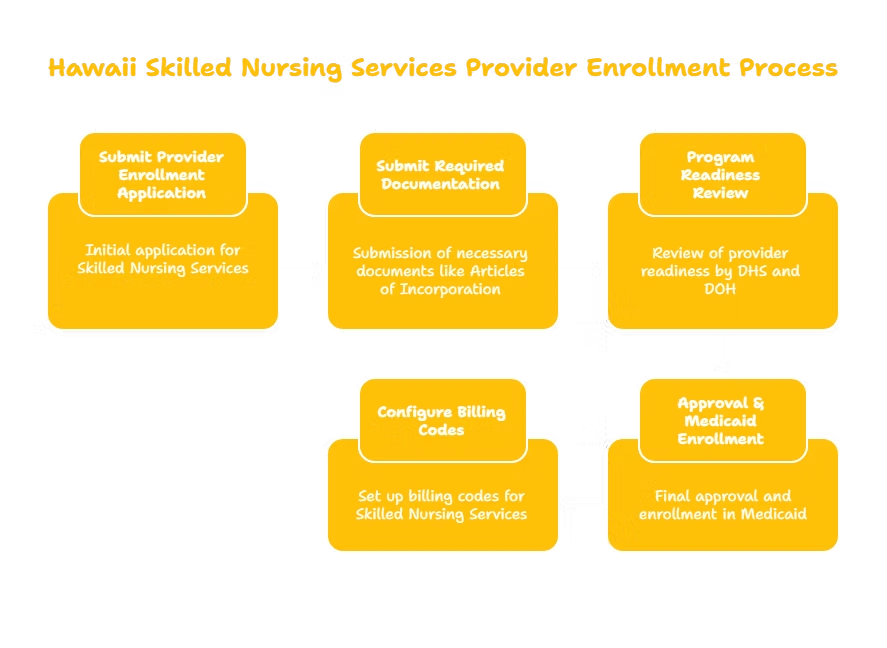
The path to becoming a provider involves a rigorous sequence of business formation, clinical licensing, and Medicaid enrollment. Before an agency can bill for services, it must establish itself as a legal entity and demonstrate its capacity to meet stringent state standards. This process begins with registering the business with the Hawaii Department of Commerce and Consumer Affairs (DCCA) and securing a Federal Employer Identification Number (EIN) and a Type 2 National Provider Identifier (NPI).
Once the business entity is established, the provider must obtain a Home Health Agency License or a Skilled Nursing Agency License through the DOH’s Office of Health Care Assurance. Following licensure, the agency must undergo the Medicaid provider enrollment process with the Hawaii Med-QUEST Division. This includes submitting comprehensive documentation such as articles of incorporation, proof of professional liability and malpractice insurance, and detailed clinical protocols that demonstrate how the agency will manage patient care and safety.
What Are the Essential Staffing and Clinical Requirements?
The quality of a Skilled Nursing Agency is directly tied to the competency of its staff. Every agency must appoint a Director of Nursing (DON) or a Clinical Supervisor who holds an active Hawaii RN license and possesses documented supervisory experience. This individual is responsible for overseeing the clinical operations, ensuring that all nursing care meets state standards, and verifying that all staff members remain compliant with current health regulations.
All nursing staff, including Registered Nurses (RNs) and Licensed Practical Nurses (LPNs), must hold active licenses in Hawaii, maintain current CPR certification, and pass mandatory background screenings. Furthermore, the agency must provide ongoing training for all staff. This training curriculum must encompass HIPAA privacy standards, patient rights, infection control protocols, emergency preparedness, and specialized Medicaid documentation and billing compliance.
Which Medicaid Programs Authorize Skilled Nursing Services?
Skilled Nursing Services are authorized through several specific Hawaii Medicaid channels. Understanding the nuances of these programs is critical for agency administrators to ensure that billing codes and service authorizations are correctly matched to the participant's eligibility. The primary programs authorizing these services include the Developmental Disabilities/Intellectual Disabilities (DD/ID) Waiver, the Community Care Services (CCS) Program, the Medicaid State Plan Home Health Benefit, and the broader QUEST Integration Managed Care Program.
Each of these programs has distinct requirements regarding the authorization of service hours and the necessity of clinical documentation. For example, some programs may focus on intermittent skilled nursing visits, while others, such as those catering to medically fragile participants, may authorize extended or continuous care models. Providers must be adept at tracking these authorizations and adjusting their service delivery logs to align with the specific requirements of the participant's enrolled program.
Frequently Asked Questions
What is the typical timeline to launch a Skilled Nursing agency in Hawaii?
The launch process generally takes between 6 to 9 months. This includes 1–2 months for business formation, 2–4 months for staffing and facility readiness, 60–90 days for Medicaid and DOH enrollment, and 30–45 days for final billing setup and claims testing.
What documentation is mandatory for the Medicaid enrollment packet?
Applicants must submit articles of incorporation, proof of EIN/NPI, DOH-issued licenses, evidence of comprehensive liability insurance, and a robust Policy & Procedure Manual. This manual must cover clinical intake, nursing assessments, medication administration, emergency responses, and HIPAA compliance.
Do I need an office location or can I operate as a mobile service?
While Skilled Nursing Services are performed in the patient's home, the agency must maintain an administrative base that meets DOH licensing standards. This facility must be equipped to securely store clinical records, host administrative staff, and facilitate the quality assurance systems required by state law.
Key takeaway: Launching a Skilled Nursing agency in Hawaii requires a meticulous focus on regulatory alignment between the Department of Health's licensing requirements and the Department of Human Services' Medicaid enrollment standards. Success depends on the ability to maintain rigorous documentation, manage highly skilled nursing staff, and navigate the specific authorization requirements of Hawaii's diverse Medicaid waiver programs.
Last verified: [Insert Date]. This content is for informational purposes only and does not constitute legal or professional advice. Readers should consult the official Hawaii Med-QUEST and Department of Health websites for the most current regulatory information and guidance.