SKILLED NURSING SERVICES PROVIDER IN FLORIDA
By Fatumata Kaba · 2025-07-11 · 5 min read
Skilled Nursing Services in Florida are a critical component of the state’s healthcare infrastructure, providing essential clinical care to individuals with chronic health conditions, disabilities, or complex recovery needs within their homes and communities. Authorized under Florida’s Medicaid and Home and Community-Based Services (HCBS) waiver programs, these services allow vulnerable populations to maintain independence while receiving professional, physician-ordered medical support.
For healthcare entrepreneurs and organizations looking to enter this space, establishing a compliant and effective Skilled Nursing operation requires navigating rigorous regulatory standards set by both state and federal authorities. Success depends on a thorough understanding of the licensure processes, clinical documentation requirements, and the specific mandates governing Medicaid provider enrollment in Florida.
What Are the Governing Agencies and Regulatory Standards?
Providing Skilled Nursing Services in Florida is a highly regulated endeavor overseen by several key agencies. The Florida Agency for Health Care Administration (AHCA) serves as the primary regulatory body for the state, responsible for licensing Home Health Agencies, overseeing Medicaid provider enrollment, and conducting ongoing monitoring of service delivery to ensure compliance with state statutes.
Beyond state-level oversight, the Florida Department of Health (DOH) manages the professional standards for nursing licensure, ensuring that all clinicians practicing in home-based settings meet established clinical practice benchmarks. Furthermore, the Centers for Medicare & Medicaid Services (CMS) provides the overarching federal framework, ensuring that all Medicaid-funded clinical services adhere to national standards for quality, safety, and accountability.
What Clinical Interventions Are Included in Skilled Nursing?
Skilled Nursing Services are defined by clinical interventions that must be performed under specific physician orders, tailored to the unique physiological requirements of each participant. Providers are expected to deliver care that is documented in a formal plan of care, ensuring that every action taken is clinically justified and meets Medicaid’s strict documentation requirements for medical necessity.
Approved providers generally offer a broad spectrum of medical support, including but not limited to:
- Medication administration and complex medication management.
- Wound care, pressure ulcer treatment, and dressing changes.
- Tracheostomy care, ventilator support, and respiratory therapies such as nebulizer treatments and oxygen monitoring.
- Catheter care, maintenance, and urological support.
- Diabetes management, including blood glucose monitoring and insulin administration.
- Gastrostomy (G-tube) feeding and specialized nutritional maintenance.
- Chronic condition monitoring and regular clinical assessments to prevent hospital readmissions.
- Caregiver education and training to help families manage complex medical needs safely.
What Are the Prerequisites for Licensure and Provider Approval?
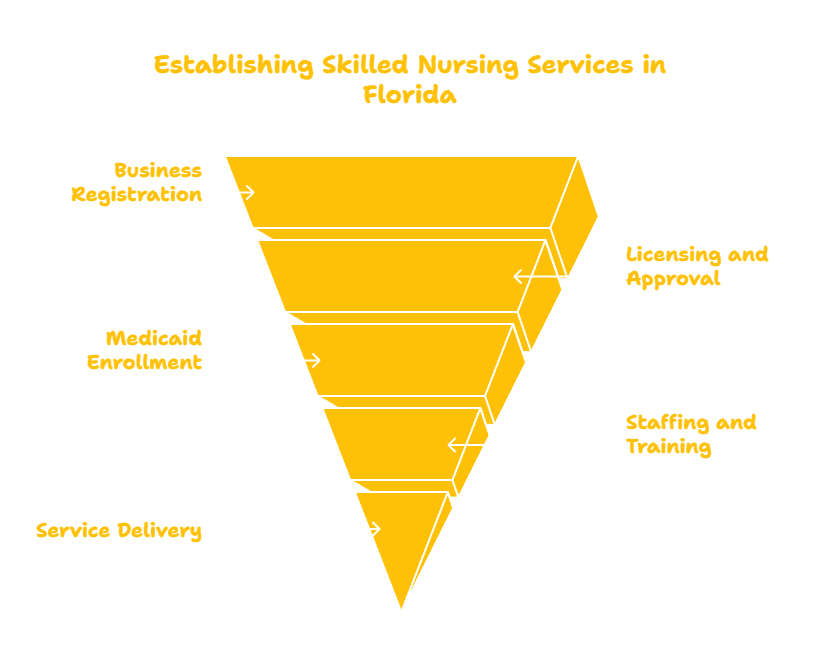
Before an agency can begin operations, it must satisfy a comprehensive list of prerequisites. Business formation begins with registering the entity with the Florida Division of Corporations (Sunbiz) and obtaining a federal Employer Identification Number (EIN) from the IRS, along with a Type 2 National Provider Identifier (NPI). These are the foundational steps for any healthcare business in the state.
Following business formation, the agency must secure a Home Health Agency license from AHCA, which is mandatory for any entity providing in-home skilled nursing. This process requires robust insurance coverage, including general liability, professional malpractice, and worker’s compensation. Agencies must also demonstrate operational readiness by developing detailed clinical policies, infection control protocols, and comprehensive emergency preparedness plans that align with Florida statutes.
How Does the AHCA Provider Enrollment Process Work?
The enrollment process is structured in distinct phases designed to verify that an agency is clinically and administratively prepared. The journey begins with the initial application for Home Health Agency licensure. This involves rigorous background screenings for all owners, administrators, and clinical staff, followed by an initial AHCA licensure inspection to ensure the physical and operational environment meets all regulatory requirements.
Once licensure is secured, the agency must move into the Medicaid provider enrollment phase. This is completed via the Florida Medicaid Provider Enrollment Portal. During this time, the agency must configure its billing systems to correspond with specific Skilled Nursing Service codes. Throughout the process, the agency must maintain clear documentation, including organizational charts, staff credentials, and evidence of HIPAA compliance, ensuring that all patient data is protected in accordance with federal law.
What Are the Essential Staffing and Clinical Documentation Requirements?
Maintaining high standards of care depends on employing qualified personnel. Every agency must have an Administrator with experience managing healthcare operations and a Director of Nursing (DON) who holds an active Florida RN license with at least two years of nursing experience, including one year in home health or a related field. All Registered Nurses (RNs) and Licensed Practical Nurses (LPNs) must maintain active Florida licenses, valid CPR certification, and pass thorough background screenings.
Comprehensive documentation is the backbone of clinical compliance. Providers must maintain a Policy and Procedure Manual that covers participant intake, nursing assessments, care planning, medication management, and incident reporting. Staff must be trained in emergency preparedness, infection control, abuse prevention, and HIPAA regulations. Annual continuing education and consistent monitoring of clinical competency are mandatory to ensure that the agency remains in good standing with Florida Medicaid.
Frequently Asked Questions
Which Medicaid programs in Florida cover Skilled Nursing Services?
Skilled Nursing Services are authorized under the Statewide Medicaid Managed Care (SMMC) Long-Term Care (LTC) Program, the Medicaid Fee-for-Service Program for medically necessary services ordered by a physician, and the iBudget Florida Waiver, which provides limited skilled nursing support specifically for individuals with developmental disabilities.
How long does it typically take to launch a Skilled Nursing Agency?
The timeline varies based on readiness but generally follows this schedule: business formation takes 2–3 weeks, the AHCA Home Health Agency licensure process takes 90–120 days, Medicaid enrollment and billing setup take 45–60 days, and final staff hiring and system implementation take an additional 30–45 days.
What core systems must be in place for Medicaid billing?
Agencies must have a functional billing system configured for specific Medicaid service codes. This requires integration with the Florida Medicaid Provider Enrollment Portal, as well as internal systems for tracking hours, verifying physician orders, and maintaining clinical notes that substantiate the services billed for reimbursement.
Key Takeaway
Launching a Skilled Nursing Services provider in Florida is a multifaceted process that requires strict adherence to AHCA licensure, Medicaid enrollment standards, and clinical documentation best practices. By focusing on administrative compliance, rigorous staff credentialing, and robust quality assurance systems, agencies can effectively support the health and independence of Florida’s most vulnerable residents while maintaining the regulatory integrity required for continued Medicaid participation.
Waiver Consulting Group (WCG) provides comprehensive start-up assistance, helping healthcare entrepreneurs navigate business registration, AHCA licensure, Medicaid enrollment, and the development of essential clinical and operational policies. For more information, visit the Florida Agency for Health Care Administration at https://ahca.myflorida.com/, the Florida Department of Health at https://www.flhealthsource.gov/, or the Florida Medicaid Provider Enrollment Portal at https://home.flmedicaidmanagedcare.com/.
Last verified: 05/23/2024. The information provided in this article is for educational purposes only and does not constitute legal or professional advice. Requirements for Medicaid provider enrollment and licensure can change; always verify the most current regulations with the relevant state and federal agencies before making business decisions.