SKILLED NURSING SERVICES PROVIDER IN DELAWARE
By Fatumata Kaba · 2025-07-07 · 5 min read
Skilled Nursing Services in Delaware provide essential, physician-directed medical care within a patient’s home to manage complex acute or chronic health conditions. These services are vital for supporting health, safety, and independence for individuals enrolled in Delaware Medicaid, including the Lifespan Waiver, and are strictly regulated by the Division of Developmental Disabilities Services (DDDS) and the Division of Medicaid and Medical Assistance (DMMA).
What Are the Roles of Delaware’s Governing Regulatory Agencies?
The delivery of skilled nursing services is a highly regulated practice that requires adherence to both state and federal mandates. To operate legally, providers must navigate a landscape of oversight from multiple agencies, each serving a distinct function in ensuring patient safety and program integrity.
The Division of Developmental Disabilities Services (DDDS) acts as the primary authorizing body for individuals with developmental disabilities requiring waiver-funded skilled care. Simultaneously, the Division of Medicaid and Medical Assistance (DMMA) governs the Medicaid State Plan and manages the reimbursement processes. Oversight of clinical standards and licensing is managed by the Division of Health Care Quality, while the Centers for Medicare & Medicaid Services (CMS) provides the overarching federal framework to ensure all Medicaid-funded services maintain compliance with national quality benchmarks.
- Delaware DDDS: Authorizes waiver-funded skilled nursing services.
- DMMA: Administers Medicaid State Plan and waiver reimbursements.
- Division of Health Care Quality: Licenses Home Health Agencies and oversees nursing standards.
- CMS: Ensures federal compliance for Medicaid-funded home health services.
How Do Skilled Nursing Services Support Complex Home-Based Care?
Skilled Nursing Services are characterized by the performance of clinical tasks that require the specialized training of a Registered Nurse (RN) or a Licensed Practical Nurse (LPN). These services are not merely custodial; they are medically necessary interventions based on a formal, written physician’s order designed to manage patient health and prevent the need for institutionalization.
Approved providers are authorized to perform a range of clinical duties that help maintain the stability of patients with intensive needs. By integrating professional medical oversight into the home, these services facilitate continuity of care and allow individuals with complex conditions to remain in their community settings rather than in hospitals or nursing facilities.
- Medication administration and injections
- Wound care and catheter maintenance
- Tracheostomy or ventilator monitoring
- Tube feeding and nutritional support
- Health assessments, documentation, and coordination with primary care physicians
What Are the Mandatory Licensing and Enrollment Requirements for Agencies?
Founding a skilled nursing agency in Delaware requires a rigorous approach to business and clinical administration. Before a provider can bill for services, they must establish a formal business structure and obtain all necessary certifications from state regulatory bodies. This includes registering the entity with the Delaware Division of Corporations, securing an EIN from the IRS, and obtaining a Type 2 NPI.
Following business formation, the agency must seek licensure as a Home Health Agency (HHA) through the Division of Health Care Quality. This process involves proving that the agency has the operational capacity to provide care safely. Furthermore, the agency must enroll as a Medicaid provider through the Delaware Medicaid Assistance Program (DMAP). Throughout this process, proof of professional liability, malpractice, and workers’ compensation insurance is mandatory to maintain compliance.
- Register business and obtain EIN and NPI.
- Obtain HHA licensure via the Division of Health Care Quality.
- Enroll as a Medicaid provider through DMAP.
- Establish HIPAA-compliant systems and quality assurance procedures.
- Hire and supervise qualified RN and LPN staff.
What Is the Sequential Process for Provider Enrollment?
The transition from a startup concept to a functioning agency involves a phased, multi-step enrollment process. Each phase is dependent on the completion of the prior step, meaning administrative delays in one area can ripple through the entire timeline. Providers should anticipate a comprehensive review process where every aspect of the organization’s operational and clinical policies is scrutinized by state regulators.
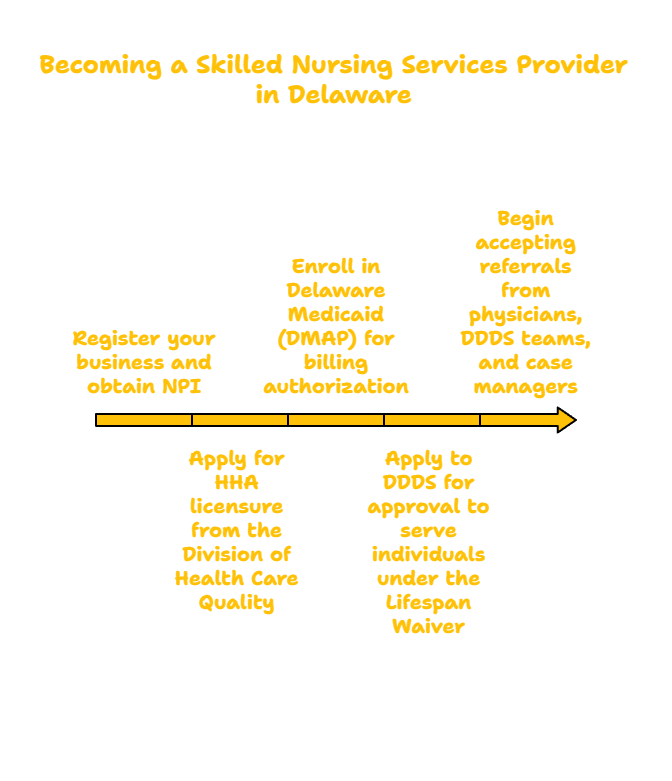
The process begins with business registration and securing the NPI. Once the business is legal, the focus shifts to HHA licensure, which requires submitting detailed operations plans, staffing charts, nursing protocols, and emergency procedures. After licensure, the agency must enroll in DMAP to facilitate billing. Finally, the provider must obtain specific approval from DDDS to serve participants within the Lifespan Waiver program before beginning to accept client referrals.
What Documentation Is Required to Ensure Regulatory Compliance?
Maintaining a comprehensive, organized documentation system is a non-negotiable requirement for any Delaware skilled nursing provider. Regulators require evidence of clinical competence, fiscal responsibility, and administrative oversight. An agency must be prepared to present a robust Policy and Procedure Manual that covers every contingency, from emergency protocols to patient rights and HIPAA safeguards.
These documents serve as the foundation for quality assurance and audit readiness. When state surveyors conduct on-site audits, they look for verifiable records of physician orders, consistent medication administration logs, and clear evidence of staff supervision. Without these documented systems, agencies risk losing their eligibility for reimbursement or facing significant penalties during the credentialing and recertification processes.
- Business documents (Articles of Incorporation, EIN, NPI).
- HHA licensure and Medicaid approval documentation.
- Policy & Procedure manual covering infection control, patient rights, and incident reporting.
- Clinical records (physician orders, nursing logs, and care plans).
- Staff credentialing and CEU compliance trackers.
Frequently Asked Questions
What is the typical timeline to launch a skilled nursing agency in Delaware?
The timeline varies based on administrative efficiency, but generally, business formation takes 1–2 weeks, HHA licensure takes 60–90 days, Medicaid enrollment takes 30–60 days, and DDDS waiver authorization takes 30–60 days.
Who is responsible for the oversight of clinical staff within the agency?
The Director of Nursing, who must hold an active Delaware RN license, is responsible for the clinical oversight, staff supervision, and ensuring all nursing practice standards remain in compliance with state regulations.
What are the primary training requirements for staff members?
All nursing staff must undergo training in HIPAA compliance, documentation standards, emergency preparedness, infection control, and abuse prevention. Additionally, the agency must maintain systems for annual skills verification and CEU tracking.
Key Takeaway
Establishing a skilled nursing service provider in Delaware is a complex undertaking that requires strict adherence to the licensing mandates of the Division of Health Care Quality and the programmatic requirements of the DDDS and DMMA. By prioritizing a robust clinical policy framework, thorough staff credentialing, and meticulous documentation, providers can build a sustainable organization capable of delivering essential, high-quality care to vulnerable populations within the Delaware Medicaid waiver system.
Last verified: 2024. This content is for informational purposes only and does not constitute legal or professional advice. Readers should consult directly with the Delaware Division of Health Care Quality, DDDS, and DMMA to verify current regulations and requirements before starting a healthcare business.