SKILLED NURSING SERVICES PROVIDER IN CONNECTICUT
By Fatumata Kaba · 2025-07-08 · 5 min read
DELIVERING PROFESSIONAL MEDICAL CARE TO SUPPORT HEALTH, INDEPENDENCE, AND COMMUNITY LIVING FOR INDIVIDUALS WITH COMPLEX NEEDS
Skilled Nursing Services in Connecticut are critical medical interventions provided by licensed Registered Nurses (RNs) and Licensed Practical Nurses (LPNs) to individuals residing in home and community-based settings. Authorized under Connecticut’s Medicaid Home and Community-Based Services (HCBS) waiver programs, these services are designed to promote health stabilization, foster independence, and provide a viable alternative to unnecessary institutionalization for individuals with chronic health conditions, disabilities, or intensive recovery needs.
What Are the Roles of Governing Agencies in Connecticut’s Medicaid System?
The delivery of Skilled Nursing Services is subject to a multi-tiered regulatory framework. The Connecticut Department of Social Services (DSS) serves as the primary authority for Medicaid, managing provider enrollment, service authorizations, and the essential oversight of compliance with state-specific Medicaid rules. Agencies operating within this space must ensure their billing and documentation protocols align perfectly with DSS requirements to maintain active status.
Beyond DSS, the Connecticut Department of Public Health (DPH) is responsible for the licensing and regulation of nursing agencies and home health care providers, ensuring that all clinical operations meet state public health standards. At the federal level, the Centers for Medicare & Medicaid Services (CMS) provides overarching guidance and oversight, ensuring that Connecticut’s HCBS waivers remain in compliance with national Medicaid rules regarding participant safety and service quality standards.
Which Medical Interventions Are Authorized Under Skilled Nursing Services?
Skilled Nursing Services are strictly defined as medically necessary interventions ordered by a physician and tailored to the unique clinical requirements of the participant. These services require professional nursing judgment and are provided within the comfort of the participant's home or community setting, as outlined in their individualized service plan.
Approved nursing providers are authorized to perform a comprehensive array of clinical tasks, including:
- Medication administration and complex medication management
- Wound care, pressure ulcer treatment, and post-surgical care
- Tracheostomy care and ventilator management
- Catheter care and bowel program management
- Diabetic care, including insulin administration and blood glucose monitoring
- Enteral feeding and G-tube management
- Clinical assessments and ongoing monitoring of chronic health conditions
- Education and training for participants and their informal caregivers
- Care coordination with physicians, therapists, and other members of the interdisciplinary team
What Are the Essential Licensing and Provider Approval Requirements?
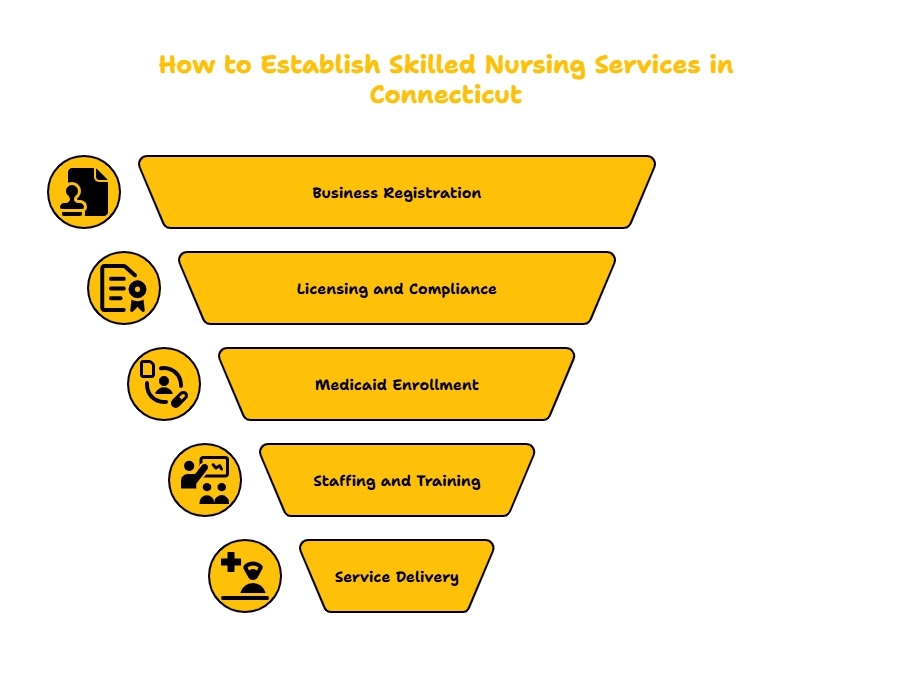
Establishing a Skilled Nursing agency begins with foundational business and regulatory compliance. Before seeking Medicaid enrollment, providers must be legally registered with the Connecticut Secretary of the State and obtain a federal Employer Identification Number (EIN). Furthermore, agencies must secure a Type 2 National Provider Identifier (NPI) to function as an organizational entity within the healthcare system.
Operational requirements are rigorous to ensure the safety of medically complex participants. Providers must obtain a Home Health Care Agency or Nursing Registry license from the Connecticut Department of Public Health if they intend to provide services directly in participant homes. Additionally, firms must maintain comprehensive professional liability and general business insurance, and they must develop a suite of clinical service policies that strictly adhere to Connecticut nursing practice acts and HCBS waiver regulations.
How Do Agencies Navigate the DSS Provider Enrollment Process?
The path to Medicaid enrollment is a structured, multi-phase procedure. Initially, prospective providers should request application materials directly from the Connecticut DSS and are strongly encouraged to attend official DSS provider orientation webinars. These sessions provide clarity on the specific expectations for documentation and administrative compliance.
The application submission requires extensive documentation, including agency licensure, detailed organizational structures, current staff rosters with verified credentials, and comprehensive clinical service descriptions. Providers must also submit sample care plans, medication administration records, and formalized emergency response protocols for review. Following the initial submission, the program undergoes a readiness review, where DSS assesses compliance systems, HIPAA protections, and participant rights protocols. Once the agency achieves approval, it must complete the final enrollment via Connecticut’s Medicaid Management Information System (MMIS) to configure service codes and enable claims processing.
Which Medicaid Waivers Authorize Skilled Nursing Services?
Skilled Nursing Services are integrated into several key Connecticut Medicaid Waiver programs, each targeting specific populations. These include the Connecticut Home Care Program for Elders (CHCPE), the Acquired Brain Injury (ABI) Waivers I and II, the Connecticut Mental Health Waiver, the Katie Beckett Waiver for medically complex children, and the Personal Care Assistance Waiver when skilled components are explicitly authorized.
Participation in these waivers requires the provider to maintain high standards of service delivery. This involves participating in the person-centered planning process, performing regular clinical assessments, and coordinating effectively with assigned case managers. Providers are also responsible for training family members and informal caregivers, which is a vital component of the waiver’s mission to keep participants successfully integrated within their communities.
Frequently Asked Questions
What are the core staff requirements for a Skilled Nursing provider?
Agencies must employ a qualified Nursing Services Administrator with an active Connecticut RN license and experience in home health management. All direct care staff, whether RNs or LPNs, must hold current Connecticut licenses, maintain valid CPR certification, and pass mandatory background checks. Ongoing requirements include annual competency evaluations, continuing clinical education, and specific training in HIPAA, infection control, and abuse prevention.
What documentation must be maintained for audit purposes?
Providers must maintain a robust Policy & Procedure Manual that covers intake and assessment, medication management, emergency response, and HIPAA compliance. Furthermore, the agency must retain accurate records of staff background checks, licensing verifications, training logs, and evidence of Medicaid billing and service authorization tracking.
How long should an agency expect the start-up process to take?
The timeline involves several phases: 3–4 weeks for business formation, 90–120 days for DPH licensing, 60–90 days for DSS readiness review, 30–45 days for staff hiring and internal systems implementation, and 45–60 days for final Medicaid enrollment and claims system configuration.
Key Takeaway
Success in providing Skilled Nursing Services in Connecticut hinges on strict adherence to the regulatory requirements set forth by the DPH and DSS. By prioritizing clinical excellence, maintaining meticulous documentation systems, and ensuring staff are fully compliant with the unique demands of the state’s HCBS waiver programs, agencies can effectively support the health and independence of their participants while ensuring long-term operational viability.
Last verified: 2024. This information is provided for general guidance and is subject to updates by state and federal regulatory bodies. Always verify current requirements through official Connecticut DSS and DPH portals before initiating application procedures.