SKILLED NURSING SERVICES PROVIDER IN ARKANSAS
By Fatumata Kaba · 2025-07-06 · 5 min read
DELIVERING PROFESSIONAL MEDICAL CARE TO SUPPORT HEALTH, INDEPENDENCE, AND COMMUNITY LIVING FOR INDIVIDUALS WITH COMPLEX NEEDS
Skilled Nursing Services in Arkansas are specialized clinical interventions designed for individuals with medical needs that require the expertise of licensed nurses but can be safely provided in home or community-based settings. These services are authorized under Arkansas’s Home and Community-Based Services (HCBS) Medicaid Waiver programs, serving as a critical component in preventing unnecessary hospitalization or institutionalization by supporting an individual's health in the least restrictive environment possible.
Understanding the Regulatory Landscape for Arkansas Skilled Nursing
The provision of Skilled Nursing Services in Arkansas is governed by a multi-layered regulatory framework. At the state level, the Arkansas Department of Human Services (DHS), specifically the Division of Aging, Adult, and Behavioral Health Services (DAABHS), holds the primary authority for approving providers, monitoring clinical service delivery, and enforcing compliance with HCBS waiver standards. Providers must navigate these requirements while maintaining alignment with broader federal guidelines.
Arkansas Medicaid, operating under the DHS umbrella, manages the financial and administrative aspects of the program, including provider enrollment, the processing of service authorizations, and the reimbursement of claims. Simultaneously, the Centers for Medicare & Medicaid Services (CMS) provides federal oversight, ensuring that all Arkansas Medicaid waiver programs adhere to national standards for person-centered care and participant safety.
Defining Scope of Practice and Clinical Responsibilities
Skilled Nursing Services involve the provision of professional nursing care that is ordered by a physician and delivered according to a strictly individualized service plan. Because these services are medical in nature, they require the specialized skills of a Licensed Practical Nurse (LPN) or a Registered Nurse (RN). Documentation remains a cornerstone of this role, as all clinical interventions must be meticulously recorded according to Medicaid and DHS standards to justify medical necessity.
Approved providers are typically responsible for a comprehensive range of clinical tasks, which may include:
- Medication administration and management
- Wound care and complex dressing changes
- Catheter care, maintenance, and irrigation
- Ostomy care and skin integrity management
- Respiratory treatments, including nebulizers and oxygen management
- Tube feeding (enteral nutrition) and suctioning
- Continuous health status monitoring and chronic disease management
- Coordination of care with physicians, therapists, and other caregivers
- Comprehensive health education for the participant and their family members
Navigating Licensing and Provider Approval Requirements
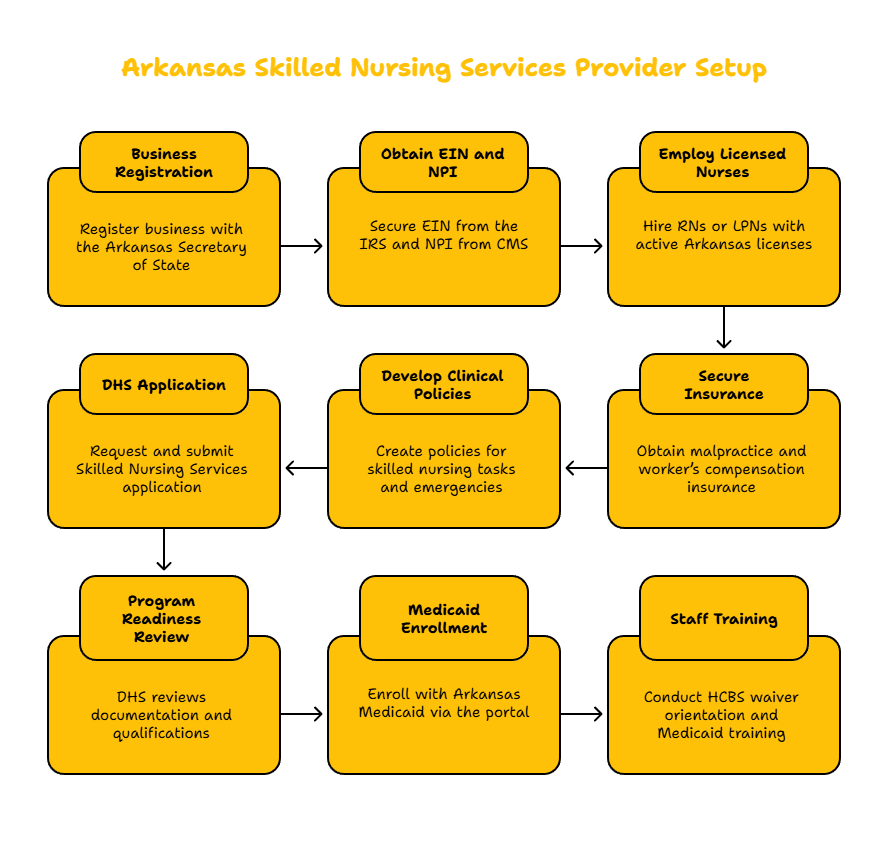
Before an agency can begin delivering services, it must establish a formal business structure and obtain all necessary credentials. The process begins with registering the business entity with the Arkansas Secretary of State, followed by obtaining a federal Employer Identification Number (EIN) from the IRS and a Type 2 National Provider Identifier (NPI). Depending on the agency’s business model and the number of nurses employed, an active nursing services agency license may be a mandatory prerequisite.
Beyond basic business registration, agencies must demonstrate clinical readiness. This involves securing professional malpractice insurance and worker’s compensation coverage to protect both the agency and its personnel. Agencies must also develop robust clinical policies and protocols that outline specific procedures for skilled nursing tasks, emergency response, and infectious disease control, ensuring that every member of the clinical staff operates within their legal scope of practice.
The DHS Provider Enrollment and Readiness Review Process
The path to becoming an approved provider involves several distinct stages, starting with an initial expression of interest and the formal request of a Skilled Nursing Services application packet from DAABHS. Prospective providers are strongly encouraged to attend a waiver provider orientation to gain a thorough understanding of current Arkansas Medicaid expectations and reporting requirements.
Following the submission of the application, which must include organizational documents, staff licenses, and a detailed scope of services, the agency enters a program readiness review. During this phase, DHS evaluates the agency’s clinical documentation processes, medication logs, emergency protocols, and staff training plans. Once DHS grants its approval, the agency must finalize its enrollment through the Arkansas Medicaid Provider Enrollment Portal, selecting the appropriate billing codes for Skilled Nursing Services and completing all necessary contractual agreements and billing system configurations.
Managing Staffing and Ongoing Quality Assurance
Effective staffing is essential for compliance and high-quality care. The agency must appoint a Skilled Nursing Supervisor, typically a Registered Nurse (RN), who possesses prior supervisory experience in Medicaid home care or clinical settings. All frontline staff, whether RNs or LPNs, must maintain a current, active Arkansas nursing license, possess valid CPR certification, and pass mandatory background check clearances before providing direct patient care.
Ongoing education is a requirement for maintaining approval status. Staff must complete comprehensive training modules, including HCBS waiver orientation, Medicaid documentation standards, emergency response, infection control, and patient safety. Furthermore, providers are expected to facilitate annual continuing education and clinical skills updates to ensure that all personnel remain competent in the latest evidence-based nursing practices.
Frequently Asked Questions
Which Medicaid waivers currently authorize Skilled Nursing Services in Arkansas?
Skilled Nursing Services are currently authorized under the ARChoices in Homecare Waiver, the Community and Employment Supports (CES) Waiver, the Living Choices Assisted Living Waiver, and the Alternatives for Adults with Physical Disabilities (AAPD) Waiver.
What is the typical timeline for establishing a Skilled Nursing agency?
The timeline varies based on administrative efficiency, but generally, business formation and licensing compliance take 2–3 weeks, the DHS application and readiness review process spans 60–90 days, staff hiring and training takes 30–45 days, and final Medicaid enrollment and billing configuration takes 45–60 days.
What core documents must be included in the Policy & Procedure Manual?
A DHS-compliant manual must cover participant intake, assessment and care planning, medication administration procedures, specific clinical policies for wound and respiratory care, incident reporting, emergency response, privacy (HIPAA) and client rights, staff training logs, and quality assurance/clinical supervision plans.
Key Takeaway for New Providers
Launching a Skilled Nursing agency in Arkansas is a highly regulated undertaking that requires meticulous attention to clinical policy, documentation accuracy, and strict adherence to Medicaid waiver guidelines. Success in this sector hinges on the ability to demonstrate, through the DHS readiness review, that your agency has the infrastructure, qualified nursing staff, and robust quality assurance systems necessary to support the health and independence of Arkansas's most vulnerable populations within the home environment.
Last verified: 05/22/2024. This information is provided for educational purposes only and does not constitute legal or professional advice. Always consult with the Arkansas Department of Human Services or qualified legal counsel when navigating state-specific Medicaid requirements.