SKILLED NURSING SERVICES PROVIDER IN ALABAMA
By Fatumata Kaba · 2025-06-24 · 5 min read
Skilled Nursing Services in Alabama provide medically necessary, professional nursing care to individuals with intellectual and developmental disabilities (IDD) within their homes and communities. These services, administered through the Alabama Department of Mental Health (ADMH) and the Alabama Medicaid Agency, are designed to ensure health stability for participants with complex medical requirements by delivering high-quality, physician-ordered care.
What Are Skilled Nursing Services Under Alabama HCBS Waivers?
Skilled Nursing Services constitute a critical component of the state’s Home and Community-Based Services (HCBS) framework. These services are intended for individuals whose medical needs are significant enough to require the expertise of a Registered Nurse (RN) or a Licensed Practical Nurse (LPN). By bringing clinical expertise into the community setting, these services help prevent hospitalizations and allow individuals with chronic conditions to maintain their independence.
Providers authorized to deliver these services operate under the oversight of both state regulatory bodies and federal guidelines established by the Centers for Medicare & Medicaid Services (CMS). The scope of practice is defined by physician orders, which dictate the specific medical procedures required. Whether an individual requires intermittent monitoring or continuous nursing care, the goal is to provide a seamless transition of care from clinical environments to the home.
Who Regulates Skilled Nursing Providers in Alabama?
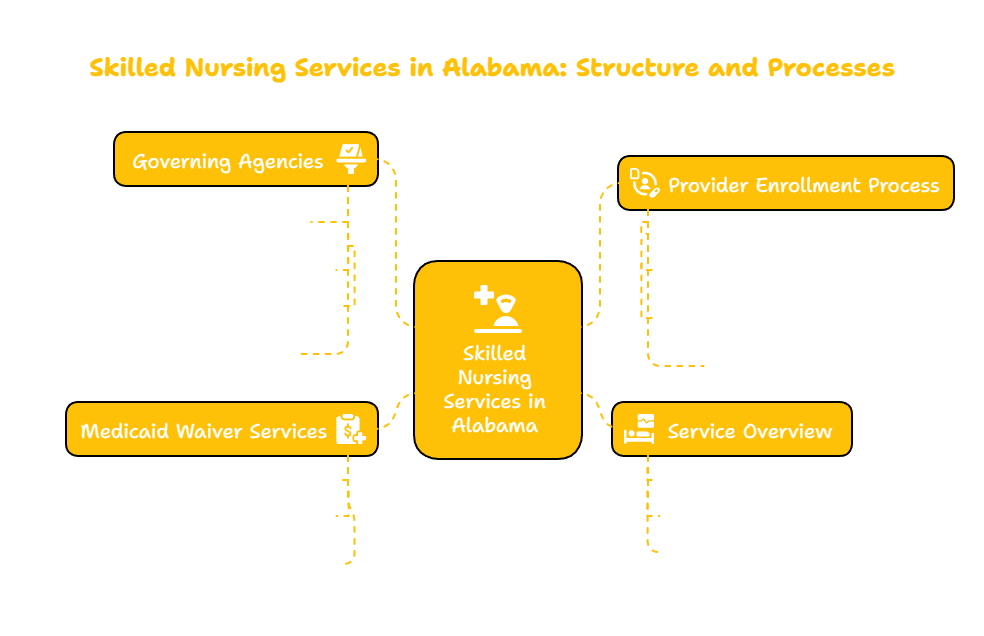
The regulatory landscape for Skilled Nursing providers in Alabama involves a collaborative effort between several key agencies. The Alabama Department of Mental Health (ADMH) serves as the primary entity responsible for the approval and ongoing monitoring of providers participating in HCBS Waiver programs. Their role is to ensure that agencies maintain the clinical, operational, and documentation standards required for high-risk, high-needs populations.
Complementing the ADMH, the Alabama Medicaid Agency manages the fiscal side of the operation, including provider enrollment, claims processing, and billing compliance. Furthermore, all nursing professionals within an agency must adhere to the regulations and practice standards set by the Alabama Board of Nursing. This hierarchy of oversight ensures that every aspect of service delivery—from clinical competence to fiscal accountability—aligns with state and federal expectations.
What Clinical Procedures Are Included in Skilled Nursing Services?
Skilled Nursing providers are tasked with performing specialized medical procedures that exceed the capabilities of routine personal care assistance. These tasks must be explicitly documented in the individual’s plan of care and, where applicable, delegated according to state law and board of nursing practice standards. Providers must maintain robust protocols to manage these interventions safely.
- Medication administration and complex monitoring.
- Tube feedings, nutritional support, and related clinical care.
- Professional wound care, dressing changes, and skin integrity management.
- Catheter maintenance and specialized medical procedures.
- Comprehensive health assessments and ongoing monitoring of chronic medical conditions.
- Education and clinical training for caregivers regarding the participant's specific medical needs.
- Close coordination with the participant’s physician and the broader Interdisciplinary Team (IDT).
How Do You Meet the Licensing and Enrollment Requirements?
The path to becoming an approved provider begins with formal business and operational registration. An agency must be registered with the Alabama Secretary of State and hold a current EIN from the IRS. Furthermore, an NPI (Type 2) is required for billing purposes, along with a physical business location situated within the state of Alabama. These foundational requirements confirm the legitimacy of the agency before clinical credentials are evaluated.
Once the business structure is established, the provider must secure a team of licensed professionals. All nurses must hold active licenses issued by the Alabama Board of Nursing. The agency is then responsible for developing a comprehensive policy and procedure manual that satisfies ADMH regulations. This manual must cover areas such as clinical documentation, infection control, HIPAA compliance, and emergency protocols. Staff must also undergo rigorous training that includes criminal background checks, abuse/neglect registry screenings, and specific clinical competency assessments.
Navigating the ADMH Provider Enrollment Process
The enrollment process is structured into phases designed to verify that a provider is operationally ready to handle medically complex cases. Initially, the applicant must submit a formal request for the Skilled Nursing Provider Application Packet from the ADMH. This submission must be accompanied by a thorough business plan, a defined scope of services, and a detailed staffing strategy. During this phase, the applicant must demonstrate that their proposed clinical workflows meet the high bar set for HCBS waiver participants.
Following the document submission, the ADMH will conduct reviews that may include an assessment of site readiness and clinical protocols. This includes a review of how medical records are managed and how the agency handles quality assurance. Once the ADMH approves the provider, the agency proceeds to enroll with the Alabama Medicaid Agency as a waiver provider, ensuring that the correct service codes for Skilled Nursing are activated to enable proper reimbursement.
Frequently Asked Questions
Which Medicaid Waivers include Skilled Nursing services?
Skilled Nursing services are currently available through the Intellectual Disabilities (ID) Waiver, the Living at Home (LAH) Waiver, and the State of Alabama Community Waiver Program.
What are the staffing qualifications for a Director of Nursing?
The Director of Nursing must be a Registered Nurse (RN) with an active Alabama license and demonstrated experience in clinical management.
How long does the overall approval process typically take?
The process involves multiple phases: ADMH review takes 60–120 days, clinical readiness/QA takes 30–60 days, and final Medicaid enrollment typically takes 60–90 days.
Key Takeaway
Launching a Skilled Nursing agency in Alabama requires a rigorous commitment to clinical excellence, strict adherence to the ADMH and Alabama Medicaid Agency requirements, and an unwavering focus on regulatory compliance. By ensuring that all clinical staff are properly licensed and that internal policies are aligned with state standards, agencies can successfully provide the essential care that enables individuals with IDD to thrive in their own communities.
Last verified: October 2023. Disclaimer: This article is for informational purposes only and does not constitute legal or professional regulatory advice. Requirements for Alabama Medicaid HCBS programs are subject to change. Always consult directly with the Alabama Department of Mental Health and the Alabama Medicaid Agency for the most current rules, forms, and compliance directives.