SKILLED NURSING PROVIDER IN ALASKA
By Fatumata Kaba · 2025-07-03 · 5 min read
Delivering Clinically Complex Care in Alaska's HCBS Waiver Landscape
Skilled Nursing Services in Alaska are specialized clinical interventions authorized under the state’s Home and Community-Based Services (HCBS) Medicaid Waivers, designed for individuals who require professional medical oversight to remain safely in their homes. These services bridge the gap between institutional care and independent living, ensuring that clients with high-acuity medical needs receive consistent, professional monitoring from Registered Nurses (RNs) or Licensed Practical Nurses (LPNs) within their own communities.
For healthcare entrepreneurs and agency administrators, providing these services requires strict adherence to regulations set forth by the Alaska Department of Health’s Division of Senior and Disabilities Services (SDS) and the Centers for Medicare & Medicaid Services (CMS). By maintaining a rigorous standard of care, providers fulfill a vital role in the state’s healthcare infrastructure, supporting complex medical management for participants across various waiver programs.
Who Governs Skilled Nursing Services in Alaska?
The delivery of Skilled Nursing Services is subject to multi-layered oversight to ensure participant safety and federal compliance. The primary state authority is the Alaska Department of Health’s Division of Senior and Disabilities Services (SDS). SDS is responsible for approving skilled nursing providers, reviewing individual participant care plans, and enforcing the specific program regulations that govern waiver-funded nursing activities.
Beyond state-level administration, the Alaska Medicaid program manages the financial infrastructure, including provider enrollment and the processing of claims for services rendered. Nationally, the Centers for Medicare & Medicaid Services (CMS) provides the overarching federal framework. CMS oversees HCBS waiver implementation, ensuring that Alaska’s delivery models meet federal quality benchmarks and maintain a commitment to person-centered, non-institutional care standards.
What Scope of Care Can Providers Deliver?
Skilled Nursing Services in Alaska are strictly defined by the clinical nature of the interventions provided. These services are intended for participants who require the professional assessment and intervention that only a licensed nurse can provide. All activities must be clearly linked to an individual’s person-centered support plan and must not duplicate other clinical or therapeutic services already authorized for the client.
The scope of care typically encompasses a wide array of medical tasks essential for maintaining the health and safety of waiver participants. Common services include:
- Medication administration and complex monitoring.
- Wound care, dressing changes, and pressure ulcer management.
- Enteral feedings (tube feedings) and specialized suctioning.
- Catheter care and other urological interventions.
- Vital sign monitoring and comprehensive clinical assessments.
- Care coordination with attending physicians, therapists, and specialists.
- Health education and training for individuals and their family caregivers.
What are the Licensing and Provider Approval Prerequisites?
Becoming an approved Medicaid provider in Alaska is a multi-step process that begins with establishing a solid business and regulatory foundation. Prospective agencies must be registered with Alaska’s Division of Corporations, Business and Professional Licensing. Furthermore, the agency must secure a Type 2 NPI and an EIN to facilitate standardized electronic billing through the Medicaid system.
Operational requirements are equally critical for agency approval. Providers must maintain a physical office or clinical base located within Alaska. Essential infrastructure includes proof of professional malpractice insurance, comprehensive worker’s compensation coverage, and robust internal protocols for staff credentialing and nursing supervision. The agency must demonstrate the capacity to manage documentation in a way that satisfies both state and federal audit requirements.
Navigating the SDS Provider Enrollment Process
The journey toward becoming a Medicaid-approved provider begins by requesting the Skilled Nursing Services application packet from SDS. While not always mandatory, attending orientation sessions for HCBS waiver providers is highly recommended to understand the nuances of the current regulatory environment. Once the application is submitted, it must include comprehensive documentation regarding staffing plans, the scope of services, and the agency’s internal quality control mechanisms.
Following submission, SDS conducts a program readiness review. This phase evaluates the agency’s staff training protocols, clinical documentation systems, and overall readiness to deliver care. In instances where facility-based services are included, a site inspection may occur. Once SDS grants approval, the agency must complete enrollment with Alaska Medicaid through the MMIS system, carefully selecting the appropriate service codes and nursing modifiers to ensure accurate claims processing and compliance with the HCBS waiver agreements.
Staffing, Training, and Clinical Documentation
The quality of an agency’s Skilled Nursing Services depends heavily on the competence and training of its personnel. Every agency must designate a Skilled Nursing Supervisor, who must be a licensed RN with significant supervisory experience and a deep understanding of Medicaid documentation standards. Direct care staff, including LPNs and RNs, must hold active Alaska nursing licenses, maintain current CPR certification, and pass thorough background checks.
Ongoing education is a non-negotiable component of staff development. All nursing personnel must participate in mandatory training covering:
- SDS waiver-specific regulations and program requirements.
- Standardized documentation and confidentiality procedures.
- Safety, infection control, and emergency preparedness protocols.
- Annual clinical education reviews and competency assessments.
Frequently Asked Questions
Which Medicaid Waivers include Skilled Nursing Services?
Skilled Nursing Services are authorized under several Alaska Medicaid Waivers, specifically the Alaskans Living Independently (ALI) Waiver, the Adults with Physical and Developmental Disabilities (APDD) Waiver, the Individuals with Intellectual and Developmental Disabilities (IDD) Waiver, and the Children with Complex Medical Conditions (CCMC) Waiver.
How long does the provider enrollment process typically take?
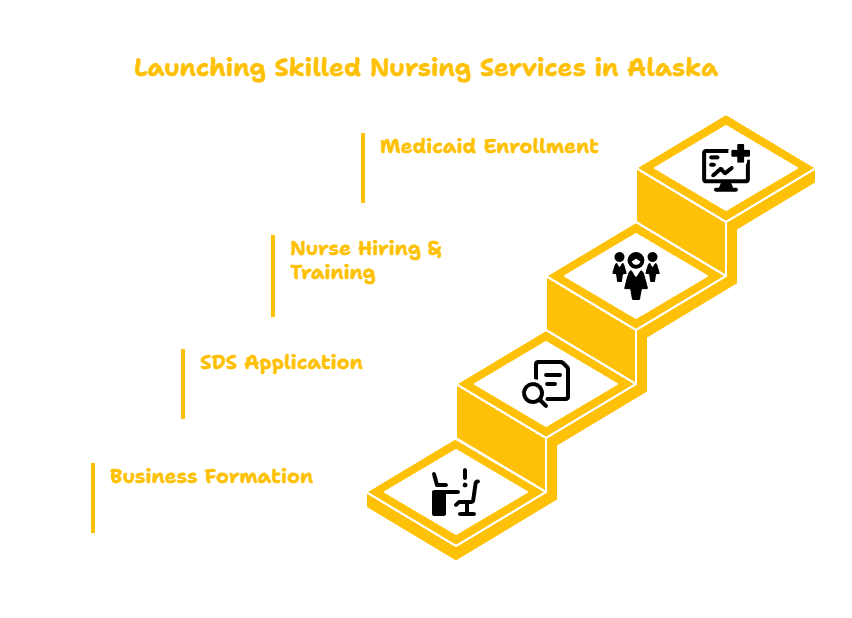
The total timeline varies, but generally, business formation takes 1–2 weeks, followed by a 60–90 day window for SDS application and compliance review. Hiring and training staff takes approximately 30–45 days, and final Medicaid enrollment through the MMIS system typically spans 45–60 days.
What core policies must an agency have in place for SDS approval?
Agencies must maintain comprehensive policies including clinical and medication protocols, structured client care documentation forms, staff oversight and incident management plans, infection control procedures, emergency response strategies, and HIPAA-compliant privacy and informed consent documentation.
Key Takeaway: Establishing a Medicaid-compliant skilled nursing agency in Alaska requires a rigorous focus on SDS documentation standards, disciplined nurse supervision, and strict adherence to the specific service definitions outlined in the ALI, APDD, IDD, and CCMC waiver programs. By ensuring that every clinical intervention is documented to reflect the person-centered support plan, providers can successfully maintain their standing with both the Division of Senior and Disabilities Services and the Alaska Medicaid program.
Last verified: October 2023. Disclaimer: This information is for educational purposes only and does not constitute legal or professional advice. Always verify current regulations and requirements directly with the Alaska Department of Health and relevant federal authorities.