SERVICE COORDINATION SERVICES PROVIDER IN NEW YORK
By Fatumata Kaba · 2025-09-03 · 5 min read
Service Coordination Services in New York serve as the essential link between individuals with complex needs and the integrated care required to maintain health and independence within their communities. By managing service access, facilitating person-centered planning, and navigating the complexities of New York’s Medicaid Home and Community-Based Services (HCBS) waiver programs, service coordination agencies play a critical role in delivering holistic, long-term support for vulnerable populations.
What Are the Governing Agencies for Service Coordination in New York?
The regulatory environment for Service Coordination in New York is tiered, involving both state-level oversight and federal guidance. The New York State Department of Health (NYSDOH) serves as the primary authority, administering Medicaid waiver funding and managing the critical infrastructure for provider enrollment, service authorization, and reimbursement protocols. Their oversight ensures that the financial and operational frameworks of these services align with state Medicaid requirements.
Specialized oversight is provided by the Office for People With Developmental Disabilities (OPWDD), which regulates coordination services tailored specifically to individuals with developmental disabilities. Similarly, the New York State Office of Mental Health (OMH) provides regulatory compliance for programs dedicated to behavioral and mental health support. At the federal level, the Centers for Medicare & Medicaid Services (CMS) sets the overarching standards for quality, safety, and person-centered care to which all Medicaid-funded programs must adhere.
How Do Providers Deliver Effective Service Coordination?
Service Coordination is fundamentally about advocacy, resource management, and the execution of person-centered care plans. Approved providers are responsible for a wide array of activities that bridge the gap between medical necessity and community integration. This involves a continuous cycle of assessment, monitoring, and adjustment to ensure that each client’s changing needs are met with appropriate and timely interventions.
Providers must maintain rigorous standards for documentation and follow-up, ensuring that every interaction and change in care status is tracked for quality assurance. Effective coordination requires a proactive approach, particularly during crisis situations where immediate linkage to medical or social support networks is vital. Whether facilitating a transition between care settings or simply managing routine access to community services, the provider acts as the primary contact point for the client’s wellbeing.
- Assessment and Planning: Identifying individual needs and developing comprehensive, person-centered service plans.
- Care Coordination: Managing access to healthcare, behavioral health, and community-based services.
- Service Monitoring: Continuously evaluating the effectiveness of care plans and adjusting as necessary.
- Crisis Intervention: Coordinating immediate support during emergencies or health changes.
- Resource Linkage: Connecting clients to essential social support networks and providers.
- Advocacy: Promoting client rights and ensuring equitable access to required services.
- Transition Planning: Supporting individuals during changes in living arrangements or care settings.
- Documentation: Maintaining detailed records of assessments, service plans, and progress tracking.
What Are the Licensing and Enrollment Prerequisites for Agencies?
Establishing a Service Coordination agency requires strict adherence to administrative and operational prerequisites. Business entities must be properly registered with the New York Department of State and hold a valid federal Employer Identification Number (EIN) and a Type 2 National Provider Identifier (NPI). These foundational documents are essential for interacting with the eMedNY portal and the state’s billing infrastructure.
Beyond legal registration, agencies must demonstrate high standards of professional practice. This includes securing comprehensive general and professional liability insurance and creating an exhaustive internal Policy and Procedure Manual. This manual must address key areas such as client rights, HIPAA compliance, grievance handling, and emergency response. Furthermore, agencies are responsible for vetting their workforce, ensuring that all staff have undergone the necessary background checks and possess the requisite credentials for their respective roles.
Navigating the New York Provider Enrollment Process
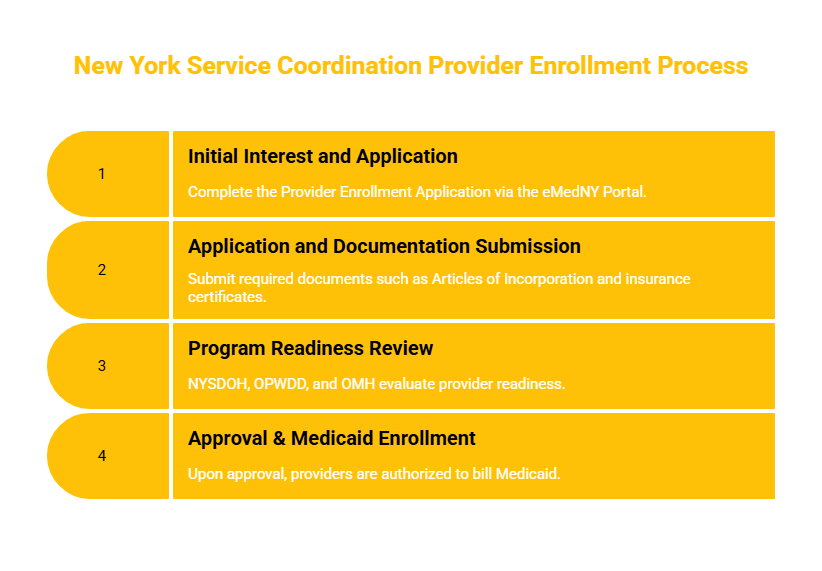
The path to becoming an authorized Medicaid waiver provider involves a structured sequence of application and review. The initial step requires completing the Provider Enrollment Application via the eMedNY Portal specifically for HCBS waiver services. Once submitted, the agency must provide a comprehensive documentation package, including proof of corporate standing, tax identifiers, insurance certificates, and detailed operational protocols.
The program readiness review is a critical stage where the NYSDOH, OPWDD, or OMH evaluates whether the applicant possesses the systems necessary to deliver care effectively. Regulators assess the agency’s internal infrastructure, including their methodology for client assessments and their readiness to handle service coordination duties. Upon successful completion of this review and subsequent approval, the provider is officially authorized to utilize designated billing codes to claim Medicaid reimbursement for services rendered.
What Are the Staffing and Training Requirements?
Quality of service is directly tied to the qualifications of the staff delivering the coordination. The Service Coordination Program Director is responsible for operational oversight and must hold a Bachelor’s or Master’s degree in social work, human services, or a related field, combined with experience in management. Front-line staff, such as Service Coordinators and Support Coordinators, also have strict educational and experience requirements focused on client advocacy and resource management.
All staff members, regardless of their role, are required to undergo comprehensive onboarding and ongoing professional development. Training must cover person-centered planning, HIPAA regulations, safety protocols, and the nuances of participant rights. Agencies are responsible for maintaining records of these training sessions and conducting annual competency evaluations to ensure that the staff remains proficient in the latest compliance and documentation standards.
- Training Topics: Service coordination models, person-centered planning, and advocacy.
- Compliance Education: HIPAA compliance, privacy, and participant rights.
- Operational Proficiency: Documentation and record-keeping best practices.
- Emergency Preparedness: Safety and crisis intervention training.
- Ongoing Development: Annual competency evaluations and professional development cycles.
Frequently Asked Questions
Which Medicaid waiver programs cover Service Coordination Services in New York?
Service Coordination is authorized under several key programs, including the OPWDD Comprehensive Waiver, the Home and Community-Based Services (HCBS) Waiver, the Nursing Home Transition and Diversion (NHTD) Waiver, the Traumatic Brain Injury (TBI) Waiver, and the Children’s Waiver.
How long does the launch process for a new agency typically take?
The timeline is generally structured into four phases: 1–2 months for business formation, 2–3 months for hiring and program development, 60–90 days for provider enrollment and readiness review, and 30–45 days for final billing setup and launch.
What must be included in an agency’s Policy and Procedure Manual?
Manuals must cover intake, assessment, and planning protocols; guidelines for advocacy and client support; staff credentialing and training records; billing and documentation standards; HIPAA compliance; participant rights; grievance procedures; crisis intervention; and quality assurance mechanisms.
Key Takeaway
Successfully launching a Service Coordination agency in New York requires a precise alignment of administrative rigor, regulatory compliance, and personnel expertise. By following the structured enrollment process mandated by the NYSDOH, OPWDD, and OMH, and by maintaining robust documentation and training programs, provider agencies can ensure they meet the complex needs of the individuals they serve while remaining audit-ready for Medicaid oversight.
Last verified: January 2024. This information is provided for educational purposes and should not be considered legal or financial advice. Regulations governing Medicaid waiver programs are subject to change. Please consult official state resources or a qualified professional consultant for specific guidance regarding your agency's compliance needs.