RESPITE CARE SERVICES PROVIDER IN VIRGINIA
By Fatumata Kaba · 2026-04-08 · 5 min read
Respite Care Services in Virginia provide essential, temporary relief to unpaid primary caregivers—typically family members—who support individuals with disabilities, complex medical conditions, or behavioral health needs. These Medicaid-funded services ensure that care recipients receive safe, person-centered support in their own homes or community settings, allowing families to sustain their caregiving roles without compromising their well-being. By partnering with the Department of Medical Assistance Services (DMAS), Community Services Boards (CSBs), and Managed Care Organizations (MCOs), provider agencies play a vital role in maintaining the stability of the home-based care ecosystem across the Commonwealth.
How is Respite Care Structured within Virginia Medicaid?
Respite care is a formalized, authorized service under the Community Living (CL) Waiver, the Family and Individual Supports (FIS) Waiver, and the Commonwealth Coordinated Care Plus (CCC Plus) Waiver. These programs are designed to accommodate short-term relief during periods when a regular caregiver is unavailable due to illness, exhaustion, personal obligations, or family emergencies. The service is not intended for long-term placement, but rather as a flexible tool to prevent caregiver burnout and support the continuation of home-based care.
The delivery model varies based on the needs of the individual and the capacity of the provider agency. Services can be categorized into four primary types, each requiring specific operational oversight:
- In-Home Respite Care: Direct support provided within the individual’s residence.
- Center-Based or Group Respite: Care delivered in a licensed facility or group setting designed for socialization and safety.
- Skilled Respite: Nursing-level care provided specifically by a Registered Nurse (RN) or Licensed Practical Nurse (LPN).
- Crisis Respite: Targeted support for emergency absences or intensive behavioral health stabilization.
Which Regulatory Agencies Oversee Respite Care?
Navigating the regulatory landscape is the most critical component of establishing a resilient provider agency. Oversight is bifurcated based on the specific waiver population served, necessitating strong relationships with multiple state and local entities. The Department of Medical Assistance Services (DMAS) serves as the overarching administrator, managing statewide Medicaid policy, provider enrollment, and reimbursement protocols.
Beyond DMAS, the operational authorization of services is managed at the local level. Community Services Boards (CSBs) are responsible for authorizing respite services for individuals enrolled in the CL and FIS Waivers. These boards ensure that services are explicitly outlined and approved within the Individual Support Plan (ISP). Conversely, for the CCC Plus Waiver, oversight and authorization are managed through contracted Managed Care Organizations (MCOs). Agencies must align their administrative workflows to satisfy the distinct requirements of both CSBs and MCOs to ensure seamless reimbursement.
What are the Mandatory Steps for Provider Licensing and Enrollment?
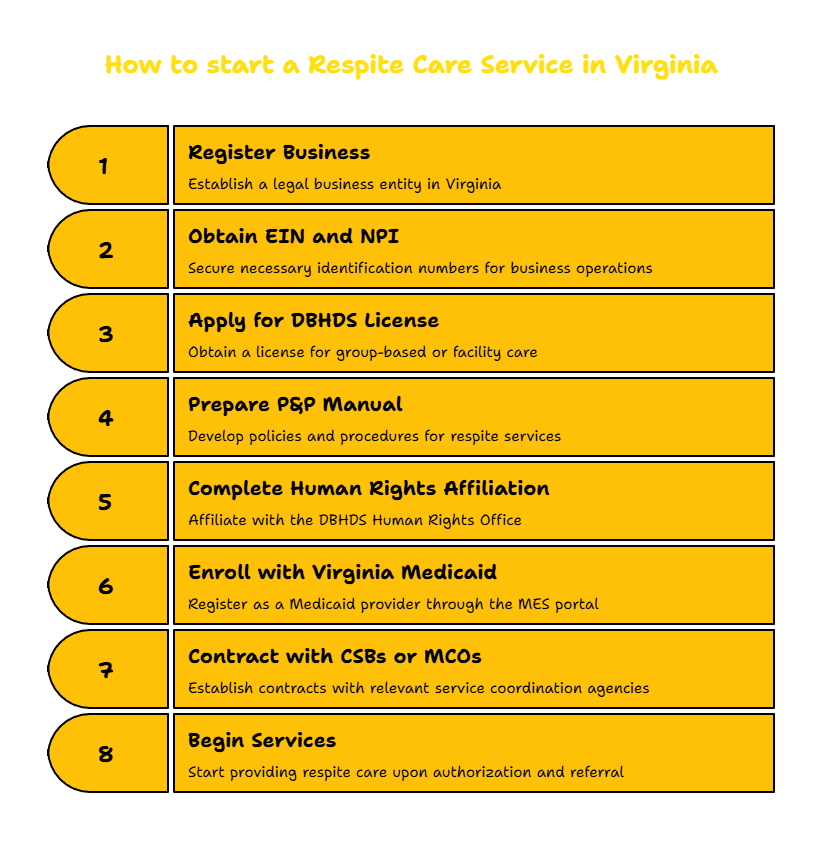
To operate as a qualified respite care provider, an agency must follow a rigorous, multi-step sequence to ensure legal and clinical compliance. The process begins with basic business formation, including registration with the Virginia State Corporation Commission (SCC) and the acquisition of an EIN and Type 2 NPI. These foundational steps must be completed before applying for licensure through the Department of Behavioral Health and Developmental Services (DBHDS) for any facility- or group-based respite models.
Once the business is registered and licensed, the agency must establish a formal administrative infrastructure. This includes creating a comprehensive Respite Services Policy & Procedure Manual and obtaining affiliation with the DBHDS Human Rights Office. Following the development of internal protocols, the agency must enroll as a formal Medicaid provider via the Medicaid Enterprise System (MES) portal. Final readiness is achieved by successfully contracting with specific CSBs or MCOs, which then permits the agency to begin accepting referrals and delivering services.
What Documentation and Staffing Standards Must be Maintained?
Compliance is documented through strict adherence to internal policies and state-mandated records. A provider’s internal manual must cover core operational areas, including admission and service delivery policies, emergency contact protocols, incident response, and HIPAA-compliant documentation of client rights. Each shift must be tracked via daily logs and activity notes, which serve as the evidentiary basis for billing and ensuring that the services delivered align with the goals stated in the Individual Support Plan.
Staffing requirements are equally stringent to ensure the safety of the individuals served. Direct Support Professionals (DSPs) must possess a high school diploma or GED, valid CPR/First Aid certification, and must pass thorough background checks, including CPS, criminal, and DMV screenings. Beyond these prerequisites, all staff must undergo standardized training in person-centered care, emergency preparedness, and mandatory incident reporting. For skilled respite care, the agency must employ an RN or LPN who is authorized to carry out physician-ordered medical interventions.
Frequently Asked Questions
What is the difference between CL, FIS, and CCC Plus Waivers regarding respite care?
While all three waivers cover respite care, they serve different populations. The CL and FIS waivers are generally for individuals with intellectual or developmental disabilities and are managed by CSBs, while the CCC Plus waiver covers medically complex or elderly individuals and is managed by MCOs.
Is a DBHDS license required for all respite care providers?
No. A DBHDS license is specifically required for providers offering center-based or group respite care. If an agency strictly limits its services to in-home respite, the licensing requirements differ, though all providers must still meet Medicaid enrollment and compliance standards.
How long does the provider enrollment process typically take?
The timeline varies based on the agency's readiness. Generally, business formation takes 2–4 weeks, licensing and Medicaid enrollment takes 1–2 months, and final staff training and contracting requires an additional 2–4 weeks. Services can only commence following formal referral and ISP approval.
Waiver Consulting Group’s Support Services
Waiver Consulting Group assists agencies in designing flexible, high-quality respite programs that meet Virginia Medicaid requirements and support family well-being. Our scope of work includes Medicaid enrollment and CSB/MCO contracting assistance, Respite Services Policy & Procedure Manual development, and licensing support for both in-home and center-based models. We also provide guidance on staff training plans, credentialing packets, emergency protocols, and HIPAA-compliant documentation tools to ensure long-term operational success.
Key Takeaway: Successful respite care provision in Virginia requires a dual focus on rigorous administrative compliance—specifically regarding DBHDS licensing and MES enrollment—and the maintenance of high-quality, person-centered staff training. By meticulously aligning internal policies with CSB and MCO requirements, agencies can build sustainable, reliable support networks for families in need.
Last verified: 2024. This content is for informational purposes only and does not constitute legal or professional advice. Always consult the Virginia Department of Medical Assistance Services (DMAS) and relevant state regulations for the most current information regarding Medicaid waiver provider requirements.