RESPITE CARE SERVICES PROVIDER IN TEXAS
By Fatumata Kaba · 2026-03-27 · 5 min read
Respite Care Services in Texas provide essential, temporary relief to primary caregivers by offering professional supervision and support for individuals with disabilities, chronic illnesses, or complex medical needs. These services are formally recognized and reimbursable under various 1915(c) Medicaid Waiver programs, including HCS, CLASS, TxHmL, DBMD, and MDCP, and are strictly regulated by the Texas Health and Human Services Commission (HHSC) to ensure the highest standards of safety and care.
Understanding the Role of Regulatory Oversight in Texas
The provision of respite care is governed by a dual-layered regulatory framework. The Texas Health and Human Services Commission (HHSC) serves as the primary state authority, responsible for the administration of waiver programs, the approval of provider agencies, and the oversight of all reimbursement processes. HHSC establishes the standards for service delivery, ensures that providers adhere to state-specific regulations, and manages the contract allocations that allow agencies to operate within the Medicaid system.
At the federal level, the Centers for Medicare & Medicaid Services (CMS) maintains jurisdiction over state waiver programs. CMS ensures that Texas programs remain in alignment with federal Home and Community-Based Services (HCBS) requirements. This federal partnership is critical, as it guarantees that respite care is delivered in a manner that protects the health, welfare, and community integration of individuals while providing meaningful, sustainable support to unpaid family caregivers.
Designing Effective Respite Care Service Models
Respite care is a flexible service designed to meet the unique needs of a participant based on their Individual Plan of Care (IPC) or Person-Directed Plan (PDP). Providers are tasked with facilitating a range of service formats that ensure continuity of care when the primary caregiver is unavailable. These services can be delivered within the participant’s private residence, in a provider-operated facility, or through various community-based settings, depending on the specific waiver under which the participant is enrolled.
Service delivery formats typically include:
- In-home respite: Provides supervision and personalized support directly at the participant’s residence.
- Out-of-home respite: Delivered in licensed foster homes, group homes, or dedicated day program settings.
- Emergency respite: Immediate, short-term support deployed during unforeseen crises or caregiver incapacitation.
- Planned respite: Regularly scheduled intervals of relief designed to mitigate the risks of caregiver burnout.
Navigating the Provider Enrollment and Licensing Journey
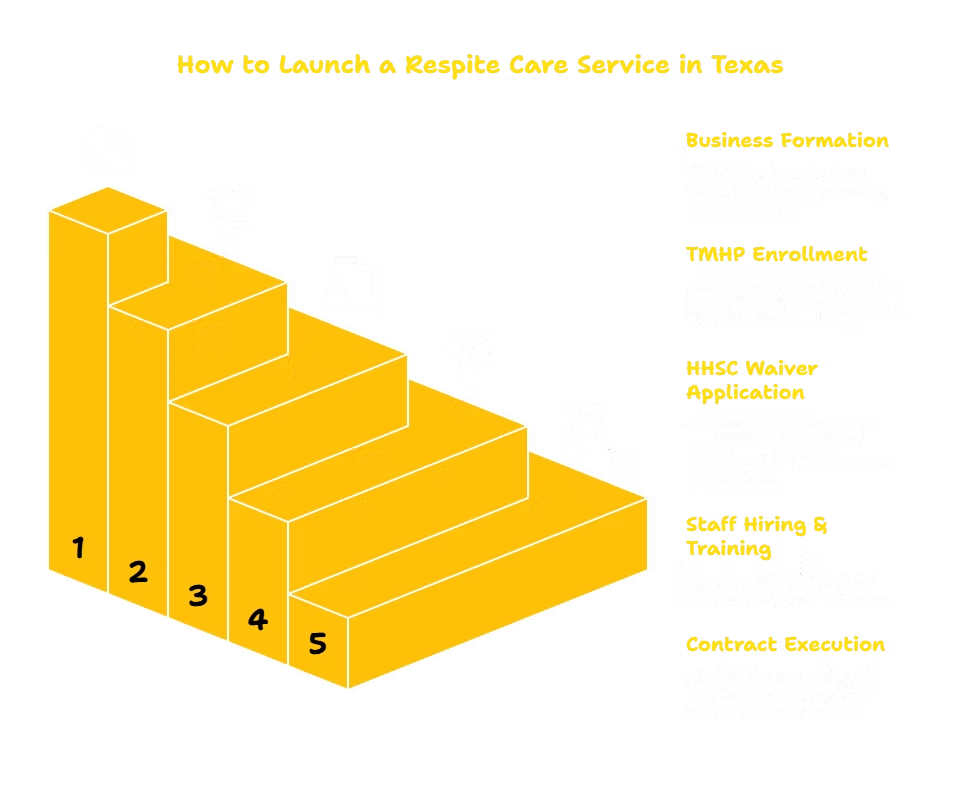
Becoming an approved Medicaid provider for respite services requires a rigorous, multi-step administrative process. Before approaching state agencies, organizations must establish a solid legal foundation by registering their business entity with the Texas Secretary of State, securing an Employer Identification Number (EIN), and obtaining a Type 2 National Provider Identifier (NPI). These foundational elements are essential for all subsequent Medicaid billing and contract applications.
Once the legal entity is established, the provider must enroll as a Medicaid provider through the Texas Medicaid & Healthcare Partnership (TMHP). Following TMHP enrollment, the agency must submit a waiver-specific contract application to the HHSC. This application must explicitly indicate the intent to provide respite services. For agencies planning to offer out-of-home respite, obtaining the appropriate residential licensure from HHSC is a mandatory prerequisite that must be satisfied before the agency can receive service authorizations.
Developing Essential Documentation and Compliance Protocols
Compliance is the cornerstone of a successful respite care agency. Prospective providers must compile a comprehensive Respite Services Policy & Procedure Manual that addresses every aspect of clinical and administrative operation. This manual serves as the operational blueprint for the agency and is subject to audit by state reviewers. Without a robust documentation strategy, agencies risk non-compliance and the denial of reimbursement claims.
A compliant Policy & Procedure Manual must include, at a minimum, the following components:
- Comprehensive protocols for staff supervision, training, and emergency contact procedures.
- Clearly defined incident prevention, reporting, and management workflows.
- Standardized daily service documentation templates that meet state verification requirements.
- Detailed emergency evacuation, health-related response, and safety protocols.
- Strict adherence to participant rights, grievance processes, and abuse prevention policies.
- Systems for tracking service authorizations and accurate billing practices.
Managing Staffing and Training Requirements
The quality of respite care is directly dependent on the competence and readiness of the Direct Support Professional (DSP) or respite caregiver. Agencies are responsible for ensuring that all staff members possess the necessary qualifications, which include a high school diploma or GED, valid CPR and First Aid certification, and successful completion of state-mandated background checks. In settings such as out-of-home facilities, a designated Program Supervisor is required to manage staff coordination and ensure adherence to waiver policies.
All staff must complete a comprehensive training program that covers foundational and individual-specific requirements, including:
- HHSC-mandated HCBS waiver training and ongoing education.
- Individualized training tailored to the participant's specific health, behavioral, and safety needs.
- Emergency and crisis response protocols to ensure immediate action in high-pressure situations.
- Strict adherence to confidentiality and HIPAA standards when managing sensitive medical information.
- Correct usage of daily documentation and service verification tools for billing accuracy.
Frequently Asked Questions
What is the typical timeline to launch a new respite care agency?
The launch timeline generally spans several months, beginning with business formation and manual development (1–2 months), followed by TMHP enrollment and HHSC waiver applications (2–3 months). Staff hiring and training usually occur within a 30–60 day window, with contract execution and the commencement of client referrals following the successful completion of an HHSC readiness review.
Which Medicaid Waiver programs cover respite services in Texas?
Respite services are covered under several key programs, including HCS (Home and Community-Based Services), CLASS (Community Living Assistance & Support Services), TxHmL (Texas Home Living), DBMD (Deaf Blind with Multiple Disabilities Program), and MDCP (Medically Dependent Children Program). Additionally, certain respite benefits are available through the YES Waiver for children with serious emotional disturbances and the STAR+PLUS program for specific eligible adults.
What documentation is required to pass an HHSC readiness review?
Providers must present proof of business incorporation, valid EIN and NPI numbers, active TMHP enrollment, and executed HHSC waiver contracts. Furthermore, the agency must provide verified staff background checks, active insurance certificates, and a completed Policy & Procedure Manual that demonstrates compliance with all emergency, safety, and service documentation requirements.
Key takeaway: Launching a respite care service in Texas requires meticulous preparation regarding state licensing, adherence to HHSC and CMS regulatory standards, and the implementation of robust internal policies. By aligning business operations with the specific requirements of the HCS, CLASS, TxHmL, DBMD, and MDCP waiver programs, provider agencies can effectively support the health and safety of individuals while providing critical relief to their caregivers.
Last verified: 2024. The information provided is for educational purposes only and does not constitute legal or professional advice. Always consult directly with the Texas Health and Human Services Commission (HHSC) or official state documentation for the most current rules, regulations, and program requirements. Waiver Consulting Group is not an official government agency and assumes no liability for the accuracy of these requirements as policies may change.