RESPITE CARE SERVICES PROVIDER IN SOUTH DAKOTA
By Fatumata Kaba · 2025-10-15 · 5 min read
Respite care services in South Dakota serve as a critical pillar of the state’s Home and Community-Based Services (HCBS) framework, offering temporary relief to primary caregivers while ensuring the health, safety, and continuity of care for individuals with disabilities or complex needs. By providing both in-home and out-of-home support options, these services allow waiver participants to maintain their routines and receive essential supervision during planned or emergency caregiver absences.
What Are the Roles of Governing Agencies in South Dakota?
The administration of respite services in South Dakota is split between two primary state departments, depending on the population served. The South Dakota Department of Human Services (DHS) – Division of Developmental Disabilities (DDD) holds responsibility for administering the CHOICES and Family Support 360 Waivers. Their role encompasses service authorizations, stringent quality assurance protocols, and the formal approval of providers who support individuals with intellectual and developmental disabilities.
Conversely, the South Dakota Department of Social Services (DSS) – Division of Long Term Services and Supports (LTSS) manages respite services specifically designed for older adults and those within specific HCBS programs. Both divisions operate under the regulatory umbrella of the Centers for Medicare & Medicaid Services (CMS). CMS ensures that all state-level respite programs remain in compliance with federal mandates governing service delivery, participant rights, and the ethical use of Medicaid funding.
How Are Respite Care Services Structured for Participants?
Respite care acts as a substitute support system, activated when the primary caregiver is unavailable. Providers are tasked with delivering care that adheres to the participant’s Individual Service Plan (ISP), ensuring that the quality of supervision remains consistent regardless of the setting. These services can be delivered as hourly or daily support, depending on the specific authorization and the depth of the caregiver’s needs.
Service delivery typically falls into one of two categories: in-home respite, which involves providing support directly within the participant’s residence, or out-of-home respite, which utilizes licensed residential facilities or group homes. Beyond direct care, providers are responsible for rigorous monitoring and documentation. This includes maintaining daily logs, verifying service hours for billing, and maintaining open lines of communication with assigned case managers to address any shifts in the participant's condition or care requirements.
What Are the Prerequisites for Becoming an Approved Provider?
Launching a respite care agency requires a structured approach to business registration and regulatory compliance. Before delivering services, an entity must be properly registered with the South Dakota Secretary of State and possess a valid Employer Identification Number (EIN) and a Type 2 National Provider Identifier (NPI). These foundational steps allow the business to interact with the state's billing and enrollment systems.
Beyond basic business registration, prospective providers must satisfy specific programmatic requirements. This includes developing a comprehensive Respite Care Services Policy & Procedure Manual that outlines how the agency will manage intake, service delivery, and incident reporting. Furthermore, the agency must maintain appropriate levels of liability and workers' compensation insurance. If the agency intends to offer out-of-home services, it must navigate the additional layer of facility licensure requirements overseen by the DSS.
- Register the business entity with the South Dakota Secretary of State.
- Obtain a Federal EIN and a Type 2 NPI for billing purposes.
- Submit formal provider applications to the DDD or LTSS based on the target population.
- Secure appropriate facility licensure if operating an out-of-home model.
- Establish comprehensive internal policies for HIPAA compliance and incident management.
How Can Providers Navigate the Enrollment and Staffing Process?
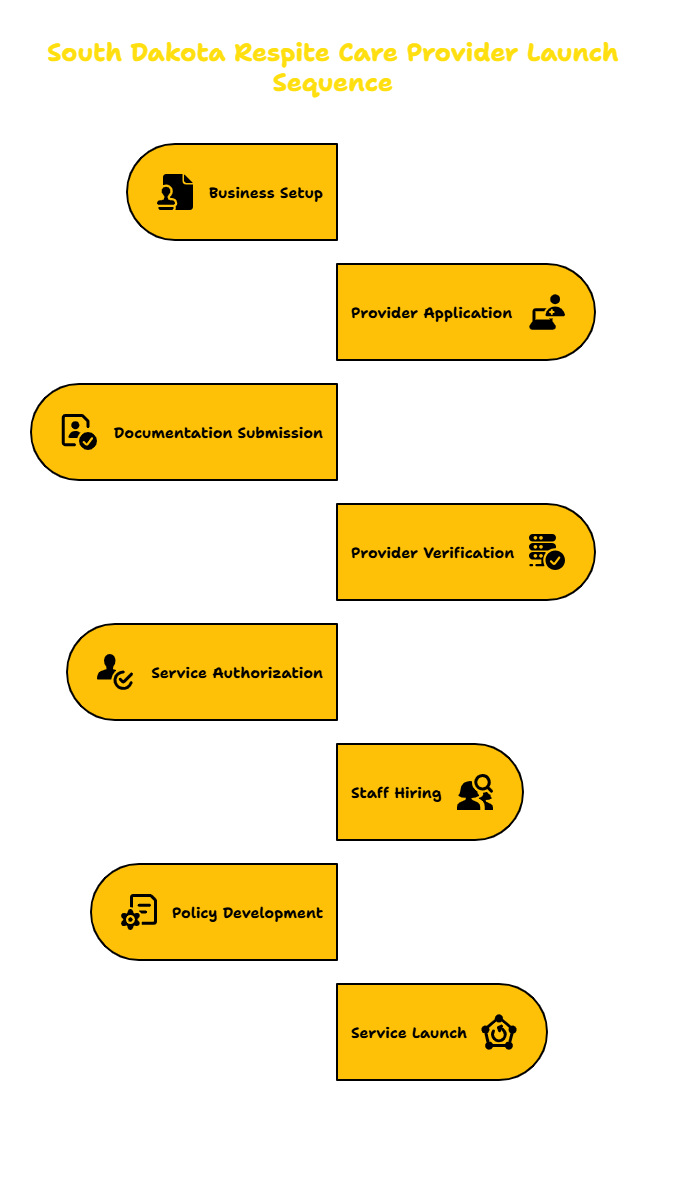
The provider enrollment journey is a multi-step process that moves from business formation to active service provision. Once the application is submitted to the appropriate division (DDD or LTSS), the agency must provide documentation samples, staff credentials, and detailed safety protocols for review. Following the submission, the agency will undergo a provider readiness verification, which confirms that the infrastructure and policies are sufficient to support high-quality care.
Once approved, staffing requirements become the focal point of operations. All direct support staff must undergo background checks and obtain certification in CPR and First Aid. Staff must also be trained on the specific needs of the individuals they support, including adherence to behavior plans and emergency protocols. Training programs should emphasize participant dignity, abuse prevention, and the legal requirements of HIPAA to ensure a culture of safety and professionalism within the organization.
What Documentation and Compliance Standards Are Required?
Compliance in the Medicaid HCBS space relies on rigorous, audit-ready documentation. Every provider must maintain an organized system that tracks participant intake, service delivery, and staff credentialing. The Policy & Procedure Manual serves as the primary governing document for these activities, ensuring that all staff members have a standardized reference for how to respond to emergencies, document service hours, and protect participant privacy.
Billing and verification processes must be equally robust. Because Medicaid services are publicly funded, every hour of respite care provided must be documented via approved logs that correlate with the participant's ISP. Agencies must keep detailed records of all staff training, including orientation sessions on Medicaid compliance and annual performance reviews. These records are subject to review by state agencies and are essential for maintaining the provider's "good standing" status.
Frequently Asked Questions
What types of waiver programs cover respite care in South Dakota?
Respite care is authorized under the CHOICES Waiver for adults with ID/DD, the Family Support 360 Waiver for children and adults, the Shared Living Program, and the LTSS HCBS Waiver for older adults. Additionally, State Plan Medicaid or EPSDT may cover pediatric respite when medical necessity is established.
How long does the provider enrollment process typically take?
The timeline varies by agency readiness, but the typical process spans 1 to 2 months for business setup, followed by 2 to 3 months for Medicaid enrollment and provider approval. Staff hiring and training usually occur within a 30- to 60-day window, culminating in service launch once referrals are received.
What is the difference between in-home and out-of-home respite?
In-home respite provides supervision and support within the participant’s own home, allowing for continuity in a familiar environment. Out-of-home respite involves taking the participant to a licensed setting, such as a residential facility or group home, where they receive professional care for a set period.
Key Takeaway: Successfully operating as a respite care provider in South Dakota requires a commitment to both administrative precision and compassionate, person-centered support. By maintaining current licensure, adhering to the policies set forth by the DDD and LTSS, and ensuring all staff are thoroughly trained, providers can build sustainable, high-quality programs that deliver essential relief to the families who rely on them most.
Last verified: 2024. The information provided is for educational purposes only and does not constitute legal or professional consulting advice. For definitive guidance on South Dakota Medicaid HCBS regulations, please consult directly with the Department of Human Services or the Department of Social Services.