RESPITE CARE SERVICES PROVIDER IN RHODE ISLAND
By Fatumata Kaba · 2025-10-09 · 6 min read
PROVIDING TEMPORARY RELIEF FOR FAMILY CAREGIVERS WHILE SUPPORTING INDIVIDUALS WITH COMPASSIONATE, DEPENDABLE CARE AT HOME OR IN THE COMMUNITY
Respite care services in Rhode Island are critical, Medicaid-funded supports designed to provide temporary relief to the primary caregivers of individuals living with disabilities, chronic illnesses, or age-related conditions. By facilitating either in-home or community-based care, these programs ensure the safety and well-being of the participant while allowing the family caregiver essential time to rest, attend to personal obligations, or manage their own health. These services are authorized under the state’s robust framework, including the Rhode Island Medicaid 1115 Waiver and various Long-Term Services and Supports (LTSS) programs administered by the Executive Office of Health and Human Services (EOHHS) and the Department of Behavioral Healthcare, Developmental Disabilities & Hospitals (BHDDH).
What Are the Governing Agencies and Regulatory Frameworks?
Navigating the Rhode Island Medicaid landscape requires a clear understanding of the roles played by various oversight bodies. The Executive Office of Health and Human Services (EOHHS) serves as the primary administrator for the state's Medicaid programs, including the HCBS waivers that facilitate respite care. Coordination with EOHHS is essential for any provider seeking to participate in the broader Medicaid managed care ecosystem, which includes partnering with managed care entities like Neighborhood Health Plan.
For providers focusing on developmental disabilities, the Department of Behavioral Healthcare, Developmental Disabilities & Hospitals (BHDDH) is the lead agency. They oversee the funding and programmatic requirements specific to DD waivers. Furthermore, while the Centers for Medicare & Medicaid Services (CMS) provides the overarching federal authority, the Rhode Island Department of Health (RIDOH) acts as the state-level regulatory body for licensure, specifically concerning the delivery of in-home care services. Providers must ensure their operational practices remain aligned with the standards set forth by these entities to maintain eligibility for reimbursement.
How Do Respite Care Services Function for Participants?
Respite care acts as a bridge, ensuring continuity of care when a primary, unpaid caregiver—often a family member—is unavailable. The service model is intentionally flexible, offering various modalities to meet the unique needs of the participant and the logistical requirements of the family. Depending on the specific authorization, respite may involve in-home companionship, assistance with activities of daily living (ADLs), or supervision within a community-based setting such as a day program or a specialized respite facility.
Effective service delivery requires rigorous documentation and standardized protocols to ensure that every visit or shift supports the individual’s health and safety. Providers are responsible for maintaining accurate visit records, detailed caregiver reports, and Medicaid-compliant billing forms. Whether the individual requires basic companionship or more specialized behavioral and medical support, the respite provider must act in strict accordance with the individual’s care plan and the broader regulatory expectations of the authorizing agency.
What Are the Essential Prerequisites for New Providers?
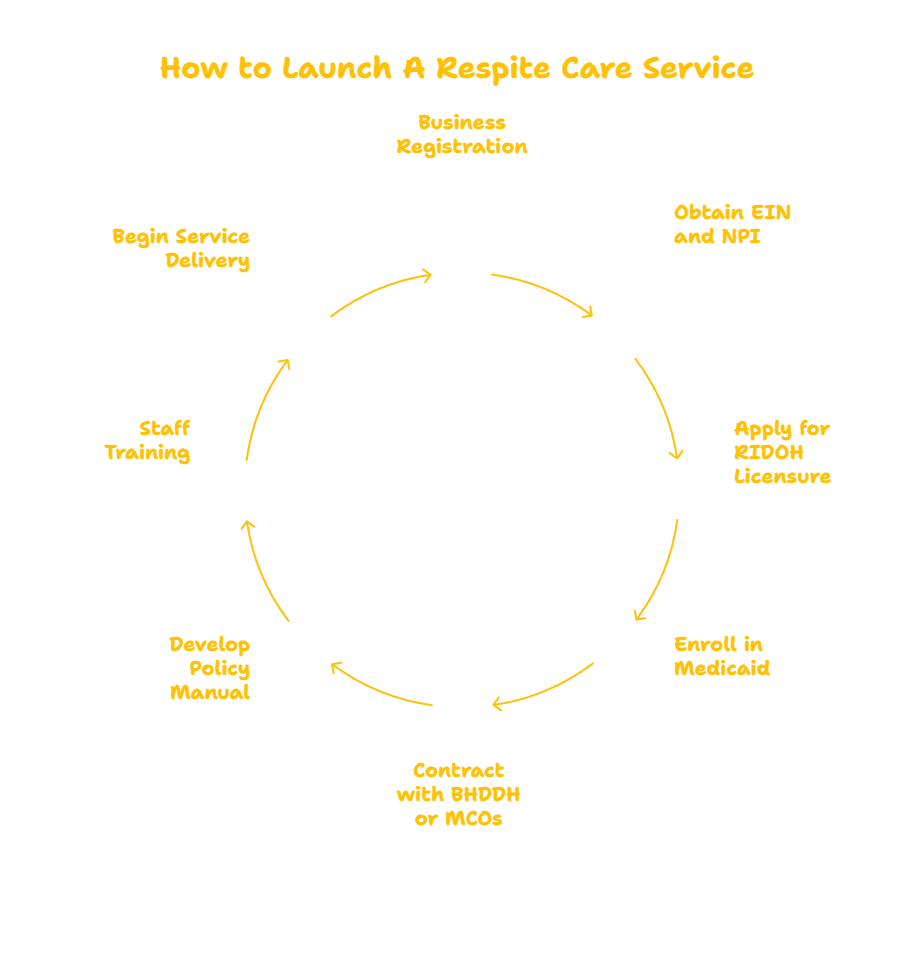
Establishing a respite care agency in Rhode Island involves a multi-step sequence of business and regulatory milestones. Before initiating service delivery, a provider must formalize their business entity through the Rhode Island Secretary of State and secure all federal identifiers, including an Employer Identification Number (EIN) and a Type 2 National Provider Identifier (NPI). These are foundational elements required for all subsequent enrollment and billing applications.
Beyond the legal entity, providers must obtain professional liability and workers’ compensation insurance to protect the agency and its employees. If the business model includes in-home support, securing a Home Care Provider license from RIDOH is a mandatory prerequisite. Additionally, the development of a comprehensive Respite Care Policy & Procedure Manual is vital. This document serves as the backbone of the agency's compliance program, detailing everything from staff onboarding and participant intake to emergency response and HIPAA-compliant data management.
How Should a Provider Approach the Enrollment and Licensing Process?
The path to becoming a recognized Medicaid respite provider is systematic and requires careful attention to detail. Initially, a provider must satisfy all state business requirements before engaging with the Medicaid provider portal. Once the entity is established and RIDOH licensure (if applicable) is secured, the provider must undergo the EOHHS provider enrollment process. This process confirms that the agency meets the technical, administrative, and clinical standards necessary to participate in state-funded programs.
Once enrolled, the provider must seek contracts with BHDDH or Medicaid managed care entities. This phase involves a formal review of the agency's internal protocols, staff credentials, and proposed service delivery models. Upon successful completion of these reviews and the receipt of service authorizations, the agency can begin accepting referrals. Successful providers maintain this momentum by consistently auditing their documentation against current waiver requirements and ensuring their staff remains fully compliant with updated state policies.
What Are the Staffing and Training Requirements?
The quality of respite care is inherently tied to the competence and reliability of the staff. Agencies must employ qualified Respite Aides or Direct Support Professionals (DSPs) who are prepared to assist with ADLs and provide consistent supervision. These individuals must be vetted through rigorous background checks and possess active CPR and First Aid certifications. For individuals with complex or medically fragile needs, the oversight of a Program Supervisor, typically an RN or a qualified Human Services Professional, is essential to ensure high-level care planning and compliance.
- HIPAA and participant rights training for all personnel.
- Comprehensive abuse and neglect prevention education.
- ADL assistance, documentation standards, and task logging proficiency.
- Emergency procedures, critical incident reporting, and safety protocols.
- Regular, documented annual skills assessments and competency checks.
Frequently Asked Questions
What types of Medicaid waiver programs cover respite care in Rhode Island?
Respite services are primarily covered through the Global Consumer Choice Compact 1115 Waiver, which supports HCBS initiatives. Additionally, programs such as the BHDDH DD Waivers and the Katie Beckett Program for children with complex medical needs offer specific respite provisions. Self-directed service models are also available, allowing families to utilize fiscal intermediaries to hire their own qualified respite workers.
What is the typical timeline for launching a respite care agency?
The development timeline generally spans several months. Business formation and the creation of a policy manual typically take 1–2 months, followed by 2–3 months for RIDOH licensure and Medicaid enrollment. Staff hiring, training, and credentialing usually require an additional 30–60 days before the agency is fully prepared to handle live referrals.
Are there specific requirements for the Respite Care Policy & Procedure Manual?
Yes, the manual must be comprehensive and align with Medicaid standards. It must detail procedures for participant intake, shift documentation, ADL tracking, emergency and incident response, HIPAA compliance, and abuse prevention. These policies must be accessible to staff and ready for audit by state agencies at any time.
WCG supports Rhode Island agencies in launching licensed, waiver-approved respite care programs that meet Medicaid standards and family caregiver needs. Our scope of work includes:
- Business registration, RIDOH licensure, and Medicaid enrollment assistance.
- Development of a Respite Care Policy & Procedure Manual tailored to in-home and facility-based care.
- Staff onboarding, documentation guidance, and creation of emergency response protocols.
- Design of ADL task logs, caregiver intake forms, and professional shift notes.
- Facilitation of contracts with BHDDH, Medicaid MCOs, and self-direction support.
- Provision of audit-readiness templates and compliance checklists.
Key takeaway: Success in the Rhode Island respite market depends on a combination of rigorous regulatory compliance, professionalized staff training, and the seamless integration of your agency into existing Medicaid and waiver-based referral pathways.
Last verified: October 2023. Disclaimer: This information is for educational purposes and does not constitute legal or professional consulting advice. State regulations, waiver requirements, and administrative codes are subject to change. Always refer to the official EOHHS, BHDDH, and RIDOH websites for the most current statutes and guidance regarding Medicaid provider requirements.