RESPITE CARE SERVICES PROVIDER IN PENNSYLVANIA
By Fatumata Kaba · 2025-10-07 · 5 min read
Respite care services in Pennsylvania are essential Medicaid-funded supports designed to provide temporary, short-term relief to primary caregivers of individuals with disabilities or complex chronic conditions. By offering professional, compassionate care—whether in the individual’s home or a community-based facility—these services help prevent caregiver burnout and ensure that participants continue to receive high-quality support while their primary caregivers attend to personal matters, rest, or handle emergencies.
Operating as a respite provider in the Commonwealth requires a thorough understanding of the regulatory landscape managed by the Department of Human Services (DHS). Providers must navigate requirements set forth by the Office of Developmental Programs (ODP) and the Office of Long-Term Living (OLTL), while ensuring compliance with Medicaid waiver standards and federal regulations overseen by the Centers for Medicare & Medicaid Services (CMS).
What Are the Governing Agencies and Regulatory Oversight Bodies?
The provision of respite care in Pennsylvania is governed by a multi-layered regulatory framework. The Pennsylvania Department of Human Services (DHS) serves as the primary state authority, with two major offices directing the implementation of services based on the population served. The Office of Developmental Programs (ODP) manages respite services for individuals with intellectual and developmental disabilities (IDD) across the Consolidated, Community Living, and P/FDS waivers. Simultaneously, the Office of Long-Term Living (OLTL) oversees respite care for older adults and individuals with physical disabilities through the Aging and Independence waivers.
Beyond these state offices, the landscape includes Community HealthChoices (CHC) Managed Care Organizations (MCOs), which play a critical role in the authorization and reimbursement of services for dual-eligible participants. Because these services are funded through federal 1915(c) waiver authority, the Centers for Medicare & Medicaid Services (CMS) provides the overarching federal regulatory oversight. Additionally, all new provider businesses must comply with the Pennsylvania Department of State requirements for entity registration to operate legally within the Commonwealth.
How Are Respite Care Services Structured for Participants?
Respite care is designed to be highly flexible, ensuring that the level of support aligns with the specific needs outlined in an individual's Individualized Service Plan (ISP). These services are categorized by their delivery method and urgency. Planned respite allows families to schedule breaks on a recurring or episodic basis, while emergency respite provides a critical safety net for families facing unforeseen circumstances, such as a caregiver’s sudden illness or an urgent family crisis. Providers must be prepared to offer these services in various modalities to meet the unique requirements of the population they serve.
The scope of service delivery can range from in-home care, where a trained aide provides support within the individual’s primary residence, to out-of-home care delivered at licensed community residences, camps, or host homes. Depending on the service authorization, these models may be structured on an hourly, daily, or overnight basis. Regardless of the setting, rigorous documentation is required for all encounters. This includes daily logs, shift reports, and Medicaid billing records that accurately reflect the care provided, ensuring audit readiness and compliance with state reporting standards.
What Are the Licensing and Enrollment Prerequisites?
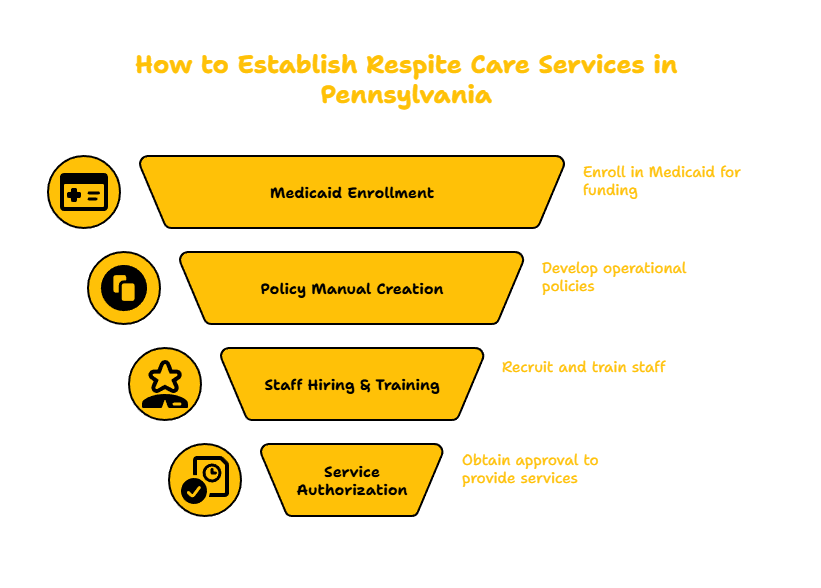
Entering the Pennsylvania respite care market requires a systematic approach to business and clinical compliance. Prospective providers must first establish a formal business entity with the Pennsylvania Department of State and obtain an Employer Identification Number (EIN) and a Type 2 National Provider Identifier (NPI). Once the business structure is set, the provider must enroll in the PROMISe™ system, which is the state's centralized Medicaid provider enrollment portal. This step is non-negotiable for any organization seeking to bill for Medicaid-funded services.
If the provider intends to operate a residential facility, specific licensure—such as Residential Habilitation or Respite Licensure—must be obtained through either the ODP or the Department of Health (DOH). Furthermore, providers serving individuals under the Community HealthChoices program must enter into contractual agreements with the relevant MCOs. Throughout this process, it is vital to secure comprehensive insurance policies, including liability and workers’ compensation, and to develop a robust Respite Care Services Policy & Procedure Manual that adheres to the standards set by ODP and OLTL.
How Should a Provider Manage Staffing and Training Requirements?
The quality of a respite program is inextricably linked to the competency of its staff. Direct Support Professionals (DSPs) and respite aides serve as the frontline representatives of the agency. Every staff member must undergo a comprehensive background check and possess valid certifications in CPR and First Aid. Beyond these basic requirements, staff must complete mandatory state-specific training modules related to the waiver population they are supporting, ensuring they are prepared to handle the diverse needs of the participants.
A well-structured program also includes defined roles such as Program Supervisors, who are responsible for overseeing the quality of care, managing complex scheduling, and ensuring that all documentation is accurate and timely. For high-acuity clients, agencies may need to employ or contract with licensed nurses or behavioral specialists. The following training areas are considered essential for all staff members:
- Mandatory reporter training and abuse prevention strategies.
- HIPAA compliance and privacy protection standards.
- Person-centered care approaches and sensitivity training.
- Emergency response protocols and behavior support techniques.
- Annual skills assessments and service documentation proficiency.
Frequently Asked Questions
What is the typical timeline to launch a respite care agency?
The launch process generally spans several months. Business registration and the creation of a comprehensive policy manual typically take 1–2 months. Medicaid enrollment and MCO qualification follow, requiring another 2–3 months. Staff recruitment and training generally take 30–60 days, with actual service activation beginning once all authorizations and documentation systems are fully operational.
Which waivers provide funding for respite services in Pennsylvania?
Funding is provided through ODP waivers, specifically the Consolidated, Community Living, and P/FDS waivers. Additionally, the OLTL provides funding via the Aging, Independence, and OBRA waivers. For participants who are dual-eligible, respite services are often authorized and managed through the Community HealthChoices (CHC) program.
What documentation must be maintained for Medicaid audits?
Providers must maintain detailed records, including business registration and insurance certificates. Crucially, they must document all service encounters in alignment with the individual's ISP. This includes HIPAA-compliant intake forms, daily care logs, incident reports, and billing records that match the services authorized through the PROMISe™ portal or MCO contract.
Key Takeaways for Prospective Providers
Establishing a successful respite care agency in Pennsylvania requires strict adherence to regulatory standards set by ODP, OLTL, and the respective MCOs. Success depends on the early establishment of a compliant business foundation, rigorous staff training, and the maintenance of precise documentation. By aligning agency policies with the specific requirements of the Pennsylvania Medicaid waivers, providers can ensure they remain compliant while delivering critical support to families and individuals in need across the state.
Last verified: May 2024. This information is intended for educational purposes only and does not constitute legal or professional consulting advice. Requirements for Medicaid provider enrollment and waiver participation are subject to change by the Pennsylvania Department of Human Services. Always verify current standards through the official PA DHS, ODP, and OLTL portals before initiating provider enrollment procedures.