RESPITE CARE SERVICES PROVIDER IN OREGON
By Fatumata Kaba · 2025-10-07 · 6 min read
DELIVERING TEMPORARY RELIEF TO CAREGIVERS WHILE ENSURING SAFE, COMPASSIONATE SUPPORT FOR INDIVIDUALS WITH SPECIAL NEEDS
Respite care services in Oregon are vital Medicaid-funded supports that provide short-term, substitute care for individuals with disabilities, chronic conditions, or age-related needs, allowing primary caregivers to take a necessary break from their daily responsibilities. These services play a critical role in preventing caregiver burnout while promoting the overall health and safety of both the caregiver and the individual receiving care, and they are authorized through the Oregon Health Plan (OHP), including Home and Community-Based Services (HCBS) waivers and the K Plan.
What Are the Governing Bodies and Regulatory Frameworks?
The provision of respite care in Oregon is governed by a multi-tiered regulatory structure involving state and federal authorities. The Oregon Department of Human Services (ODHS), specifically through its Aging and People with Disabilities (APD) and Developmental Disabilities (DD) divisions, serves as the primary gateway for provider certification. These local APD offices and Community Developmental Disabilities Programs (CDDP) are responsible for the daily authorization and coordination of services, ensuring that each participant receives support aligned with their individualized care plan.
At the state level, the Oregon Health Authority (OHA) administers the Oregon Health Plan and manages Medicaid operations, ensuring that all service delivery adheres to federal and state compliance mandates. Meanwhile, the Centers for Medicare & Medicaid Services (CMS) oversees federal standards for respite care under HCBS authorities, specifically 1915(c) and 1915(k) waivers. Additionally, any provider entity must maintain corporate compliance with the Oregon Secretary of State (SOS) to ensure legal authorization to conduct business within the state.
How Are Respite Care Services Structured?
Respite care is designed to provide caregivers with the flexibility to travel, rest, or attend to urgent personal matters while maintaining consistent, high-quality care for their family member. Services are highly customizable, ranging from brief, planned breaks to emergency interventions. The service delivery model is determined by the individual's specific Medicaid waiver and support needs, ensuring that the respite environment is both appropriate and safe.
Approved respite providers typically offer several core service models:
- In-Home Respite: Temporary support delivered directly within the individual’s residence.
- Out-of-Home Respite: Care provided in a certified provider’s home, foster care setting, or community-based location.
- Facility-Based Respite: Short-term stays in licensed adult foster homes or residential care settings for those requiring a more structured environment.
- Planned or Emergency Respite: Flexible options ranging from scheduled relief to immediate crisis-response support.
- Personal Support & Monitoring: Direct assistance with Activities of Daily Living (ADLs), medication reminders, and general supervision.
What Are the Essential Licensing and Enrollment Requirements?
Entering the respite care market requires meticulous attention to operational prerequisites and administrative compliance. Before an agency can begin billing for Medicaid services, it must establish a formal business structure and obtain all necessary identifiers, including a federal Employer Identification Number (EIN) and a Type 2 National Provider Identifier (NPI). These foundational elements are essential for enrollment in the OHP Provider Portal.
Beyond standard business registration, prospective providers must satisfy specific programmatic requirements. For organizations serving individuals with developmental disabilities, certification through ODHS-DD is mandatory. Furthermore, those offering out-of-home care must demonstrate compliance with adult foster home or residential licensing requirements set by the ODHS. Providers must also secure comprehensive liability and workers’ compensation insurance to mitigate operational risks. Developing a robust Respite Care Services Policy & Procedure Manual—tailored to the specific target population and service type—is a critical step that demonstrates a commitment to quality and regulatory adherence.
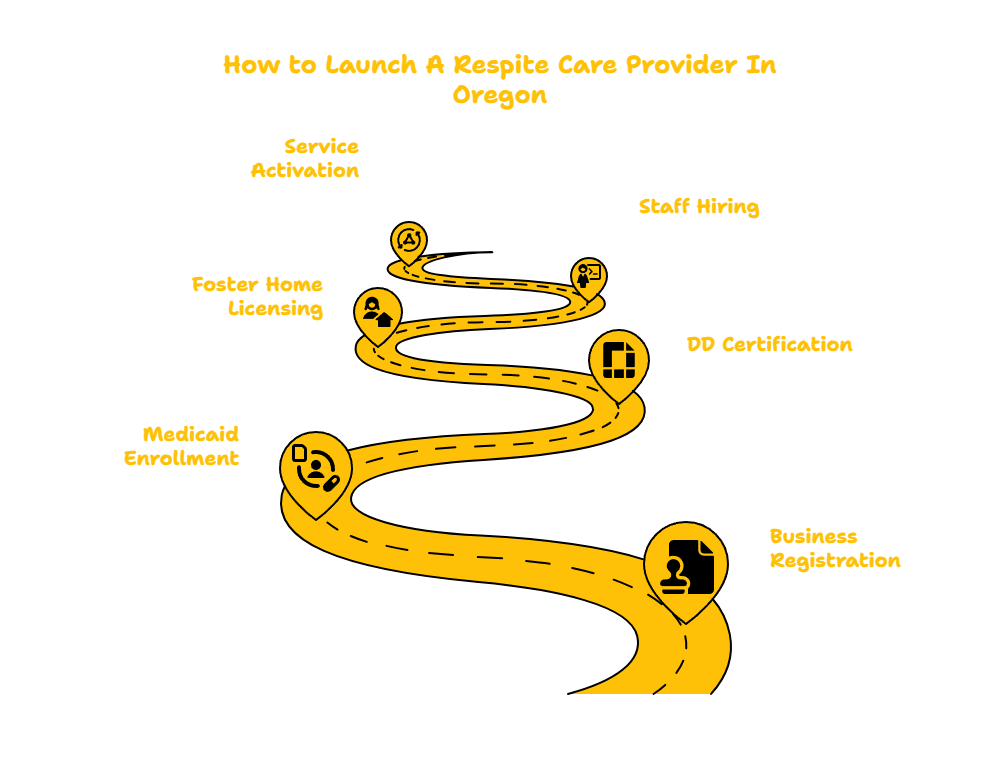
How Do Providers Successfully Navigate the Enrollment Process?
The pathway to becoming an active Medicaid provider involves a logical, sequential process of registration and certification. Once the business entity is formed, the agency must initiate the Medicaid enrollment process through the OHP Provider Portal. For providers specifically targeting the IDD (Intellectual and Developmental Disabilities) population, this process involves close coordination with local CDDP offices to obtain the necessary certifications and to establish connections with local case management entities.
For those pursuing residential-based respite, the application for adult foster home licensing through APD should be pursued concurrently. After all documentation is submitted and verified, providers must complete the necessary background checks and training requirements before receiving authorization to accept clients. Once the provider is fully enrolled, they can begin receiving referrals from service coordinators and integrating into the existing network of support services.
What Documentation and Staffing Standards Must Be Met?
Medicaid requires rigorous documentation to ensure accountability, audit readiness, and client safety. An agency’s administrative records must include copies of business registration, EIN/NPI confirmation, insurance certificates, and all applicable ODHS/APD/DD certifications. Additionally, the Policy & Procedure Manual must clearly detail intake processes, emergency protocols, backup staffing contingency plans, and incident reporting procedures. Quality assurance is maintained through consistent recordkeeping, including detailed progress notes and adherence to Medicaid billing protocols, including Electronic Visit Verification (EVV) requirements.
Staffing requirements are equally stringent to ensure high-quality care delivery:
- Direct Support Professionals (DSPs): Must be ODHS-approved, pass comprehensive background checks, and demonstrate experience with ADLs and behavioral support.
- Program Supervisors: Responsible for daily operations, staff scheduling, training oversight, and maintaining a deep understanding of the DD/APD service systems.
- Clinical Oversight: For clients with complex medical needs, an RN or Licensed Practitioner may be required to provide nursing oversight.
- Mandatory Trainings: All staff must complete CPR/First Aid, abuse reporting training, HIPAA compliance, and specific EVV and documentation protocols.
Frequently Asked Questions
How long does the provider launch process typically take?
The timeline varies based on the scope of services, but generally, business registration and manual creation take 1–2 months, Medicaid enrollment and certification take 2–3 months, and hiring/training takes 30–60 days. Service activation begins upon receiving official authorization from case management offices.
What types of Medicaid waivers cover respite services?
Respite services are available through various programs, including the K Plan (Community First Choice 1915(k)), APD Waiver services for seniors and adults with physical disabilities, IDD Waivers, the Children’s Waiver, and the Medically Fragile Waivers, alongside standard OHP respite options.
What is the role of EVV in respite care?
Electronic Visit Verification (EVV) is a federal and state mandate designed to verify that services are delivered to the participant. Providers must use approved EVV systems to log the time, location, and nature of the respite care provided to ensure accurate Medicaid billing and compliance.
Key Takeaways for Provider Success
Establishing an Oregon respite care program requires a structured commitment to administrative compliance, regulatory certification, and high-quality staff training. By meticulously aligning business operations with the guidelines set forth by the ODHS, OHA, and CMS, providers can bridge the gap for caregivers in need while ensuring a sustainable and ethical business model. The successful integration of robust policy manuals, reliable billing systems, and well-trained personnel is essential for long-term viability in the Medicaid HCBS landscape.
WCG helps Oregon providers launch fully compliant respite care programs with: Business registration and Medicaid enrollment navigation, ODHS and DD respite provider certification assistance, customized Respite Policy & Procedure Manuals, staff training guides and credentialing templates, EVV setup, billing support, and documentation systems, emergency response plans and quality assurance templates, and partnership development with case managers and family networks.
Last verified: October 2023. This information is intended for educational purposes only and does not constitute legal or professional advice. Always consult with the Oregon Department of Human Services (ODHS) or the Oregon Health Authority (OHA) regarding the most current statutes and administrative rules governing HCBS and Medicaid provider requirements.