RESPITE CARE SERVICES PROVIDER IN NORTH DAKOTA
By Fatumata Kaba · 2025-09-18 · 6 min read
Respite care services in North Dakota are essential community-based supports designed to provide temporary relief to primary caregivers, ensuring the safety and well-being of individuals with disabilities, chronic illnesses, or age-related conditions. Authorized under various North Dakota Medicaid Home and Community-Based Services (HCBS) waivers, these services allow caregivers to take necessary breaks while guaranteeing consistent, compassionate care for their loved ones.
What Are the Governing Agencies and Regulatory Frameworks?
The delivery of respite care within the state is governed by a network of federal and state entities. These agencies ensure that Medicaid-funded services adhere to strict quality, safety, and person-centered care standards. Navigating these requirements is a prerequisite for any provider agency seeking to participate in the state’s Medicaid landscape.
The North Dakota Department of Human Services (NDDHS) serves as the primary authority, administering Medicaid waiver funding and overseeing the crucial processes of provider enrollment, service authorization, and reimbursement. Working in tandem, the North Dakota Medical Services Division (MSD) manages specific waiver services and monitors provider participation, while the North Dakota Division of Aging Services provides direct oversight for respite programs targeting elderly individuals and adults with disabilities. At the federal level, the Centers for Medicare & Medicaid Services (CMS) maintains overarching compliance standards for all Medicaid-funded activities.
- NDDHS: Oversees funding, enrollment, and reimbursement protocols.
- Medical Services Division: Manages Medicaid waiver service operations.
- Division of Aging Services: Provides specific oversight for aging and disability populations.
- CMS: Sets the federal standard for quality and person-centered care delivery.
How Does the Respite Care Service Model Function?
Respite care is designed to be highly adaptable, meeting the diverse needs of families across North Dakota. Providers may be called upon to deliver services in a variety of settings, ranging from the participant’s private home to specialized community facilities. The core objective is to offer a seamless transition for the care recipient during the primary caregiver’s absence.
Services encompass a wide spectrum of support, including routine personal care assistance—such as help with bathing, grooming, and meal preparation—as well as specialized health monitoring and behavioral support. Whether the respite is planned in advance or required on an emergency basis, providers must be equipped to maintain accurate documentation of care delivered. This documentation is not only vital for the safety of the individual but is also a core requirement for compliant Medicaid billing.
- In-Home vs. Out-of-Home: Flexibility between the recipient’s residence and licensed facility settings.
- Emergency and Planned Care: Capacity to respond to both scheduled breaks and unexpected crises.
- Specialized Support: Delivery of health monitoring, behavioral intervention, and personal care tasks.
What Are the Licensing and Provider Enrollment Requirements?
Entering the North Dakota Medicaid waiver market requires rigorous preparation. Business entities must first be formally registered with the North Dakota Secretary of State and obtain the necessary federal identifiers, including an IRS Employer Identification Number (EIN) and a Type 2 National Provider Identifier (NPI). These foundational steps establish the business as a legitimate entity prepared to operate within the state’s regulatory framework.
Following business formation, agencies must undergo the formal enrollment process through the North Dakota Medicaid Management Information System (MMIS). This process involves a comprehensive program readiness review, where the NDDHS and MSD evaluate the provider's care protocols, safety standards, and staff qualifications. Providers are required to maintain robust professional and general liability insurance, as well as a comprehensive policy and procedure manual that covers everything from HIPAA compliance to emergency response.
- Entity Registration: Completion of Secretary of State filings and procurement of EIN and Type 2 NPI.
- MMIS Enrollment: Formal submission of the application via the North Dakota Medicaid portal.
- Readiness Review: Verification of safety protocols, insurance coverage, and operational readiness.
How Are Staffing and Training Managed?
The quality of a respite program is defined by the caliber of its staff. The program director must possess the necessary credentials, typically a Bachelor’s or Master’s degree in a human services field, combined with experience in program management. This leadership role is responsible for ensuring that all direct care workers and personal care aides are qualified, trained, and supervised in accordance with state expectations.
All staff members must undergo rigorous training programs that cover respite techniques, client safety, infection control, and HIPAA privacy regulations. Beyond initial onboarding, providers must implement a system for annual competency evaluations and ongoing professional development. Maintaining detailed records of these trainings, along with clear documentation of staff background clearances, is mandatory for maintaining compliance during state audits.
- Leadership: Experienced program directors with degrees in social work or related fields.
- Direct Care Personnel: Certified individuals experienced in disability and chronic illness care.
- Continuing Education: Requirements for ongoing competency testing and safety training.
Which Medicaid Waivers Cover Respite Services?
In North Dakota, respite care is strategically integrated into several Medicaid waiver programs, each targeting specific populations to ensure appropriate care delivery. These waivers represent the primary funding mechanisms for providers, and understanding their individual requirements is essential for accurate service delivery and billing.
Current programs include the Aged and Disabled Waiver, the Technology Dependent Waiver, and the Developmental Disabilities Waiver. Additionally, general Home and Community-Based Services (HCBS) waivers provide broad coverage for those in need of temporary relief. Providers must ensure that their billing practices align with the specific codes and service definitions associated with each of these waiver programs.
Frequently Asked Questions
What is the typical timeline for launching a respite care agency?
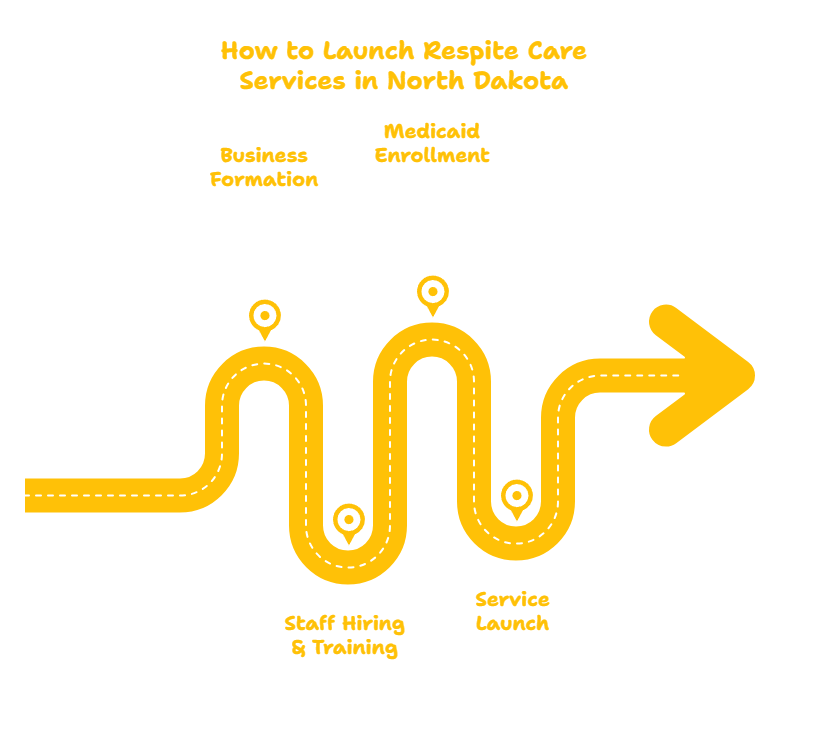
The launch process generally spans several months, beginning with a 1–2 month phase for business formation and compliance preparation. This is followed by 2–3 months for staffing and internal documentation development, 60–90 days for Medicaid enrollment and readiness reviews, and a final 30–45 day period for billing system setup.
What must be included in the provider’s policy and procedure manual?
A comprehensive manual must contain protocols for care planning, emergency respite, personal care, and safety management. It must also detail staff credentialing processes, HIPAA compliance measures, grievance procedures, infection control, and rigorous documentation standards for Medicaid billing and quality assurance.
Where can providers find information on Medicaid enrollment?
Providers should consult the North Dakota Department of Human Services (NDDHS) website and the North Dakota Medicaid Management Information System (MMIS) portal. These sites offer the official documentation, application links, and regulatory guidance required to become an authorized participant in the state’s HCBS waiver programs.
Key Takeaway
Successfully launching a respite care provider agency in North Dakota hinges on meticulous attention to regulatory detail, comprehensive policy development, and a steadfast commitment to participant safety. By aligning organizational practices with the standards set by the NDDHS and the specific requirements of the state’s HCBS waivers, agencies can effectively build the infrastructure necessary to support both caregivers and their loved ones in a compliant and sustainable manner.
WAIVER CONSULTING GROUP’S START-UP ASSISTANCE SERVICE — NORTH DAKOTA RESPITE CARE SERVICES PROVIDER: WCG supports agencies in launching Medicaid-compliant Respite Care Services in North Dakota, offering business registration, Medicaid enrollment, and licensing assistance; policy manual development for respite care and caregiver support; staff credentialing, training program templates, and compliance documentation; Medicaid billing setup and audit-prepared financial management; branding, website development, and client outreach strategies; quality assurance systems for care coordination and compliance monitoring; and collaboration with healthcare providers, family caregivers, and community organizations.
Last verified: 05/20/2024. The information provided in this article is for educational purposes only and does not constitute legal or professional advice. Always verify current state regulations and waiver requirements through the official North Dakota Department of Health and Human Services (NDDHHS) and the North Dakota Medicaid Management Information System (MMIS) portals.