RESPITE CARE SERVICES PROVIDER IN NEW YORK
By Fatumata Kaba · 2025-09-04 · 6 min read
Respite Care Services in New York offer critical, short-term relief for primary caregivers by providing professional supervision and support to individuals with disabilities, chronic health conditions, or age-related challenges. These services are authorized under various New York Medicaid Home and Community-Based Services (HCBS) waiver programs and are designed to prevent caregiver burnout while maintaining the safety and well-being of the care recipient in their home or a community-based setting.
What Are the Governing Agencies and Regulatory Requirements?
The delivery of Medicaid-funded respite care is strictly regulated to ensure high standards of safety, quality, and person-centered care. The New York State Department of Health (NYSDOH) serves as the primary administrator, overseeing Medicaid waiver funding, provider enrollment, and reimbursement protocols. By managing the financial and administrative framework, the NYSDOH ensures that service delivery aligns with federal mandates set by the Centers for Medicare & Medicaid Services (CMS).
Beyond state-level oversight, specific populations are managed by specialized departments. The Office for People With Developmental Disabilities (OPWDD) provides essential oversight for respite services tailored to individuals with developmental disabilities. Similarly, the New York State Office of Mental Health (OMH) ensures compliance for programs dedicated to individuals with behavioral or mental health needs. Providers must adhere to the unique standards established by these governing bodies to maintain their eligibility for Medicaid billing.
How Are Respite Care Services Delivered to Participants?
Respite care acts as a bridge, offering caregivers a temporary pause from their duties while ensuring the care recipient receives consistent, high-quality attention. These services can be pre-scheduled to allow for planned time away or accessed on an emergency basis to address sudden changes in a caregiver’s availability or the recipient’s health status. The scope of service is highly individualized, reflecting the unique medical and social requirements of the participant.
Approved providers must be prepared to deliver a comprehensive array of services that support the participant's daily life. This includes personal care assistance such as hygiene and grooming, medication administration, health monitoring of vital signs, and behavioral support. Furthermore, providers facilitate engagement through recreational activities and companionship, which play a vital role in reducing the social isolation often experienced by individuals requiring long-term care.
- Personal Care Support: Assistance with hygiene, grooming, and daily living activities.
- Supervision and Safety Monitoring: Ensuring a safe environment during the caregiver’s absence.
- Medication Administration: Managing prescribed medication regimens.
- Recreational Activities: Engaging individuals in activities that promote physical and mental well-being.
- Companionship: Offering social interaction to reduce isolation.
- Health Monitoring: Checking vital signs and observing overall well-being.
- Behavioral Support: Addressing emotional and behavioral needs during care.
- Transportation Assistance: Helping individuals access community activities or medical appointments.
- Crisis Intervention: Providing immediate support during emergencies or changes in health status.
- Documentation: Maintaining accurate records of services delivered and care outcomes.
What Are the Essential Prerequisites for Provider Approval?
Entering the New York Medicaid market as a respite care provider requires meticulous preparation of business, administrative, and clinical structures. Founders must first register the business entity with the New York Department of State and obtain an Employer Identification Number (EIN) from the IRS. A National Provider Identifier (NPI) Type 2 is also mandatory for organizational billing purposes. These foundational steps ensure the business is recognized as a legal entity capable of entering into state contracts.
Compliance also hinges on risk management and internal policy development. Prospective providers must secure robust general and professional liability insurance policies. Furthermore, agencies are required to develop comprehensive Policy and Procedure Manuals that address emergency response, safety protocols, HIPAA compliance, and participant rights. Agencies must also have rigorous systems in place for conducting staff background checks and health screenings to ensure that only qualified individuals provide direct care.
What Is the Step-by-Step Provider Enrollment Process?
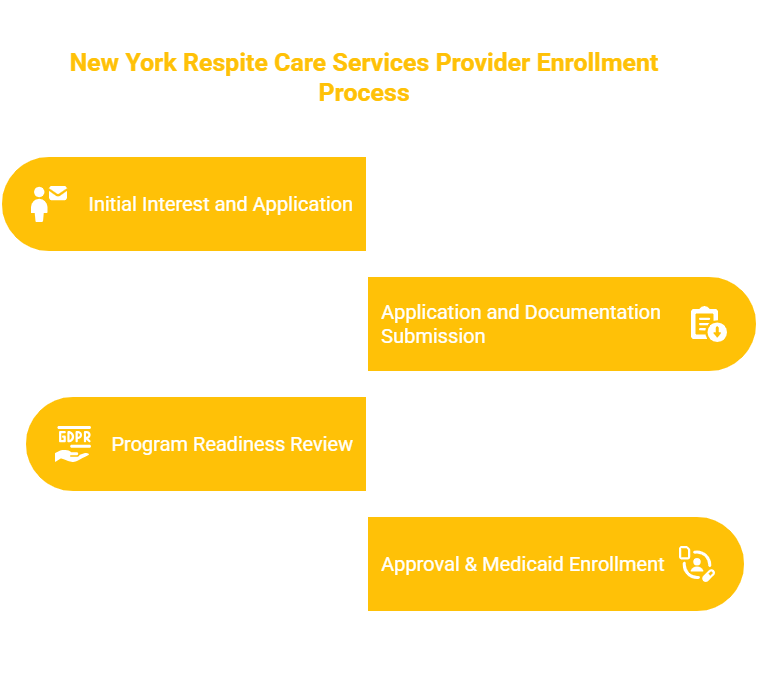
The journey to becoming an authorized provider begins with the application via the eMedNY Provider Enrollment Portal. This is the central gateway for applying for Respite Care Services under the various HCBS waivers. Applicants must submit extensive documentation, including Articles of Incorporation, proof of NPI/EIN, insurance certificates, and detailed procedural manuals that demonstrate a clear understanding of the regulatory requirements for the specific waivers they intend to serve.
Once the application is submitted, the relevant agencies—including the NYSDOH, OPWDD, or OMH—perform a Program Readiness Review. This phase involves evaluating the provider's ability to maintain safety standards, verify staff credentials, and execute care plans effectively. Successful completion of this review leads to approval, which authorizes the provider to submit billing for services using the designated Medicaid codes. This process is complex and requires careful adherence to state guidelines to avoid delays.
How Do Staffing and Training Standards Affect Compliance?
The quality of respite care is inherently tied to the qualifications and training of the staff. A Respite Care Program Director is expected to hold a Bachelor’s or Master’s degree in social work, healthcare administration, or a related field, and must possess demonstrated experience in program management. Direct care staff, such as Respite Care Aides, must hold at least a high school diploma or equivalent, while Certified Nursing Assistants (CNAs) must maintain current certifications and provide proof of appropriate training.
Ongoing professional development is a regulatory necessity. All staff members must participate in consistent training that covers HIPAA compliance, safety and crisis intervention, and the proper documentation of services. Annual competency evaluations are required to ensure that staff remain adept at identifying changes in a participant's condition and maintaining the high standards expected by Medicaid programs. By investing in staff training, agencies protect their operational integrity and ensure high-quality outcomes for the participants they serve.
Frequently Asked Questions
Which Medicaid waiver programs cover Respite Care in New York?
Respite care is available under several programs, including the OPWDD Comprehensive Waiver, the Home and Community-Based Services (HCBS) Waiver, the Children’s Waiver, the Nursing Home Transition and Diversion (NHTD) Waiver, and the Traumatic Brain Injury (TBI) Waiver.
How long does the startup process typically take?
The full timeline to launch generally ranges from several months to a year. Business formation and compliance take approximately 1–2 months, staffing and program development take 2–3 months, the Medicaid enrollment and readiness review takes 60–90 days, and final billing setup takes 30–45 days.
What documentation is essential for a Medicaid audit?
Providers must maintain comprehensive records, including staff training and background check logs, individualized care plans, detailed service logs documenting the date and nature of care provided, incident reports, and evidence of compliance with HIPAA and participant rights.
Waiver Consulting Group’s Assistance
Waiver Consulting Group assists agencies in launching Medicaid-compliant Respite Care Services in New York. Services include business registration, Medicaid enrollment assistance, policy manual development, staff credentialing, and the establishment of quality assurance systems. By aligning administrative workflows with state requirements, agencies can focus on delivering essential care to those who need it most.
Key Takeaway: Establishing a Respite Care agency in New York requires a deep commitment to administrative compliance, rigorous staff training, and constant coordination with the NYSDOH, OPWDD, and OMH to ensure that caregiver relief services are delivered according to the high standards of the Medicaid waiver programs.
Last verified August 2024. This content is for informational purposes only and does not constitute legal or professional advice. Always consult with the relevant New York state agencies or a qualified consultant to ensure compliance with current regulations and statutes.