RESPITE CARE SERVICES PROVIDER IN NEW HAMPSHIRE
By Fatumata Kaba · 2025-07-27 · 5 min read
Respite Care Services in New Hampshire offer essential temporary relief to family caregivers, allowing them to take necessary breaks while ensuring that individuals with disabilities or age-related conditions continue to receive high-quality, professional support. Authorized under various New Hampshire Medicaid Home and Community-Based Services (HCBS) waivers, these services are a cornerstone of long-term care, promoting both caregiver health and the sustained well-being of the participant in their home or community environment.
Understanding the Governing Landscape for New Hampshire Respite Providers
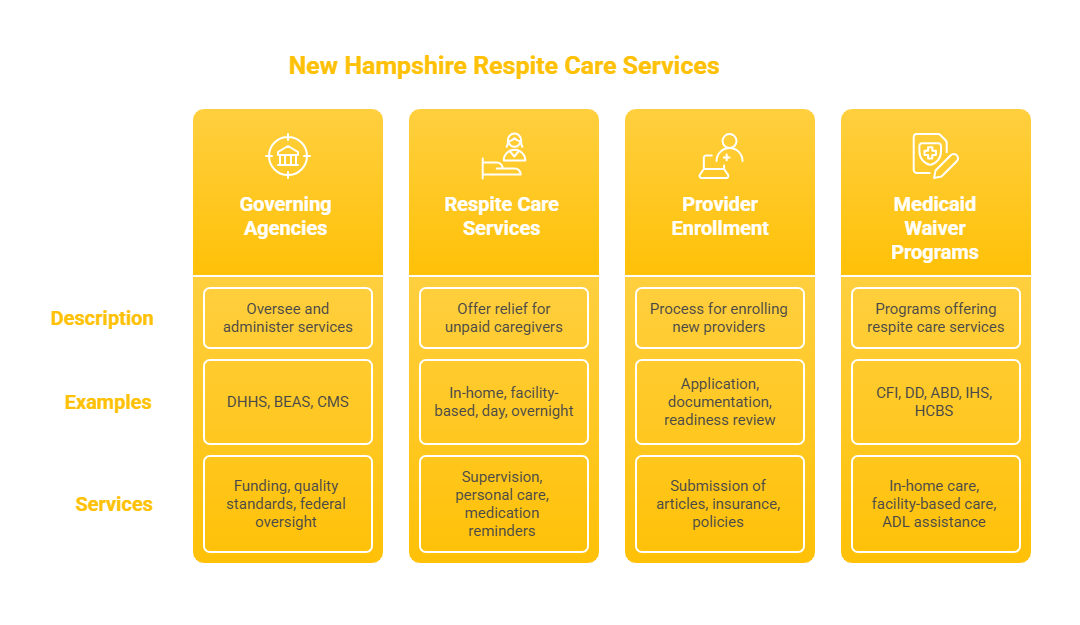
Navigating the regulatory environment in New Hampshire requires a clear understanding of the hierarchy of oversight. The primary governing entity is the New Hampshire Department of Health and Human Services (DHHS), which serves as the central authority for managing Medicaid waiver funding, overseeing the provider enrollment process, and directing service reimbursement protocols. Providers must align their operational objectives with DHHS standards to maintain eligibility for state and federal funding.
Direct oversight and quality assurance are managed by the Bureau of Elderly and Adult Services (BEAS). This agency ensures that the delivery of Respite Care Services adheres to strict HCBS quality standards, ensuring participants remain safe and supported according to their individualized care plans. Furthermore, the Centers for Medicare & Medicaid Services (CMS) provide federal guidance, ensuring that New Hampshire’s waiver programs uphold the federal mandates of person-centered planning, participant protection, and service integrity.
Defining the Scope and Delivery of Respite Care Services
Respite Care Services are designed to provide planned or emergency support, stepping in when an unpaid caregiver needs time to rest, handle personal business, or recover from the physical and emotional demands of caregiving. These services are highly adaptable, with delivery methods tailored to the unique needs of the participant and the capacity of the provider agency. By integrating into the participant’s Individualized Service Plan (ISP), respite care ensures continuity of care.
Approved providers may offer a range of support modalities, including:
- In-Home Respite Services: Care provided directly within the participant’s residence to minimize disruption to their daily routine.
- Facility-Based Respite Care: Temporary stays in licensed community settings designed for supervision and support.
- Day, Overnight, and Weekend Respite: Flexible scheduling options that accommodate the specific timing needs of family caregivers.
- Personal Care and Support: Assistance with Activities of Daily Living (ADLs), including bathing, grooming, mobility, and feeding, as well as non-skilled medication reminders and social engagement activities.
Navigating Licensing and Provider Approval Requirements
Before an agency can begin billing for Respite Care Services, it must establish a formal business and compliance foundation. The process begins with registering the business entity with the New Hampshire Secretary of State and obtaining the necessary federal identifiers, including an Employer Identification Number (EIN) and a Type 2 National Provider Identifier (NPI). These administrative steps are mandatory precursors to the state-level enrollment process.
Beyond basic business registration, agencies must secure the appropriate facility licensure from DHHS if they intend to provide facility-based services. Operational preparedness is equally critical; agencies are required to maintain comprehensive general and professional liability insurance to mitigate risk. Furthermore, the agency must develop a robust suite of internal policies governing participant intake, incident reporting, emergency preparedness, and the ongoing supervision of direct care staff to ensure compliance with state and federal mandates.
Executing the New Hampshire Medicaid Enrollment Process
The enrollment process is a structured sequence that ensures only qualified agencies participate in the Medicaid waiver program. Initially, the applicant must submit a comprehensive provider enrollment application through the New Hampshire Medicaid Provider Enrollment Portal. This application must specify the intended services and the HCBS waivers under which the agency will operate. Accompanying documentation is extensive and must clearly demonstrate the agency's operational readiness.
Once the initial application is submitted, DHHS and BEAS conduct a program readiness review. This review evaluates the agency’s capacity to deliver safe and reliable care, focusing on staff credentialing, established care and supervision protocols, and the efficacy of internal documentation systems. After the review process is finalized and all documentation is verified, the provider is officially enrolled and granted the authority to bill Medicaid using the specific billing codes assigned to their approved Respite Care services.
Establishing Essential Documentation and Staffing Standards
An audit-ready agency relies on meticulous documentation. This includes maintaining copies of business licenses, proof of insurance, and a comprehensive Policy & Procedure Manual. This manual serves as the operational blueprint for the agency, detailing procedures for participant rights, HIPAA-compliant confidentiality, grievance handling, and critical incident reporting. Agencies must also keep rigorous records of staff credentials, including background screenings, CPR/First Aid certifications, and ongoing competency evaluations.
Staffing requirements are strictly defined to ensure a baseline of care quality across all providers. The Respite Services Program Director typically requires a bachelor’s degree in a human services or healthcare field, paired with relevant supervisory experience. Direct care workers must hold at least a high school diploma or GED and complete mandatory training, which covers:
- Safety and emergency preparedness protocols.
- HIPAA compliance and the protection of participant rights.
- Abuse, neglect, and exploitation awareness and prevention.
- Infection control and health monitoring techniques.
- Ongoing annual competency assessments and continuing education requirements.
Frequently Asked Questions
What is the typical timeline for launching a Respite Care agency?
The entire launch process typically spans several months. Business formation and initial compliance preparation generally take 1–2 months, followed by 2–3 months for staff hiring and credentialing. The formal Medicaid provider enrollment and readiness review phase requires 60–90 days, while the final billing setup and service launch usually take 30–45 days.
Are respite services available under all New Hampshire Medicaid waivers?
Respite Care is specifically authorized under several key waivers, including the Choices for Independence (CFI) Waiver, the Developmental Disabilities (DD) Waiver, the Acquired Brain Disorder (ABD) Waiver, the In-Home Support (IHS) Waiver for Children, and the general Home and Community-Based Services (HCBS) Waiver.
What is the role of the Respite Services Program Director?
The Program Director is responsible for overseeing the clinical and administrative operations of the agency. This includes ensuring all staff members meet training requirements, managing participant intake and care planning, and ensuring that all agency policies comply with DHHS and BEAS regulations.
Key Takeaways for Prospective Providers
Launching a Respite Care Services agency in New Hampshire is a comprehensive process that centers on regulatory compliance, thorough documentation, and a commitment to staff training. By aligning business operations with the guidelines established by the DHHS, BEAS, and CMS, providers can ensure they remain eligible for Medicaid reimbursement while offering the high-quality, reliable relief that family caregivers require. Success in this field is achieved through careful attention to the operational timelines, stringent adherence to safety protocols, and a proactive approach to audit readiness.
Last verified: September 2024. This content is provided for informational purposes only and does not constitute legal or professional advice. Always consult directly with the New Hampshire Department of Health and Human Services (DHHS) or the Bureau of Elderly and Adult Services (BEAS) for the most current regulations, forms, and program requirements.