RESPITE CARE SERVICES PROVIDER IN NEVADA
By Fatumata Kaba · 2025-09-04 · 6 min read
Respite Care Services in Nevada provide essential temporary relief to the primary, unpaid caregivers of individuals with disabilities, chronic illnesses, or age-related conditions, ensuring continuity of care while supporting caregiver well-being. These services, authorized under Nevada Medicaid Home and Community-Based Services (HCBS) waiver programs, allow caregivers to rest, manage personal affairs, and mitigate the risks of caregiver burnout by providing professional supervision and support for the participant.
For entrepreneurs and healthcare organizations looking to enter this sector, establishing a Respite Care agency requires rigorous adherence to state and federal standards administered by the Nevada Department of Health and Human Services (DHHS). Success depends on navigating complex enrollment protocols, maintaining robust policy documentation, and ensuring that all staff meet the stringent competency requirements necessary for delivering high-quality, person-centered support.
What Are the Governing Agencies and Regulatory Frameworks?
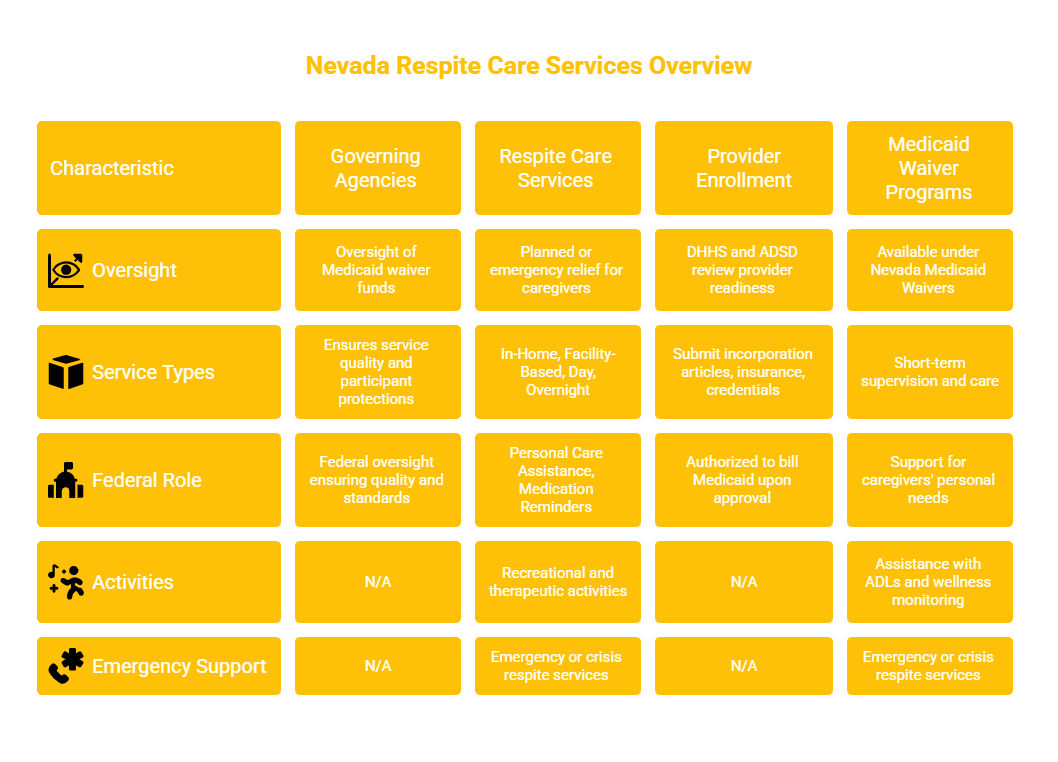
The delivery of Respite Care in Nevada is overseen by a trifecta of regulatory bodies, each ensuring that Medicaid funds are utilized effectively and that the health, safety, and welfare of participants are prioritized. Understanding the hierarchy of these agencies is the first step in establishing a compliant provider agency.
The Nevada Department of Health and Human Services (DHHS) serves as the primary administrative authority for Medicaid waiver funding. They manage the critical processes of provider enrollment, service authorization, and reimbursement. Working in tandem, the Aging and Disability Services Division (ADSD) is responsible for the ongoing oversight of service quality, participant protections, and compliance with the specific mandates outlined in the HCBS waiver programs.
At the federal level, the Centers for Medicare & Medicaid Services (CMS) provides the overarching regulatory framework. CMS requires that all Medicaid-funded Respite Care services strictly adhere to HCBS quality standards, person-centered planning methodologies, and rigorous participant protection protocols. Compliance with these federal standards is a prerequisite for receiving state and federal reimbursement.
How Do Respite Care Services Function Under Nevada HCBS Waivers?
Respite Care is defined as planned or emergency relief intended to support unpaid caregivers by providing temporary assistance to the participant. Providers must be prepared to deliver services that align with the participant’s Individualized Service Plan (ISP), ensuring that every intervention is tailored to the unique health and safety requirements of the individual.
Providers generally offer a spectrum of care modalities, ranging from in-home visits to specialized facility-based arrangements. This flexibility is essential for meeting the diverse needs of the Medicaid population, ensuring that participants remain in the least restrictive environment while their primary caregivers are unavailable.
- In-Home Respite Services: Care provided directly within the participant’s residence.
- Facility-Based Respite Care: Temporary care provided in licensed community-based residential settings.
- Day Respite: Supervision and structured support provided during daytime hours.
- Overnight or Weekend Respite: Extended care cycles designed to accommodate caregiver breaks.
- Personal Care Assistance: Direct support with Activities of Daily Living (ADLs) such as bathing, grooming, mobility, feeding, and toileting.
- Health Monitoring: Providing medication reminders and basic health observations (non-skilled tasks).
- Recreational Activities: Facilitating social, leisure, or therapeutic engagement for the participant.
What Are the Licensing and Provider Enrollment Prerequisites?
Launching a Respite Care agency is a process of systematic administrative preparation. Before applying for Medicaid enrollment, an agency must establish a formal business entity, register with the Nevada Secretary of State, and secure an Employer Identification Number (EIN) and an NPI (Type 2). These foundational steps provide the legal and financial structure required for all subsequent applications.
Once the business is legally established, the provider must demonstrate operational readiness. This involves obtaining necessary facility licensure—if the agency intends to provide facility-based services—and securing comprehensive general and professional liability insurance. Furthermore, the agency must develop an extensive Policy and Procedure Manual. This document must clearly articulate protocols for participant intake, caregiver communication, emergency preparedness, incident reporting, and the handling of protected health information (HIPAA compliance).
What Is the Required Documentation for Medicaid Enrollment?
The Nevada Medicaid Provider Enrollment Portal is the central gateway for credentialing. Applicants should be prepared to upload comprehensive documentation that proves their agency is capable of managing the specialized needs of HCBS waiver participants. The readiness review process conducted by DHHS and ADSD is exhaustive, focusing on the legitimacy of the business and the adequacy of the proposed internal controls.
Providers must maintain organized, audit-ready records that verify their compliance with state law. Beyond standard business registrations, the application must reflect a deep understanding of the specific requirements associated with the Frail Elderly (FE) Waiver, Intellectual and Developmental Disabilities (IDD) Waiver, Physical Disabilities Waiver, and Traumatic Brain Injury (TBI) Waiver.
- Articles of Incorporation or Nevada Business License.
- Verification of IRS EIN and NPI.
- Facility License (if applicable).
- Proof of current general and professional liability insurance.
- Comprehensive Policy & Procedure Manual (intake, safety, emergency, HIPAA, grievance).
- Documentation of staff credentialing and background check protocols.
- Medicaid billing and audit-readiness documentation systems.
How Must Agencies Manage Staffing and Training Requirements?
The quality of Respite Care is directly proportional to the competency of the direct care workforce. Agencies are responsible for recruiting a qualified Program Director or Supervisor, typically requiring a bachelor’s degree in a human services or healthcare-related field and demonstrated experience in direct care management. This leadership role is the lynchpin for ensuring that all care staff perform their duties in accordance with the ISP and regulatory expectations.
Direct Support Professionals (DSPs) must meet specific baseline requirements, including a high school diploma or GED, valid CPR/First Aid certification, and successful completion of a comprehensive background screening. The agency is mandated to provide ongoing training for these staff members to ensure they remain capable of addressing the complex needs of the participants they support.
- Participant Safety: Emergency preparedness and incident management training.
- Compliance: Thorough education on HIPAA, privacy, and participant rights.
- Protection: Mandated training on the prevention of abuse, neglect, and exploitation.
- Wellness: Infection control, hygiene standards, and ongoing wellness monitoring techniques.
Frequently Asked Questions
How long does the provider enrollment process typically take?
The timeline for enrollment can vary, but generally, the entire process from initial business formation to becoming a billable Medicaid provider takes approximately 6 to 8 months. This includes 1–2 months for business formation, 2–3 months for internal program development, and 60–90 days for the Medicaid Provider Enrollment and Readiness Review phases.
What types of Nevada Medicaid waivers cover Respite Care?
Respite Care is covered under several HCBS waiver programs, including the Frail Elderly (FE) Waiver, Intellectual and Developmental Disabilities (IDD) Waiver, Physical Disabilities Waiver, and the Traumatic Brain Injury (TBI) Waiver. Each waiver has specific eligibility criteria for participants and defined service caps for providers.
Are providers required to maintain a physical facility?
While many providers operate as in-home service agencies without a physical facility, those intending to provide facility-based respite care must obtain specific licensure through DHHS or ADSD. All providers, regardless of service setting, must have a dedicated administrative space and robust documentation systems to maintain compliance and audit readiness.
Key Takeaways for Provider Success
Establishing a Respite Care agency in Nevada is a commitment to both administrative excellence and the provision of high-quality, person-centered care. Providers must focus on developing a solid, audit-ready infrastructure, maintaining strict adherence to Medicaid documentation standards, and fostering a culture of safety through rigorous staff training. By aligning business operations with the guidelines provided by DHHS, ADSD, and CMS, agencies can effectively support Nevada’s caregivers while ensuring the long-term sustainability of their operations.
Waiver Consulting Group (WCG) supports agencies in launching Medicaid-compliant Respite Care Services in Nevada. Our assistance includes business registration, Medicaid enrollment, facility licensure support, development of comprehensive policy and procedure manuals, staff credentialing templates, and the setup of Medicaid billing systems and quality assurance protocols. For more information, visit our online portal to explore resources related to state requirements and program management.
Last verified: 2024. This information is intended for educational purposes and does not constitute legal or professional consulting advice. Regulatory requirements are subject to change; please consult the Nevada DHHS and ADSD official websites for the most current rules and statutes.