RESPITE CARE SERVICES PROVIDER IN MONTANA
By Fatumata Kaba · 2025-08-06 · 6 min read
Respite Care Services in Montana serve as a vital support mechanism, providing temporary, short-term relief to unpaid primary caregivers while ensuring individuals with disabilities, chronic conditions, or age-related needs receive safe and compassionate care. By leveraging Montana’s Home and Community-Based Services (HCBS) Waivers, provider agencies deliver these essential services in-home, within the community, or at licensed out-of-home facilities to maintain both the health of the caregiver and the continuity of support for the individual.
Understanding the Role of Governing Agencies
Navigating the regulatory landscape for respite care in Montana requires an understanding of the interconnected roles held by state and federal entities. The primary oversight body is the Montana Department of Public Health and Human Services (DPHHS), which manages the state's Medicaid HCBS Waiver programs and provides the funding structures necessary for respite care delivery. Compliance with state-specific administrative rules and program-specific service definitions is essential for maintaining eligibility as a Medicaid provider.
In addition to DPHHS, the Montana Department of Labor and Industry (DLI) plays a critical role in the oversight of health and caregiving business licensing. Prospective providers must ensure their business operations align with DLI requirements to maintain operational legitimacy. Finally, the Centers for Medicare & Medicaid Services (CMS) provides the overarching federal framework, ensuring that Montana’s waiver programs remain compliant with federal mandates and that state funding is utilized appropriately to support the target populations.
- Montana Department of Public Health and Human Services (DPHHS): Administers Medicaid and HCBS Waiver programs, including funding for respite care services.
- Montana Department of Labor and Industry (DLI): Oversees licensing and compliance for respite care providers.
- Centers for Medicare & Medicaid Services (CMS): Provides federal oversight and ensures waiver compliance.
Service Delivery and Scope of Care
Respite care is designed to offer a temporary reprieve for the primary caregiver, whether that break is planned or necessitated by an emergency. The scope of service for each participant is strictly defined by the Individual Service Plan (ISP) or the Person-Centered Plan (PCP). These documents outline exactly what level of supervision and support is required, ensuring that the respite provided is personalized to the individual's unique needs.
Providers are responsible for a range of activities, which may include in-home or out-of-home care, companionship, and assistance with personal care. A core requirement of this service is the meticulous documentation of care sessions. Providers must record the dates, specific hours of service, and the general well-being of the individual throughout the shift. This documentation not only serves as evidence for billing purposes but also provides essential updates to the primary caregiver and service coordinators.
The Provider Enrollment and Licensing Roadmap
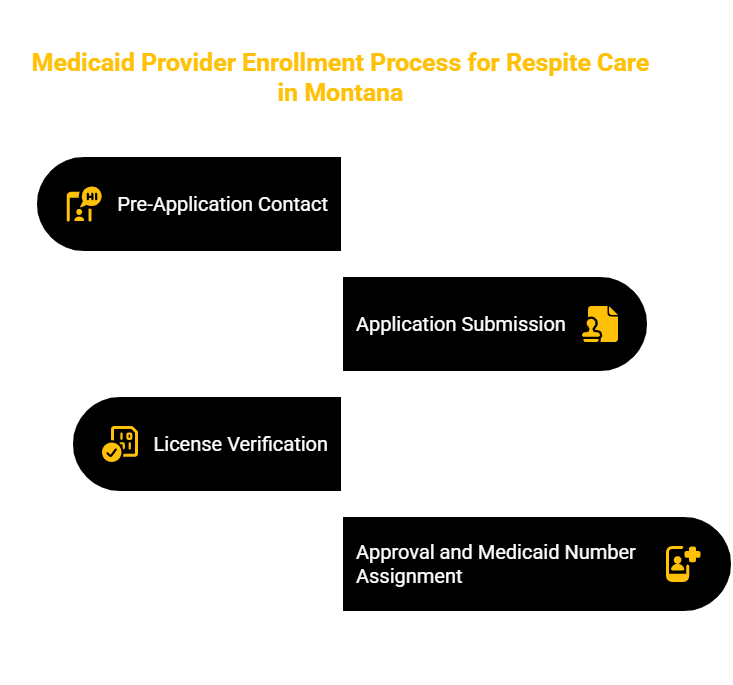
Becoming an approved Medicaid respite provider is a structured, multi-step process that requires formal business establishment before clinical or service-oriented applications can be approved. Founders must begin by registering their business with the Montana Secretary of State and obtaining a federal Employer Identification Number (EIN) from the IRS, as well as a Type 2 National Provider Identifier (NPI) to distinguish the agency as a healthcare organization.
Once the business is legally formed, the operator must obtain a Respite Care License through the Montana Department of Labor and Industry and enroll as a Medicaid provider with DPHHS. This process involves submitting proof of liability insurance and detailed service descriptions. Following a successful review of these documents and verification of licensure, the agency will be assigned a Medicaid provider number, which serves as the authorization to begin billing for respite services delivered to waiver participants.
- Register your business with the Montana Secretary of State.
- Obtain EIN from the IRS and NPI (Type 2).
- Obtain a Respite Care License from the Montana Department of Labor and Industry.
- Enroll as a Medicaid provider with the Montana Department of Public Health and Human Services.
- Maintain liability insurance and documentation of staff qualifications.
Essential Documentation and Compliance Protocols
The administrative burden of operating a respite agency is centered on maintaining comprehensive internal records. A robust policy and procedure manual is the foundation of a compliant agency. This manual must detail every aspect of daily operations, including client intake procedures, caregiver communication protocols, and how the agency handles emergencies. If the agency does not have clinical licensure to administer medication, procedures must clearly define how staff assist with medication reminders without violating scope-of-practice regulations.
Compliance also hinges on the ability to demonstrate that the agency respects client rights and privacy. Every agency must have established protocols for handling grievances and protecting confidential health information. Furthermore, staff supervision logs and training records must be maintained in an audit-ready format. This ensures that if a state or federal agency reviews the provider's operations, the provider can quickly produce evidence of regulatory adherence.
Staffing, Training, and Human Capital Management
The quality of a respite care agency is defined by its staff. The Program Manager or Respite Care Supervisor is responsible for overseeing the clinical and administrative safety of the program, and should ideally possess a background in social services or human development. For the direct support workers providing the hands-on care, requirements typically include a high school diploma or equivalent, as well as mandatory background checks and fingerprinting to ensure the safety of vulnerable populations.
Beyond background checks, training is a continuous requirement. Staff must receive training that emphasizes client safety, abuse prevention, and emergency response. Furthermore, because staff members serve as the eyes and ears for families and the primary caregiver, they must be trained in effective communication and cultural sensitivity. Annual refresher courses on ethics, privacy, and client rights are vital to keeping the staff focused on the highest standards of professional care.
WAIVER CONSULTING GROUP'S START-UP ASSISTANCE SERVICE — MONTANA RESPITE CARE SERVICES PROVIDER
We support agencies and entrepreneurs in launching compliant Respite Care Services across Montana under the HCBS Waiver models. Our scope of work includes business registration, Medicaid provider enrollment, policy manual development, staff credentialing, and audit preparation tools to ensure a smooth transition from start-up to service delivery.
Frequently Asked Questions
What are the primary waivers that cover respite care in Montana?
Respite care services are primarily delivered through the Big Sky Waiver (BSW), Community First Choice/Personal Assistance Services (CFC/PAS), and certain Medicaid Home Health Services. Each of these programs has specific eligibility criteria and service authorization processes defined by the DPHHS.
How long does the provider enrollment process typically take?
While the timeline can vary depending on the completeness of the submission, the Medicaid provider enrollment process generally takes between 60 and 90 days. Proper preparation of documentation and clear communication with the DPHHS can help streamline this timeline.
Is it necessary to have a brick-and-mortar facility to provide respite?
No, respite care can be provided as in-home respite, which occurs in the individual's own home, or as out-of-home respite in a licensed facility. The choice depends on the agency’s business model and the needs specified in the individual's Person-Centered Plan.
Key Takeaway
Launching a respite care agency in Montana requires a rigorous commitment to administrative compliance, licensing adherence, and personnel management. By aligning business operations with the specific requirements of the DPHHS and the CMS waiver frameworks, agencies can successfully deliver the critical support that caregivers and individuals with disabilities depend on to maintain their quality of life.
Last verified: October 2023. This content is provided for informational purposes only and does not constitute legal or professional advice. Always consult with the Montana Department of Public Health and Human Services and relevant legal counsel for the most current regulations and specific compliance requirements regarding Medicaid HCBS waiver programs.