RESPITE CARE SERVICES PROVIDER IN MICHIGAN
By Fatumata Kaba · 2025-07-27 · 5 min read
PROVIDING TEMPORARY RELIEF FOR FAMILY CAREGIVERS WHILE ENSURING SAFE, COMPASSIONATE SUPPORT FOR INDIVIDUALS WITH DISABILITIES OR COMPLEX NEEDS
Respite care services in Michigan provide essential, short-term relief to unpaid family caregivers by offering professional, substitute support for individuals with disabilities, chronic health conditions, or age-related limitations. By authorized participation in Home and Community-Based Services (HCBS) waivers, such as the MI Choice Waiver Program, providers deliver care in residential homes, licensed facilities, or community settings to ensure continuity of care while the primary caregiver takes a necessary break.
What Are the Governing Agencies and Oversight Roles for Michigan Respite Care?
The delivery of respite services in Michigan is subject to a multi-tiered regulatory framework. The Michigan Department of Health and Human Services (MDHHS) acts as the primary state authority, responsible for the regulation of HCBS waivers and the ongoing monitoring of provider quality and licensure compliance. Their role is central to maintaining the integrity of the Medicaid system and ensuring that participants receive high-quality care that meets state standards.
Federal oversight is provided by the Centers for Medicare & Medicaid Services (CMS), which governs the 1915(c) waiver-funded programs. At the regional level, Medicaid Health Plans (MHPs) manage the coordination and authorization of respite services within the managed care environment. Furthermore, local Area Agencies on Aging (AAA) serve as critical facilitators for senior-focused respite care, particularly for participants enrolled in the MI Choice Waiver program.
What Does a Respite Care Service Overview Include for Providers?
Respite care functions by offering both planned and emergency breaks to family caregivers, ensuring the individual’s daily needs are met by trained professionals. For providers, this necessitates a service model that is highly adaptable and strictly aligned with the participant’s individualized Plan of Care (POC). Service delivery can range from hourly companionship to more intensive assistance, depending on the specific waiver requirements and the participant's health status.
Approved respite services typically encompass a variety of delivery models:
- In-home respite: Professional caregiving services performed within the participant’s own home.
- Out-of-home respite: Short-term care provided in licensed residential settings or adult day facilities.
- Planned or emergency coverage: Support provided during scheduled absences, medical appointments, travel, or unexpected caregiver illness.
- Overnight or weekend respite: Extended support sessions, provided as specifically authorized by the case manager.
- Behavioral support and ADL/IADL assistance: Ongoing help with Activities of Daily Living (ADL) and Instrumental Activities of Daily Living (IADL) during the coverage period.
How Do Providers Approach Licensing and Enrollment Requirements?
Becoming an approved Medicaid respite provider requires a rigorous sequence of administrative and legal steps. Before delivering services, providers must ensure their business entity is officially recognized and fully registered with the Michigan Department of Licensing and Regulatory Affairs (LARA). This foundation must be supplemented by obtaining a federal IRS EIN and a Type 2 NPI, which are necessary for all Medicaid billing operations.
Once the business is legally established, providers must navigate the provider enrollment process via the CHAMPS (Community Health Automated Medicaid Processing System) portal. Facility-based providers face additional scrutiny, as they must secure specific state licenses through LARA that prove their facility meets all safety, ADA, and programmatic standards. Maintaining comprehensive general liability and workers' compensation insurance is also a non-negotiable requirement for all prospective and active providers.
What Are the Essential Documentation and Policy Requirements?
Audit readiness is the hallmark of a successful Medicaid respite agency. Providers must maintain a robust Policy & Procedure Manual that serves as the blueprint for daily operations. This manual must explicitly cover client intake procedures, scheduling, medication administration protocols—if applicable—and clear, actionable emergency response procedures. Documentation must remain HIPAA-compliant at all times to protect participant privacy.
Essential components of your agency’s documentation should include:
- Articles of Incorporation or formal sole proprietor registration.
- Verification of IRS EIN and NPI numbers.
- Proof of required insurance coverage levels.
- Comprehensive staff training logs for abuse and neglect prevention.
- Standardized templates for daily activity logs and shift documentation.
- Participant rights, consent forms, and incident response checklists.
- Audit-ready billing logs that align with authorized service hours.
How Should Agencies Manage Staffing and Training Requirements?
The quality of your respite agency depends directly on the competency of your Direct Support Professionals (DSPs). A qualified respite worker must hold at least a high school diploma or equivalent, possess relevant experience in disability or chronic care support, and maintain up-to-date CPR and First Aid certifications. Before assignment to a participant, every staff member must undergo thorough background check clearances to ensure the safety and security of the vulnerable individuals they serve.
Beyond technical care skills, all staff members must participate in a mandatory, ongoing training curriculum. This curriculum must cover the fundamentals of person-centered care, HIPAA confidentiality, and abuse and neglect prevention as mandatory reporters. Administrative staff, including program supervisors, are responsible for verifying that these training requirements are met and documented, ensuring that every shift delivered by the agency maintains the required standards of quality and regulatory compliance.
Frequently Asked Questions
Which Medicaid waiver programs cover respite care in Michigan?
Respite care is reimbursable under several programs, including the MI Choice Waiver Program for seniors and adults with disabilities, the Habilitation Supports Waiver (HSW) for developmental disabilities, the Children’s Waiver Program (CWP), the Serious Emotional Disturbance (SED) Waiver, and various Community Mental Health (CMH) programs.
What is the typical timeline for launching a respite agency?
The launch process generally spans 3 to 6 months. Business registration and initial hiring typically take 1–2 months, followed by 60–90 days for Medicaid enrollment and internal policy development. If a physical facility is involved, additional time should be allocated for LARA licensure and site inspections.
How does a provider receive referrals for respite services?
Providers generally receive referrals through ongoing coordination with waiver support coordinators, local Area Agencies on Aging (AAAs), and hospital discharge planners. Maintaining active, professional relationships with these entities is essential for establishing a consistent referral stream.
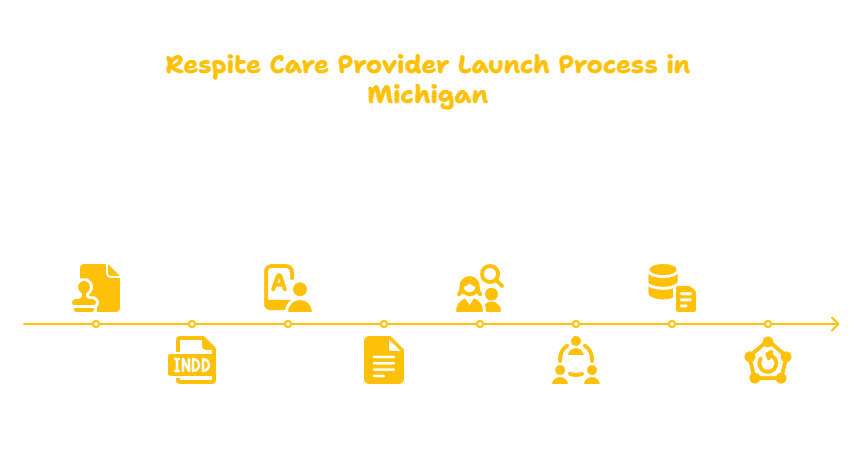
WAIVER CONSULTING GROUP’S START-UP ASSISTANCE SERVICE — MICHIGAN RESPITE CARE PROVIDER
WCG supports caregiver agencies, community organizations, and independent providers in launching licensed, Medicaid-approved Respite Care programs across Michigan. Our scope of work includes business registration, Medicaid enrollment, LARA facility licensure, the creation of comprehensive Policy & Procedure Manuals, and the development of audit-ready billing systems.
Key Takeaway: Successful participation in Michigan’s respite care waiver programs requires strict adherence to MDHHS regulations, rigorous staff training, and proactive coordination with regional support coordinators. By focusing on administrative precision and regulatory compliance, agencies can provide the stability needed to support family caregivers while ensuring participants receive reliable, high-quality care.
Last verified: 2024. This information is intended for educational purposes for potential providers and does not constitute legal or financial advice. Always consult the official MDHHS provider manual and local waiver guidelines for the most current regulatory requirements.