RESPITE CARE SERVICES PROVIDER IN MASSACHUSETTS
By Fatumata Kaba · 2025-08-08 · 5 min read
Respite care services in Massachusetts are essential support mechanisms designed to provide short-term relief to primary caregivers of individuals living with physical, cognitive, or behavioral health challenges. By offering temporary care in the home, community, or licensed facilities, these services ensure that individuals receive consistent, high-quality support while allowing their primary caregivers the necessary time to recuperate and maintain their own well-being.
What Are the Governing Agencies and Regulatory Frameworks?
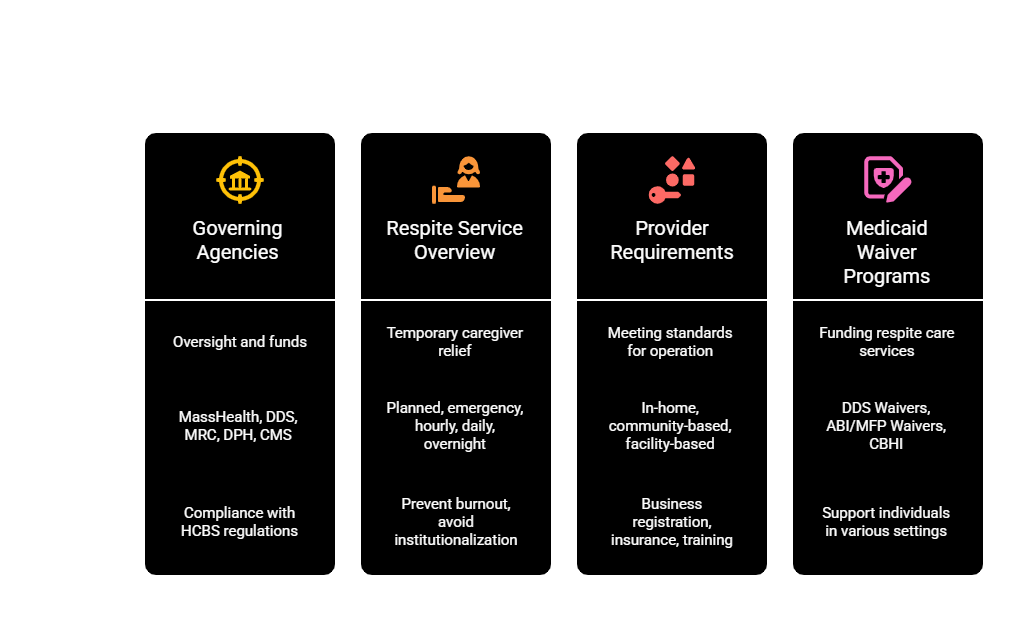
The delivery of respite care in Massachusetts is governed by a multi-layered regulatory structure to ensure that all Medicaid-funded services adhere to both state and federal standards. MassHealth, as the state’s Medicaid agency, is the primary entity responsible for funding these services through various waiver programs and ensuring total compliance with Home and Community-Based Services (HCBS) regulations. Under federal oversight, the Centers for Medicare & Medicaid Services (CMS) establishes the overarching standards that states must meet to maintain federal financial participation for waiver-funded programs.
At the state level, oversight is specialized based on the population served. The Department of Developmental Services (DDS) manages respite for individuals with intellectual and developmental disabilities (IDD), while the Massachusetts Rehabilitation Commission (MRC) oversees respite supports for individuals with brain injuries through the ABI and MFP waivers. When respite care is provided in a facility-based or medical setting, the Department of Public Health (DPH) steps in to provide the necessary licensing and safety oversight, ensuring that the physical environment meets established safety codes.
How Are Respite Care Services Structured and Delivered?
Respite care is designed to be highly flexible, categorized primarily as intermittent, time-limited support rather than permanent residential placement. Services can be planned in advance to accommodate a caregiver’s scheduled absence, or they can be accessed on an emergency basis to address unforeseen family crises. These supports can be delivered in the individual's own home, in community-based settings, or within alternative licensed sites depending on the participant's specific needs and the authorization granted by the waiver program.
The fundamental goal of these services is to support family stability and long-term caregiving outcomes. By preventing caregiver burnout, providers help participants avoid unnecessary institutionalization and stay safely within their own communities. Delivery models are tailored to the individual’s requirements, ranging from simple companionship to skilled nursing care, and are performed by qualified professionals including direct care staff, certified aides, and licensed nurses.
What Steps Are Required to Become a Qualified Provider?
Establishing a respite care agency requires a rigorous commitment to administrative and clinical compliance. Business founders must first register their entity as an LLC or nonprofit, secure an Employer Identification Number (EIN), and obtain a Type 2 NPI. The next critical step is enrolling as a MassHealth waiver provider through the ePREP portal. If the provider intends to serve individuals within specific DDS or MRC populations, additional program-specific applications must be completed to satisfy the requirements of those respective departments.
Beyond basic enrollment, agencies must maintain comprehensive internal infrastructure. This includes keeping robust liability insurance, implementing rigorous background check policies, and establishing detailed staff training protocols. For those moving into facility-based care, the requirements expand to include licensure from the DPH, adherence to specific group residence standards, and the creation of detailed fire safety and emergency preparedness plans that are verified during routine inspections.
What Documentation and Staffing Standards Must Be Met?
Documentation is the backbone of any compliant Medicaid provider agency. Founders must compile a professional policy and procedure manual that covers the full lifecycle of care, including participant intake forms, caregiver consent protocols, and detailed incident reporting systems. These manuals must also detail HIPAA compliance, data protection, and explicit procedures for medication administration and crisis response. The ability to produce these documents during an audit is essential for maintaining provider status.
- Staffing Requirements: All staff, including Respite Workers and Direct Support Professionals (DSPs), must possess relevant experience with the target population, current CPR/First Aid certification, and a cleared Criminal Offender Record Information (CORI) check.
- Clinical Supervision: A Program Supervisor or Registered Nurse must oversee care plans, coordinate backup support, and ensure that staff performance meets the agency's quality standards.
- Mandatory Training: Staff must be trained in person-centered care, abuse and neglect reporting (mandated reporting), infection control, and emergency crisis procedures.
Frequently Asked Questions
Can respite care be provided in the participant's home?
Yes, in-home respite is a core service component supported by most Massachusetts waiver programs, including those managed by DDS, MRC, and those categorized under AFC or CFC funding. It allows the individual to remain in a familiar environment while receiving necessary support.
What is the difference between DDS and MRC waivers?
DDS waivers are specifically designed for individuals with intellectual and developmental disabilities, offering various tiers of support such as the Community Living and Intensive Supports Waivers. MRC waivers, such as the ABI or MFP, are targeted toward individuals recovering from brain injuries or those transitioning out of long-term institutional care.
How does an agency ensure it is ready for enrollment?
Readiness involves a logical progression from business formation and the development of a comprehensive policy manual to the submission of enrollment applications via ePREP. Agencies should verify that all staff training packets, emergency contact logs, and incident report templates are finalized before seeking referrals from state agencies.
Waiver Consulting Group: Operational Support for New Providers
Launching a respite care program requires navigating complex regulatory requirements and administrative hurdles. Support is available for agencies aiming to design high-quality, family-centered programs that comply with MassHealth and departmental mandates. Scope of work often includes assistance with business registration, Medicaid waiver enrollment, policy manual creation, and the development of effective billing and scheduling tools. Agencies focused on operational success utilize these resources to ensure that every participant receives compassionate care while the provider maintains consistent program integrity.
Key Takeaway: Success in the Massachusetts respite care market depends on the intersection of strict regulatory compliance, staff competency, and efficient administrative documentation. By adhering to the standards set by MassHealth, DDS, and MRC, providers create a sustainable framework that empowers caregivers and enhances the quality of life for individuals with disabilities.
Last verified: October 2023. This information is for educational purposes only and does not constitute legal or professional advice. Always verify current state requirements through official state agency portals before initiating business operations.