RESPITE CARE SERVICES PROVIDER IN KENTUCKY
By Fatumata Kaba · 2025-07-25 · 6 min read
Respite Care Services in Kentucky provide essential temporary relief for family caregivers, ensuring that participants receive consistent, high-quality care while their primary support system takes time to rest or manage emergencies. By offering short-term, substitute support, these services play a critical role in preventing caregiver burnout and maintaining the stability of the participant’s home environment. Providers delivering these services operate under the oversight of various state and federal agencies to ensure compliance with Medicaid Home and Community-Based Services (HCBS) waiver regulations.
How Do Governing Agencies Regulate Respite Care in Kentucky?
The delivery of respite care is a regulated endeavor requiring coordination between state agencies and federal guidelines. The Kentucky Cabinet for Health and Family Services (CHFS) serves as the primary body, with the Department for Medicaid Services (DMS) overseeing the administration of funding and the enrollment of qualified providers. Ensuring that providers meet the necessary standards is a joint effort, with the Department for Aging and Independent Living (DAIL) defining the specific service standards monitored under the state’s various HCBS waivers.
At the federal level, the Centers for Medicare & Medicaid Services (CMS) ensures that all respite care services remain integrated within the person-centered planning process. On the operational front, Managed Care Organizations (MCOs) are the entities that handle the day-to-day management of the service. MCOs are responsible for credentialing providers, approving individual service authorizations, tracking outcomes, and processing billing for services rendered to participants.
- Kentucky Department for Medicaid Services (DMS): Administers Medicaid funding and handles provider enrollment.
- Kentucky Department for Aging and Independent Living (DAIL): Sets service standards and monitors delivery under HCBS waivers.
- Centers for Medicare & Medicaid Services (CMS): Maintains federal compliance and person-centered planning standards.
- Managed Care Organizations (MCOs): Approve service authorizations, credential providers, and manage billing.
What Does the Scope of Respite Care Services Include?
Respite care is designed to act as a substitute for the primary caregiver when they are unavailable or in need of support. It is not intended to function as full-time residential care but rather as a temporary bridge to maintain the participant's wellbeing. Providers must ensure that all delivered services are explicitly documented in the participant’s Person-Centered Service Plan (PCSP) to be eligible for Medicaid reimbursement.
Services can be delivered in a variety of settings, ranging from the participant’s own home to licensed respite facilities or staff residences, depending on the specific waiver requirements. A Respite Care Aide or Direct Support Worker may provide assistance with Activities of Daily Living (ADLs), medication reminders, behavioral support, and social engagement. Successful providers maintain close coordination with the primary caregiver and the participant’s case manager to ensure continuity of care.
What Are the Prerequisites for Provider Enrollment?
Launching a respite care agency requires meticulous attention to business infrastructure and regulatory compliance. Before engaging with the Medicaid system, a provider must be a legally recognized business entity in Kentucky, registered with the Secretary of State. Providers must obtain an IRS Employer Identification Number (EIN) and a Type 2 National Provider Identifier (NPI) to begin the enrollment process.
Beyond basic business registration, operational requirements include the development of a comprehensive Respite Care Services Policy & Procedure Manual. This document must detail how the agency handles participant safety, HIPAA compliance, incident reporting, and staff management. Furthermore, agencies must secure necessary liability insurance and ensure that all facilities, if applicable, have passed the required site inspections.
- Register business with the Kentucky Secretary of State.
- Obtain IRS EIN and Type 2 NPI.
- Develop a comprehensive Respite Care Services Policy & Procedure Manual.
- Secure appropriate liability and property insurance.
- Implement protocols for background checks, CPR/First Aid training, and HIPAA compliance.
How Do You Navigate the Kentucky Provider Enrollment Process?
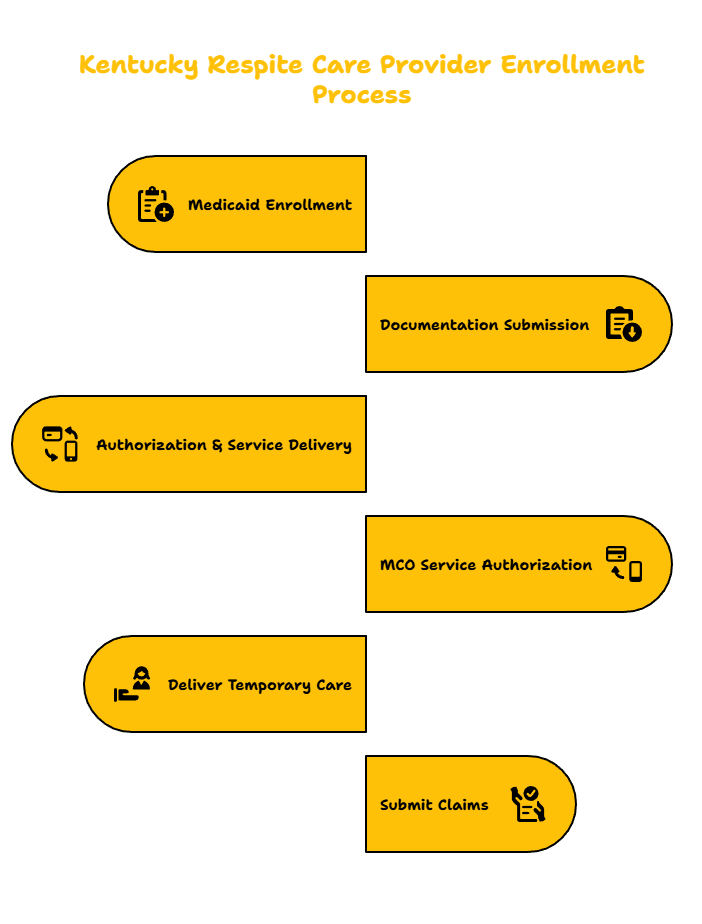
The enrollment process is structured into distinct phases, beginning with the Medicaid Partner Portal Application (MPPA). Applicants must register as a provider of Respite Services under the appropriate waiver programs. This digital submission is the foundation for all subsequent credentialing and contracting with the MCOs that operate in Kentucky.
Once the initial application is submitted, the agency must provide extensive documentation, including business licenses, insurance certificates, and proof of staff credentials. After the provider is fully enrolled and credentialed, they may begin receiving service authorizations. At this stage, coordination with case managers is critical, as every service delivered must correspond with a specific MCO authorization to ensure that billing claims are successfully processed using the correct HCPCS codes.
Which Kentucky HCBS Waivers Support Respite Care?
Respite Care Services are currently authorized under several Kentucky Medicaid HCBS waivers, each serving different populations with specific needs. Understanding which waivers an agency intends to serve is essential for tailoring the service delivery model. These programs include the Supports for Community Living (SCL) Waiver, the Michelle P. Waiver (MPW), the Home and Community-Based (HCB) Waiver, the Acquired Brain Injury (ABI and ABI-LTC) Waivers, and the Model II Waiver (MIIW).
The specific requirements for staff and service intensity may vary based on the waiver under which the participant is enrolled. For example, some waivers may necessitate the presence of a licensed nurse or specific behavioral support staff to handle medical or complex behavioral respite needs. Regardless of the waiver, all staff must undergo rigorous training in person-centered care, abuse prevention, and emergency response protocols to ensure the safety and dignity of the participant.
Frequently Asked Questions
What is the typical timeline for launching a respite care program?
The launch process generally spans several months, typically beginning with 1–2 months for business formation and manual development. The MPPA enrollment and MCO credentialing phase follows, taking approximately 60–90 days. Subsequent staff hiring and training require another 1–2 months, followed by 30–45 days for final service coordination and program launch.
Are facility-based services required for all respite care?
No, respite care can be provided in the participant’s home, a staff-operated residence, or a licensed respite facility, depending on the specific waiver and the needs identified in the participant’s Person-Centered Service Plan. Each setting must comply with the specific safety and licensing standards associated with that location type.
What documentation is essential for maintaining compliance?
Providers must maintain organized records including intake forms, caregiver release documentation, staff credentialing logs, emergency contact information, and detailed ADL and medication logs. Additionally, robust grievance procedures, incident reporting, and HIPAA-compliant billing documentation systems are mandatory for ongoing participation in Kentucky Medicaid programs.
WAIVER CONSULTING GROUP’S START-UP ASSISTANCE SERVICE — KENTUCKY RESPITE CARE PROVIDER
WCG supports caregiver organizations, group homes, and home care agencies in launching Medicaid-compliant respite care programs that strengthen family care systems across Kentucky. Our services include business registration, MPPA enrollment, MCO credentialing, and the creation of essential compliance documents. We assist in building staff hiring protocols, background screening guides, and robust policy manuals to ensure agencies are prepared for the operational demands of the Kentucky Medicaid landscape.
Our comprehensive support extends to developing billing templates, intake checklists, and incident reporting tools that align with state and federal regulations. By standardizing these operational workflows, WCG helps new and expanding providers navigate the complexities of MCO referral systems and family outreach, ensuring that agencies can focus on delivering high-quality, reliable respite care to those who need it most.
Key Takeaway: Establishing a respite care agency in Kentucky requires a disciplined approach to Medicaid enrollment, strict adherence to HCBS waiver standards, and the implementation of robust operational policies. By focusing on compliant documentation and effective coordination with MCOs, providers can successfully support Kentucky families while building a sustainable, mission-driven organization.
Last verified: October 2023. Disclaimer: This article is for informational purposes only and does not constitute legal or professional medical advice. Always consult with the Kentucky Cabinet for Health and Family Services (CHFS) or a qualified consultant for the most current regulations and specific compliance requirements for your organization.