RESPITE CARE SERVICES PROVIDER IN ILLINOIS
By Fatumata Kaba · 2025-07-19 · 5 min read
Respite Care Services in Illinois serve as a vital support system, providing short-term, temporary relief to family caregivers of individuals with disabilities, chronic illnesses, or age-related conditions. Authorized under various Illinois Medicaid Home and Community-Based Services (HCBS) Waiver programs, these services ensure that participants remain safe and well-supported while allowing primary caregivers the essential time needed to rest, manage personal matters, or recover from the physical and emotional demands of caregiving.
For healthcare entrepreneurs and agency administrators, navigating the regulatory environment in Illinois requires a deep understanding of state oversight, specific service delivery models, and rigorous provider enrollment standards. This guide outlines the essential requirements and operational milestones necessary to establish a compliant and effective Respite Care program within the Illinois Medicaid ecosystem.
What Governing Agencies Oversee Respite Care in Illinois?
The delivery of Respite Care in Illinois is governed by a multi-tiered regulatory structure that ensures service quality, participant safety, and fiscal responsibility. At the state level, the Illinois Department of Healthcare and Family Services (HFS) serves as the primary administrator for Medicaid waiver funding. HFS is responsible for managing provider enrollment through the IMPACT portal, overseeing service authorizations, and processing reimbursements for authorized services.
Supporting these functions are the Illinois Department of Human Services (DHS) divisions, specifically the Division of Developmental Disabilities (DDD) and the Division of Rehabilitation Services (DRS). These divisions are tasked with the granular oversight of service quality, ensuring that agencies adhere to person-centered planning standards and maintain high levels of participant protection. Furthermore, the federal Centers for Medicare & Medicaid Services (CMS) provides overarching guidance, ensuring that all Medicaid-funded respite services align with federal HCBS quality and documentation standards.
What Are the Core Requirements for Respite Care Service Delivery?
Respite Care Services are designed to provide flexibility for caregivers through either planned relief or emergency intervention. Providers may operate in various settings, including in-home services within the participant’s residence or facility-based care in licensed community settings. Regardless of the setting, all care must be provided in accordance with the participant’s Individualized Service Plan (ISP), which dictates the frequency, duration, and nature of the support required.
- In-home respite services provided directly within the participant’s living environment.
- Facility-based respite care delivered in approved, licensed community settings.
- Overnight, weekend, or extended respite schedules tailored to specific caregiver relief needs.
- Assistance with Activities of Daily Living (ADLs) such as bathing, grooming, feeding, mobility, and toileting.
- Medication reminders and routine health monitoring, provided these tasks are non-skilled in nature.
- Engagement in therapeutic or recreational activities that support the participant's social and emotional well-being.
How Do Providers Navigate the IMPACT Enrollment Process?
The path to becoming an approved Medicaid provider begins with establishing a legal business entity with the Illinois Secretary of State. Once the business is formed, the provider must secure an EIN from the IRS and a Type 2 NPI. The cornerstone of the enrollment process is the Illinois Medicaid Provider Enrollment (IMPACT) system. Applicants must submit a formal application for Respite Care Services under the specific HCBS waivers they intend to serve.
The process is intensive and requires significant documentation, including proof of liability insurance, articles of incorporation, and comprehensive service policies. Following the submission, DHS conducts a program readiness review. This phase evaluates the provider’s operational infrastructure, including staff qualification tracking, care and supervision protocols, and the robustness of safety plans. Only after successfully clearing this readiness review and obtaining necessary facility licensure is an agency authorized to begin billing for services.
What Documentation Is Essential for Audit Readiness?
Maintenance of meticulous records is a primary obligation for any Medicaid-certified agency. Because the Illinois Department of Healthcare and Family Services may conduct audits at any time, providers must organize and store specific business and clinical documents. This library of documentation serves as proof that the agency meets state standards and is providing authorized services to qualified participants.
- Business documentation including Articles of Incorporation and valid professional liability insurance certificates.
- Complete Respite Care Services Policy & Procedure Manual covering intake, scheduling, and health monitoring.
- Emergency preparedness protocols, including detailed plans for abuse, neglect, and exploitation prevention.
- Personnel files containing evidence of background checks, CPR/First Aid certifications, and annual competency evaluations.
- Clinical documentation including progress notes, incident reports, and evidence of participant ISP alignment.
- Financial and billing records that track service delivery hours against authorized Medicaid codes.
What Are the Staffing and Training Expectations?
The quality of respite care is directly linked to the competency of the direct support staff. A Respite Services Program Director or Supervisor is required to oversee daily operations. This individual generally holds a Bachelor’s degree in a human services or healthcare field and possesses documented experience in direct care supervision. All supervisors must also undergo thorough background screenings to ensure they meet state suitability requirements.
Respite Care Workers and Direct Support Professionals are required to hold at least a high school diploma or GED. Before interacting with participants, these staff members must complete mandatory training covering participant rights, HIPAA compliance, and infection control. Furthermore, annual continuing education and competency evaluations are necessary to maintain staff proficiency in wellness monitoring and emergency response protocols, ensuring that the agency remains compliant with evolving state requirements.
Frequently Asked Questions
Which Medicaid Waiver programs cover Respite Care in Illinois?
Respite Care is available under several programs, including the Adults with Developmental Disabilities Waiver, the Children and Young Adults with Developmental Disabilities Waiver, the Persons with Brain Injury (BI) Waiver, the Persons with Disabilities (PD) Waiver, and the Elderly Waiver (Community Care Program), which is limited to specific caregiver respite needs.
How long does the provider enrollment process typically take?
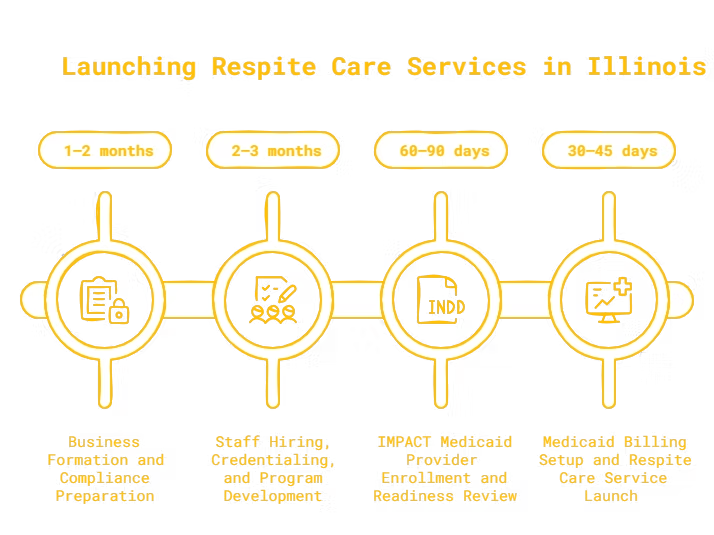
The timeline varies based on organizational readiness, but generally follows this trajectory: 1–2 months for business formation, 2–3 months for staff credentialing and policy development, 60–90 days for the IMPACT enrollment and readiness review, and 30–45 days for final billing setup.
Is facility licensure required for all respite providers?
Facility licensure is strictly required for any provider planning to deliver facility-based respite care. This licensure must be obtained through the appropriate state departments, such as the DHS DDD or the Illinois Department of Public Health (IDPH), depending on the nature of the facility and the population served.
Key Takeaway
Establishing a Respite Care Services agency in Illinois is a complex undertaking that requires strict adherence to Medicaid HCBS standards, robust internal policy development, and a commitment to ongoing staff training. By prioritizing audit readiness and aligning operations with the requirements set forth by HFS and DHS, providers can successfully deliver essential relief to caregivers while ensuring high-quality, person-centered care for Illinois participants.
Last verified: May 2024. This content is provided for informational purposes only and does not constitute legal or professional regulatory advice. Always consult the Illinois Department of Healthcare and Family Services (HFS) and the Illinois Department of Human Services (DHS) for the most current regulations and program requirements.