RESPITE CARE SERVICES PROVIDER IN HAWAII
By Fatumata Kaba · 2025-07-16 · 5 min read
OFFERING TEMPORARY RELIEF FOR PRIMARY CAREGIVERS WHILE ENSURING CONTINUITY OF CARE AND SUPPORT FOR PARTICIPANTS
Respite Care Services in Hawaii provide vital, short-term substitute care for individuals with disabilities, chronic health conditions, or aging-related needs to offer relief to family members or primary caregivers. Authorized under Hawaii’s Medicaid Home and Community-Based Services (HCBS) waiver programs, these services are essential for preventing caregiver burnout, promoting family stability, and ensuring that participants continue to receive high-quality, person-centered care within their communities.
Understanding the Regulatory Landscape for Respite Providers
Operating a Respite Care agency in Hawaii requires a clear understanding of the hierarchy of governing agencies. The Hawaii Department of Human Services (DHS), through the Med-QUEST Division, serves as the primary authority for Medicaid provider enrollment, service authorization, and the administration of reimbursement workflows. Compliance with these administrative standards is the foundational step for any organization seeking to provide authorized services.
Simultaneously, the Hawaii Department of Health (DOH) Developmental Disabilities Division (DDD) plays a critical role in administering HCBS waiver respite services specifically for individuals with intellectual and developmental disabilities (IDD). Providers must navigate the intersection of DHS administrative rules and DOH-DDD programmatic standards to remain in good standing. At the federal level, the Centers for Medicare & Medicaid Services (CMS) provides oversight, ensuring that all Hawaii-based HCBS services adhere to national quality and safety standards.
- Hawaii Department of Human Services (DHS) - Med-QUEST Division: Manages enrollment and reimbursement.
- Hawaii Department of Health (DOH) - Developmental Disabilities Division (DDD): Oversees IDD-specific waiver programming.
- Centers for Medicare & Medicaid Services (CMS): Ensures federal quality and HCBS compliance.
Service Scope and Delivery Models
Respite Care Services function as a bridge for caregivers, offering the professional support necessary to sustain the participant's living arrangement. Services are delivered according to the Individualized Service Plan (ISP), ensuring that the care provided is directly aligned with the specific goals and needs of the participant. By delivering temporary relief, providers allow primary caregivers to rest, manage personal matters, or address health needs without disrupting the continuity of care.
Approved providers may offer a variety of delivery models, including in-home care, where services occur at the participant’s residence, or out-of-home care in an approved community or facility setting. Whether the need is for scheduled respite or emergency coverage, the service must focus on core support activities such as assistance with Activities of Daily Living (ADLs) like bathing, eating, and toileting. Furthermore, providers are expected to monitor health and safety while ensuring participants remain engaged in recreational and social activities.
Licensing and Initial Provider Requirements
The journey to becoming an approved Respite Care provider begins with establishing a formal business entity. Providers must register their business with the Hawaii Department of Commerce and Consumer Affairs (DCCA) to ensure legal standing within the state. Following registration, the organization must secure an Employer Identification Number (EIN) from the IRS and a National Provider Identifier (NPI - Type 2) to facilitate billing and administrative tracking.
Insurance requirements are stringent; providers must carry both general liability and professional liability insurance to protect against operational risks. For agencies planning to offer out-of-home respite, additional facility licensing may be required depending on the nature of the setting and whether overnight care is offered. Demonstrating readiness to meet these criteria is the first hurdle in the Medicaid enrollment process.
Navigating the Med-QUEST Enrollment and Readiness Process
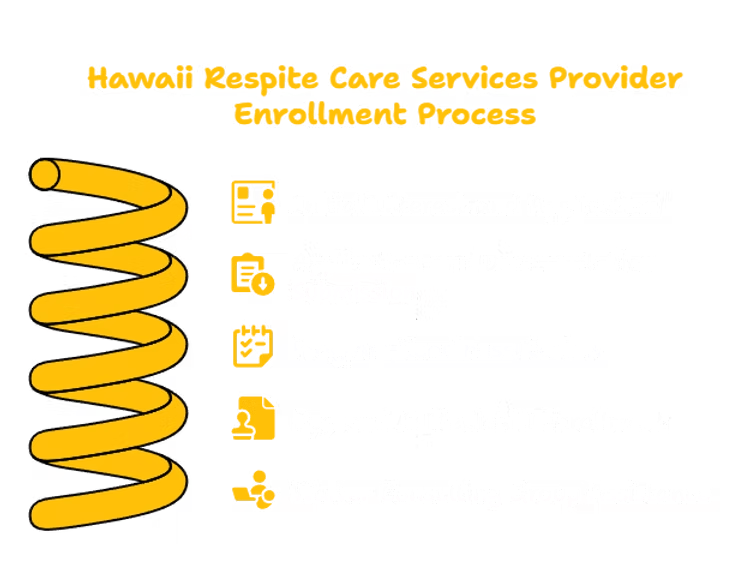
The transition from a business entity to an active Medicaid provider is a structured, multi-phase process managed by the Hawaii Med-QUEST Division. Interested organizations must submit a comprehensive Provider Enrollment Application, which includes the submission of key documentation such as Articles of Incorporation, proof of insurance, and detailed service descriptions. The completeness of this initial package significantly impacts the speed of the review.
During the program readiness review, DHS and DOH officials evaluate the provider’s operational integrity. This includes an assessment of participant protection measures, robust staff training protocols, and documentation systems that demonstrate Medicaid compliance. Once these internal systems are approved, the organization will be granted authorization to configure billing codes, allowing them to start submitting claims for services rendered on an hourly, daily, or overnight basis.
- Documentation Phase: Submit organizational filings, EIN/NPI, and insurance certificates.
- Review Phase: DHS/DOH conducts a readiness audit of emergency protocols and HIPAA compliance.
- Operational Phase: Configuration of billing systems to match Medicaid reimbursement rates.
Staffing Standards and Operational Compliance
The quality of a respite program is defined by its personnel. A Respite Services Program Manager or Supervisor is responsible for overseeing the daily operations and ensuring that Direct Support Professionals (DSPs) adhere to state and program standards. These supervisors are typically expected to have experience in direct care or human services management, along with a clean background screening.
Direct Support Professionals are the frontline staff providing daily supervision and ADL support. Minimum requirements typically include a high school diploma or GED, and CPR/First Aid certification is generally expected. Regardless of experience, all staff must complete mandatory training on HIPAA privacy, abuse prevention, incident reporting, and emergency preparedness. An ongoing culture of education, characterized by annual training refreshers, is vital for maintaining the high standards expected by Medicaid and the communities served.
Frequently Asked Questions
What are the primary differences between in-home and out-of-home respite care?
In-home respite care is delivered at the participant’s own home, providing comfort and familiarity. Out-of-home respite occurs in an approved community or facility setting, which may be beneficial for participants who require a change of environment or specialized facility-based support.
Is there a specific training curriculum for Respite Care staff?
Yes, all staff must complete training that covers HIPAA confidentiality, participant rights, abuse prevention, and incident reporting. Additionally, training on ADL/IADL support and emergency preparedness is required to ensure consistent, high-quality care.
How does the Med-QUEST Division monitor provider performance?
The Med-QUEST Division and the DOH-DDD monitor performance through periodic audits of service documentation, billing accuracy, and adherence to the Individualized Service Plan (ISP). Providers are expected to maintain comprehensive records that document service delivery and compliance with all safety protocols.
Key Takeaway
Launching a Respite Care agency in Hawaii requires meticulous attention to both state regulatory standards and Medicaid HCBS compliance. By focusing on robust administrative infrastructure, comprehensive staff training, and transparent service documentation, providers can effectively meet the critical needs of participants while navigating the rigorous enrollment requirements of the Med-QUEST and DOH-DDD systems.
Last verified: October 2023. Disclaimer: This article is for informational purposes only and does not constitute legal or professional Medicaid consulting advice. Regulations, policies, and program requirements are subject to change; always consult with the Hawaii Med-QUEST Division or the Department of Health (DDD) directly for the most current information regarding provider enrollment and service delivery standards.