RESPITE CARE SERVICES PROVIDER IN CONNECTICUT
By Fatumata Kaba · 2025-07-08 · 5 min read
GIVING FAMILY CAREGIVERS A BREAK WHILE ENSURING SAFE, COMPASSIONATE SUPPORT FOR INDIVIDUALS WITH DISABILITIES AND COMPLEX NEEDS
Respite Care Services in Connecticut provide short-term, temporary relief to unpaid caregivers supporting individuals with disabilities, chronic health conditions, or age-related needs. These essential services are authorized through various Connecticut Medicaid Home and Community-Based Services (HCBS) Waivers, including the Personal Care Assistance (PCA) Waiver, the Acquired Brain Injury (ABI) Waivers, the Connecticut Home Care Program for Elders (CHCPE), and Department of Developmental Services (DDS) programs.
For prospective providers, launching a respite care agency requires a deep understanding of the regulatory environment administered by the Connecticut Department of Social Services (DSS) and the Department of Developmental Services (DDS). By adhering to these federal and state standards, providers play a vital role in sustaining the family-based caregiving network that keeps vulnerable residents in their homes and communities.
Understanding the Governance and Regulatory Landscape
The provision of Medicaid-funded respite care in Connecticut is governed by a multi-tiered regulatory framework. At the federal level, the Centers for Medicare & Medicaid Services (CMS) provides oversight to ensure that all waiver-based services adhere to HCBS final settings rules, prioritizing participant independence, health, and welfare.
At the state level, the Department of Social Services (DSS) acts as the primary authority, administering the majority of Medicaid waiver programs and managing the reimbursement processes for authorized providers. Simultaneously, the Department of Developmental Services (DDS) maintains specialized oversight for individuals with intellectual and developmental disabilities. Understanding which agency governs a specific participant’s waiver is the first step in successful provider enrollment and ongoing compliance.
Defining the Scope of Respite Care Delivery
Respite care is designed to offer relief to family caregivers by providing substitute support for an eligible individual. These services must be clearly defined within the participant's authorized care plan and can be delivered in various environments, including the individual's home, the community, or licensed out-of-home settings.
Approved providers are responsible for delivering consistent, high-quality care that meets the specific needs identified in the care plan. Key service elements include:
- In-home respite providing short-term supervision and assistance.
- Out-of-home respite in licensed facilities or supervised community-based settings.
- Assistance with activities of daily living (ADLs), behavioral support, and safety monitoring.
- Flexibility to provide both planned relief and emergency coverage for caregivers.
- Comprehensive documentation of all hours provided and specific tasks performed during the visit.
Navigating Licensing and Provider Enrollment Requirements
To operate as a Medicaid provider in Connecticut, businesses must follow a structured path to eligibility. This begins with formal business registration through the Connecticut Secretary of the State and the acquisition of an Employer Identification Number (EIN) from the IRS. Furthermore, agencies must secure a Type 2 National Provider Identifier (NPI) to function as an organizational healthcare provider.
Enrollment typically follows two distinct models depending on the business structure. Agency-based providers must enroll through the DSS Medicaid Provider Enrollment Portal, submitting extensive documentation regarding staff qualifications and service descriptions. Conversely, individuals participating in self-directed models may engage respite workers through a Financial Management Service (FMS), which handles the administrative aspects of enrollment and payroll.
Developing Essential Operational Documentation
A successful respite care operation relies on a robust policy and procedure manual that satisfies both state and federal auditors. This manual serves as the blueprint for your agency’s operations and must address critical areas such as HIPAA compliance, participant rights, and incident reporting protocols.
Comprehensive documentation should include, at minimum, the following:
- Articles of Incorporation and proof of business registration.
- Confirmation of NPI and DSS Medicaid enrollment or FMS authorization.
- Detailed policies on client intake, caregiver communication, and emergency response.
- Standardized templates for daily service logs and Electronic Visit Verification (EVV).
- Clear guidelines for staff hiring, background checks, and annual competency training.
- Quality assurance forms for service reviews and grievance handling.
Staffing, Credentialing, and Training Standards
The quality of respite care is directly linked to the competency of the direct support workers. Agencies are responsible for ensuring that all staff meet stringent background check requirements, TB screening standards, and possess valid CPR/First Aid certifications where applicable. For agencies, the role of a Program Coordinator is equally vital, as this individual oversees staff supervision and ensures adherence to the care plan.
Ongoing training is a mandatory component of maintaining provider status. All staff must receive initial and periodic training on the following topics:
- Person-centered care approaches and maintaining participant safety.
- Abuse prevention and the legal obligations of a mandated reporter.
- Confidentiality and HIPAA regulations in a home-based setting.
- Documentation requirements and emergency preparedness procedures.
- Annual refreshers regarding ethics, boundary setting, and professional conduct.
Frequently Asked Questions
What is the typical timeline to launch a respite care agency in Connecticut?
The process generally spans several months. Business formation usually takes 1–2 weeks, followed by a 30–60 day window for DSS Medicaid enrollment or FMS registration. Hiring and credentialing staff typically requires an additional 2–4 weeks before you are ready to accept service referrals.
Can an individual be a self-directed respite provider?
Yes, through the self-directed model, individuals can be hired by participants or their families. These workers must enroll through an FMS provider, which verifies their background and manages the necessary employment eligibility documentation.
How are respite care providers reimbursed?
Providers are reimbursed according to the rates established by the specific Medicaid waiver program (e.g., CHCPE, ABI, or DDS). Reimbursement is contingent upon the submission of accurate documentation, including verified service logs that prove the care was provided as authorized in the individual’s service plan.
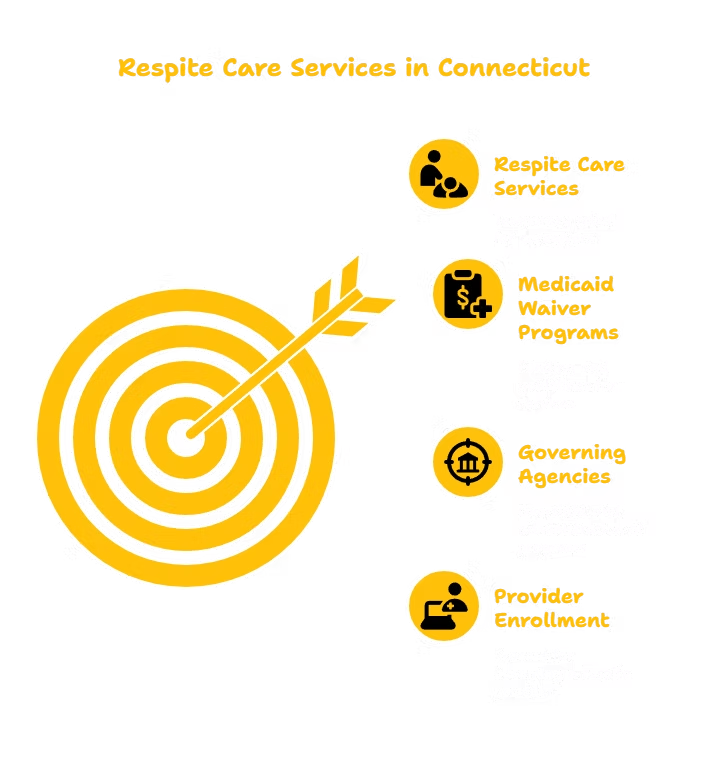
Key Takeaway: Establishing a respite care agency requires rigorous adherence to state enrollment portals and regulatory guidelines. By maintaining precise documentation, ensuring staff are well-trained in person-centered care, and fostering strong relationships with agencies like DSS and DDS, providers can build a sustainable, compliant, and impactful service that supports Connecticut's most vulnerable residents.
Last verified: 2024. This content is provided for informational purposes only and does not constitute legal or professional advice. Always consult with the Connecticut Department of Social Services (DSS) or the Department of Developmental Services (DDS) for the most current policies and enrollment requirements.