RESPITE CARE SERVICES PROVIDER IN COLORADO
By Fatumata Kaba · 2025-07-06 · 6 min read
PROVIDING TEMPORARY RELIEF FOR CAREGIVERS WHILE ENSURING CONTINUITY OF SUPPORT FOR INDIVIDUALS WITH DISABILITIES OR CHRONIC CONDITIONS
Respite Care services in Colorado are a critical component of the state’s Home and Community-Based Services (HCBS) ecosystem, designed to provide temporary relief to primary caregivers by offering supervised support to individuals with complex health needs, disabilities, or age-related challenges. As a Medicaid-funded service, respite care ensures that families have access to professional, reliable support, allowing them to sustain long-term caregiving arrangements while maintaining the health and well-being of the participant.
Operating a Respite Care provider agency in Colorado requires strict adherence to regulations set forth by the Colorado Department of Health Care Policy and Financing (HCPF), the Colorado Department of Public Health and Environment (CDPHE), and federal guidelines established by the Centers for Medicare & Medicaid Services (CMS). Agencies must navigate a structured enrollment and licensing process to ensure they are qualified to deliver high-quality, person-centered care that aligns with the specific requirements of various HCBS waivers.
How Does the Colorado Respite Care Regulatory Framework Work?
The regulatory landscape for Respite Care is overseen by several governing bodies, each serving a distinct role in ensuring participant safety and financial accountability. The Colorado Department of Health Care Policy and Financing (HCPF) acts as the primary administrator for Medicaid and the various HCBS waivers that authorize and reimburse respite services. They set the policy standards and reimbursement structures that providers must follow to maintain active status within the Medicaid program.
If an agency intends to provide hands-on personal care or medical-related assistance, it must also interface with the Colorado Department of Public Health and Environment (CDPHE). The CDPHE is responsible for the licensing of home care agencies, ensuring that providers meet the mandatory health and safety standards for home-based support. Furthermore, at the federal level, the Centers for Medicare & Medicaid Services (CMS) oversees the entire Medicaid program, ensuring that Colorado’s waiver-funded services remain in compliance with national statutes and expectations for care delivery.
What Are the Core Responsibilities of a Respite Care Provider?
Respite Care is defined by its ability to offer either planned or emergency short-term relief to a primary caregiver. This care is designed to be flexible, occurring in the participant’s home, within the broader community, or in a licensed setting depending on the specific waiver and the individual’s personalized care plan. Because these services are often used during moments of caregiver burnout or unexpected unavailability, providers must be prepared to maintain continuity of care regardless of the setting.
Approved providers are tasked with delivering a range of support services that prioritize the safety and independence of the individual. These duties typically include:
- In-home supervision and companionship to ensure a safe environment.
- Personal care support, including assistance with bathing, dressing, feeding, and toileting.
- Safety monitoring and mobility assistance to prevent injury.
- Basic Activities of Daily Living (ADL) support and meal preparation.
- Community outings or structured activities where specified in the care plan.
- Rigorous documentation of time, tasks performed, and service delivery verification.
What Steps Are Necessary to Achieve Provider Enrollment?
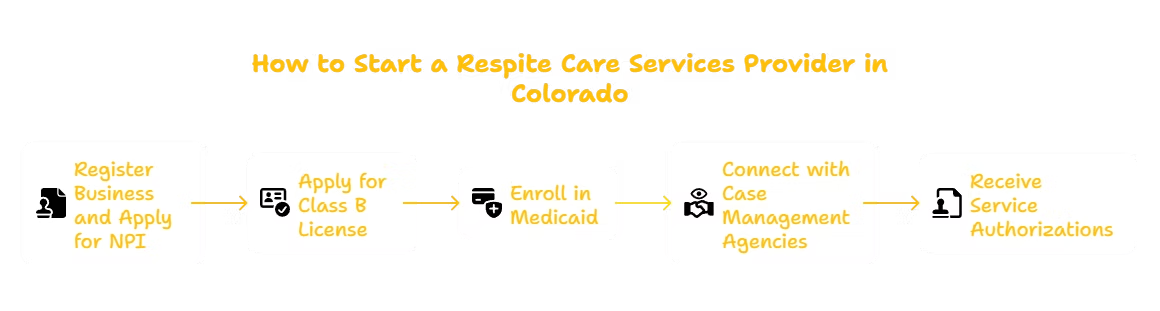
The path to becoming a recognized Medicaid respite provider in Colorado is a multi-step journey that requires precision in documentation and administrative compliance. The process begins with the foundational establishment of the business entity, including registration with the Colorado Secretary of State and obtaining an Employer Identification Number (EIN) from the IRS. Providers must also secure a Type 2 National Provider Identifier (NPI) to distinguish their business entity in the claims processing system.
Once the legal foundation is established, agencies providing personal care must apply for a Class B Home Care Agency license through the CDPHE. This licensure process involves a thorough review of the agency’s operational procedures and safety protocols. Following successful licensure, the agency must enroll as a Medicaid provider through the Gainwell Technologies Provider Portal. This is the final gateway to billing for services; upon approval, agencies should proactively connect with local Case Management Agencies (CMAs) to begin receiving service authorizations and client referrals.
What Documentation Is Required for Compliance and Audit Readiness?
Successful agencies maintain a highly organized system for documentation, as it is the primary evidence of compliance during state audits. Required documentation includes the basic business records—such as Articles of Incorporation, the IRS EIN letter, and NPI confirmation—alongside active licensure and Medicaid provider IDs. Beyond these foundational items, agencies must curate a comprehensive Policy and Procedure manual that governs day-to-day operations.
Key components of this manual and the accompanying files must include:
- Standardized client intake and eligibility confirmation processes.
- Clear consent forms and caregiver instructions for every participant.
- Detailed task and time logs that accurately reflect the services rendered during each session.
- Robust emergency contact protocols and safety procedures for home and community settings.
- Strict confidentiality, abuse prevention, and grievance policies to protect client rights.
- Well-documented staff supervision, training logs, and incident reporting procedures.
What Are the Essential Staffing and Training Mandates?
The quality of Respite Care is directly tied to the competency of the direct support staff. Respite caregivers and Direct Support Professionals (DSPs) are expected to hold a high school diploma or GED, and they must undergo mandatory background checks and tuberculosis (TB) screenings before interacting with participants. For staff providing personal care, CPR and First Aid certifications are required to ensure they can manage health-related emergencies.
In addition to front-line staff, agencies must designate a Program Supervisor responsible for the oversight of staff scheduling, care quality, and the accuracy of service documentation. All personnel, regardless of their specific role, must complete comprehensive training on HIPAA confidentiality standards, person-centered care principles, safety and infection control, and mandatory incident reporting procedures. Continuous professional development is not only a regulatory requirement but a cornerstone of high-quality respite service delivery.
Frequently Asked Questions
Which Medicaid waivers cover Respite Care services?
Respite Care is reimbursed under several Colorado HCBS waivers, including the Elderly, Blind, and Disabled (EBD) waiver, the Supported Living Services (SLS) waiver, the Children’s Extensive Support (CES) waiver, and the Developmental Disabilities (DD) waiver, among others.
How long does the provider enrollment process typically take?
The timeline varies by phase: business formation generally takes 1–2 weeks, CDPHE Class B licensing takes 45–90 days, and Medicaid enrollment via Gainwell Technologies takes 30–60 days. Referral activation is an ongoing process that begins after enrollment is finalized.
What is the role of a Case Management Agency (CMA)?
Case Management Agencies are the intermediaries between the state and the provider. They assess the participant’s needs, develop the person-centered service plan, and issue the authorizations that allow a Respite Care provider to deliver and bill for services.
WAIVER CONSULTING GROUP'S START-UP ASSISTANCE SERVICE — COLORADO RESPITE CARE SERVICES PROVIDER
Waiver Consulting Group assists caregivers, home care agencies, and service professionals in establishing Medicaid-compliant Respite Care services. Our support covers the full scope of requirements, including business registration, CDPHE Class B license support, Medicaid provider enrollment, and the creation of robust policy and procedure manuals. We provide templates for shift logs, incident reports, caregiver notes, and client intake packets, ensuring that your agency is audit-ready from day one. Our resources also include guidance on staff credentialing, client intake, and effective referral networking strategies.
Key Takeaway: Establishing a successful Respite Care provider agency in Colorado requires a dual focus: strict adherence to the licensing and documentation mandates of the CDPHE and HCPF, and a commitment to rigorous, person-centered care. By maintaining impeccable records, investing in quality staff training, and fostering strong relationships with local Case Management Agencies, providers can reliably serve the needs of the HCBS community while ensuring the long-term sustainability of their business operations.
Last verified: August 2024. This information is intended for educational purposes and does not constitute legal or professional advice. Always consult with the Colorado Department of Health Care Policy and Financing or legal counsel to ensure your organization’s full compliance with current state and federal regulations.