RESPITE CARE SERVICES PROVIDER IN CALIFORNIA
By Fatumata Kaba · 2025-07-07 · 5 min read
Giving family caregivers a break while ensuring safe, compassionate support for individuals with disabilities or complex needs.
Respite Care Services in California provide essential short-term, temporary relief to unpaid primary caregivers of individuals with developmental disabilities, chronic conditions, or aging-related needs. These services are delivered through California’s Home and Community-Based Services (HCBS) Waivers, the state’s 21 non-profit Regional Centers, and the Self-Determination Program (SDP), ensuring that individuals receive appropriate care while their primary caregivers take necessary breaks.
What Are the Roles of Governing Agencies in Respite Care?
The California respite care landscape is governed by a multi-layered regulatory structure that ensures service quality and fiscal accountability. The California Department of Developmental Services (DDS) serves as the primary entity responsible for the coordination and funding of respite services. They provide the oversight for the Regional Centers, which act as the point of contact for service providers, and they manage the overarching framework for the Self-Determination Program.
Complementing the DDS, the California Department of Health Care Services (DHCS) administers the Medicaid and HCBS Waiver programs, providing the necessary funding streams for in-home respite. On a federal level, the Centers for Medicare & Medicaid Services (CMS) maintains oversight to ensure that all state programs remain in full compliance with federal waiver requirements. Navigating these relationships is critical for any agency looking to provide services under these funding umbrellas.
How Does the Respite Care Service Delivery Model Work?
Respite care is designed to offer flexibility, whether the service is planned in advance or required during an unforeseen emergency. The specific nature, frequency, and duration of the care are defined within the individual’s Individual Program Plan (IPP) or Person-Centered Plan (PCP). These plans act as the blueprint for service delivery, ensuring that the respite provider adheres to the specific preferences and medical or behavioral needs of the participant.
Approved providers generally deliver services through two primary modalities: in-home respite, which occurs directly within the individual’s residence, or out-of-home respite, which involves care at a licensed facility or community setting. Regardless of the setting, the provider is responsible for maintaining rigorous documentation regarding service dates, total hours provided, and the general well-being of the individual throughout the duration of the care.
- In-home respite (care provided in the individual’s home)
- Out-of-home respite (in a licensed facility or community setting)
- Supervision, personal care, and basic support during the caregiver’s absence
- Short-term behavioral support or companionship
- Documentation of service dates, hours, and individual well-being
What Are the Prerequisites for Provider Licensing and Approval?
Establishing a respite care agency requires strict adherence to both business and human service regulations. Before providing services, an entity must register as a business with the California Secretary of State and obtain both an EIN from the IRS and a Type 2 NPI. From a regulatory compliance standpoint, providers must follow Title 17 of the California Code of Regulations and, if employing home care aides, obtain a Home Care Organization (HCO) license from the California Department of Social Services.
Beyond initial licensing, providers must implement a robust internal infrastructure. This includes maintaining comprehensive liability insurance and establishing secure systems for staff record-keeping. Because these services are often funded through state-managed programs, agencies must be prepared to integrate their billing and reporting systems with the Regional Center or the Financial Management Service (FMS) if operating within the Self-Determination Program.
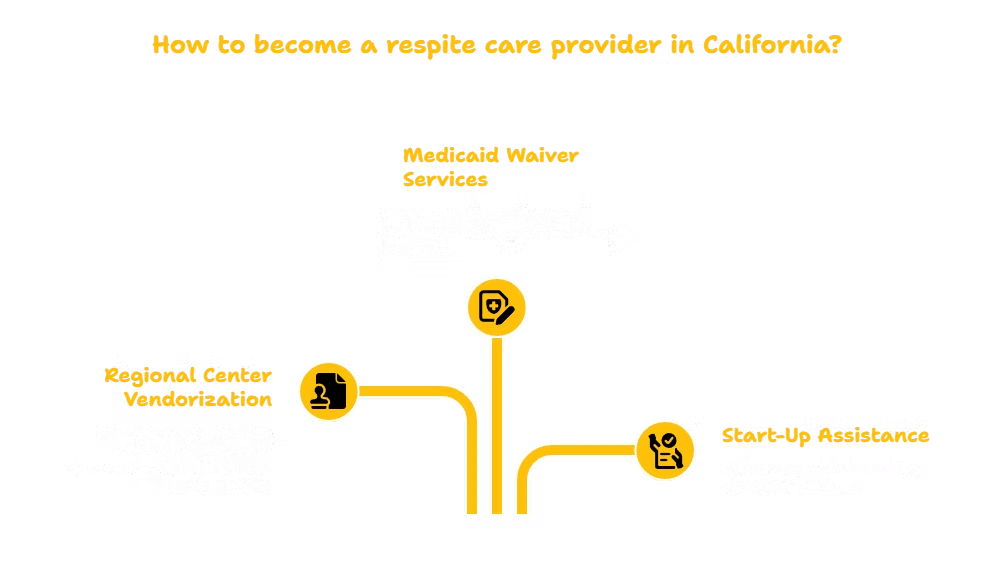
How to Navigate the Regional Center Vendorization Process
The vendorization process is the mechanism by which an agency becomes authorized to receive referrals and bill for services. The process begins with a pre-application contact with the local Regional Center to request a vendor application packet specifically for Service Code 420 (In-Home Respite). Once the packet is received, the provider must submit detailed business documentation, including service descriptions, sample timesheets, staff qualification credentials, and comprehensive emergency protocols.
For those intending to provide out-of-home respite, the timeline will necessarily include obtaining a Community Care Licensing (CCL) facility license. After the application is reviewed and approved, the Regional Center will issue a vendor number, which authorizes the agency to start accepting referrals. This phase is critical, as it transitions the organization from a business entity to an active service provider within the state’s developmental disability network.
What Are the Essential Staffing and Training Requirements?
Quality of care is heavily dependent on the caliber of the staff hired. A Respite Care Supervisor or Program Manager should ideally possess a background in caregiving, social services, or human development, with preference given to those with prior supervisory experience. In contrast, Respite Care Workers or in-home aides are required to meet baseline standards, including a high school diploma or equivalent, current CPR/First Aid certification, and a clean background check via Live Scan and TB clearance.
All staff members must undergo a structured training program that emphasizes client safety, the prevention of abuse, and standardized emergency responses. Furthermore, agencies must mandate training on confidentiality, cultural sensitivity, and the nuances of effective communication with families. Documentation is a constant requirement; therefore, staff must be trained to maintain accurate, professional logs that satisfy both state auditing standards and family reporting expectations.
Frequently Asked Questions
Is medication administration allowed by respite care providers?
Respite care workers may assist with medication reminders, but they are not permitted to administer medication unless they possess the appropriate medical licensing to do so. Documentation of medication reminders is a standard part of the service logs required for compliance.
What is the difference between HCBS Waiver services and Regional Center services?
While both provide funding and support, the 1915(c) HCBS Waiver is a federal Medicaid program with specific federal requirements, while Regional Center services are often funded under the state's Lanterman Act. Many agencies operate across both spheres to serve a broader range of individuals.
How long does the launch process generally take?
The timeline varies based on organizational readiness. Business formation usually takes 1–2 weeks, while Regional Center vendorization or obtaining an HCO license typically takes 60–90 days. Staffing and training usually require an additional 30–45 days to complete.
Key Takeaway: Successfully launching a respite care agency in California requires a balanced approach of meeting rigorous state-mandated licensing, securing Regional Center vendorization, and maintaining a high standard of staff training to ensure compliance with both the Lanterman Act and federal Medicaid HCBS Waiver requirements.
Last verified: October 2023. This information is for educational purposes only and does not constitute legal or professional consulting advice. Always consult with the California Department of Developmental Services or your local Regional Center for the most current regulatory requirements.