RESIDENTIAL SUPPORT SERVICES PROVIDER IN WEST VIRGINIA
By Fatumata Kaba · 2026-04-14 · 5 min read
Becoming a Residential Support Services provider in West Virginia requires navigating a rigorous regulatory framework designed to ensure the safety, stability, and independence of vulnerable populations in community settings. This role involves delivering 24/7 supervision and comprehensive care to individuals under Medicaid waiver programs, serving as a vital alternative to institutionalized living.
For prospective provider agencies, success depends on achieving seamless integration between the West Virginia Department of Health and Human Resources (WVDHHR) requirements, Bureau for Medical Services (BMS) enrollment standards, and the Office of Health Facility Licensure & Certification (OHFLAC) mandates. This guide outlines the essential steps, compliance expectations, and operational necessities for establishing a high-quality residential program in the state.
What Are the Governing Agencies and Their Roles?
The provision of residential services in West Virginia is strictly regulated to maintain high standards of care and participant safety. Three primary agencies define the environment in which a provider operates. The West Virginia Department of Health and Human Resources (WVDHHR) serves as the primary administrative authority, responsible for the overarching policy, regulation, and oversight of waiver services across the state.
Supporting this oversight, the Bureau for Medical Services (BMS) manages the fiscal and procedural elements of the Medicaid program. This includes the enrollment of providers and the continuous monitoring of billing compliance and service delivery standards. Additionally, the Office of Health Facility Licensure & Certification (OHFLAC) ensures that the physical residential settings meet the necessary safety and health codes. If a home provides health-related services or overnight supervision, licensure from OHFLAC is mandatory to ensure the environment is suitable for participant care.
How Do Residential Support Services Function in the Community?
Residential Support Services act as a holistic care model for participants enrolled in the Intellectual/Developmental Disabilities (I/DD) Waiver, the Children with Serious Emotional Disorder Waiver (CSEDW), or, in specific cases, the Traumatic Brain Injury Waiver (TBIW). By providing supervised living arrangements, these services allow individuals to remain in their communities while receiving necessary support tailored to their Individualized Service Plan (ISP).
Care delivery focuses on personal care, skill-building, medication management, and behavioral reinforcement. The following services are core components of a successful residential program:
- 24/7 supervision and comprehensive personal care support
- Assistance with Activities of Daily Living (ADLs) and Instrumental Activities of Daily Living (IADLs)
- Medication administration, oversight, and monitoring
- Support with meal preparation, light housekeeping, and personal hygiene
- Behavioral redirection, skill reinforcement, and crisis de-escalation
- Transportation coordination for medical appointments and community integration
- Facilitation of social and recreational engagement
- Meticulous documentation and progress reporting
What Are the Prerequisites for Licensure and Enrollment?
Establishing a provider agency is a multi-phase process that begins with business formation and moves into state-specific compliance. Before an agency can serve its first participant, it must be legally recognized and fully enrolled within the Medicaid system via Gainwell Technologies. This includes obtaining a Federal Employer Identification Number (EIN) and a Type 2 National Provider Identifier (NPI) to distinguish the business entity from individual practitioners.
Once registered, the agency must develop a comprehensive Residential Support Services Policy & Procedure Manual. This manual serves as the blueprint for operations, detailing everything from admission and discharge criteria to emergency protocols and HIPAA compliance. Following these foundational steps, the agency must undergo the application process to be recognized as a waiver-approved residential provider, ensuring that all staffing plans and safety procedures align with state-mandated benchmarks.
How Does the Provider Enrollment Process Progress?
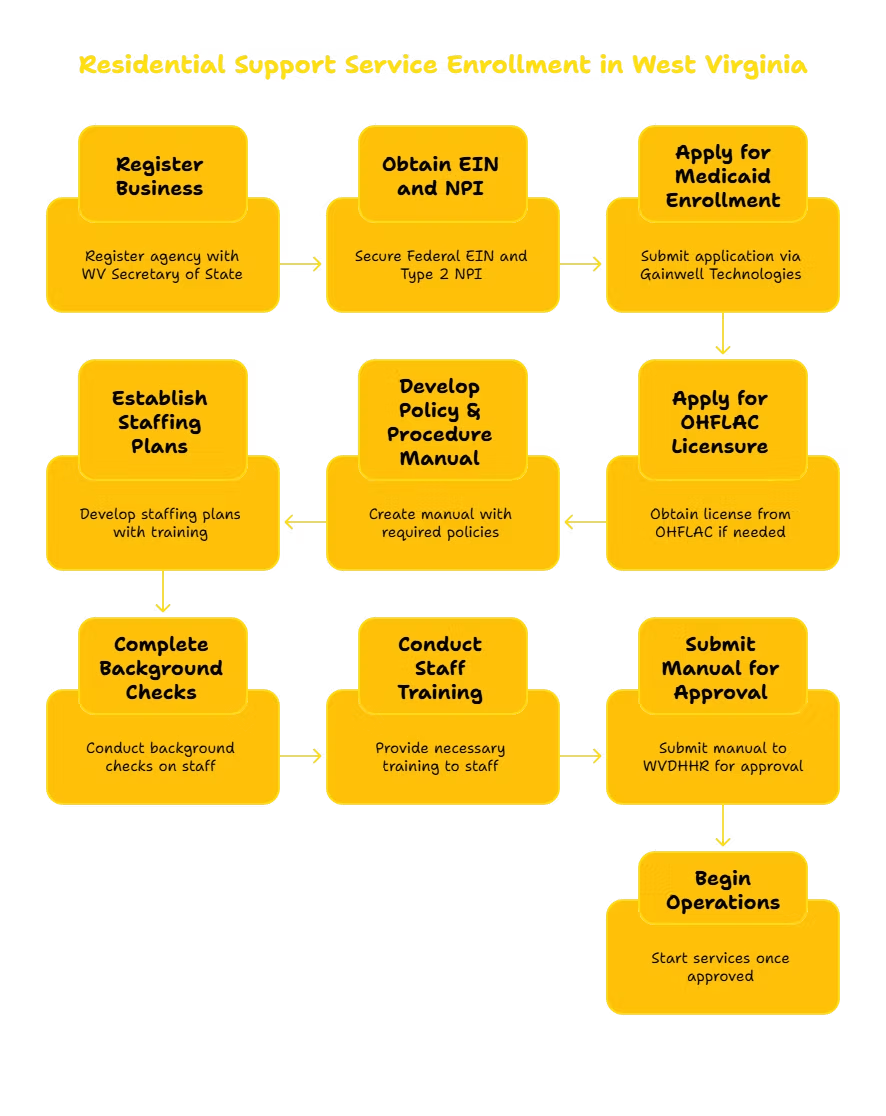
The path to operation is sequenced to ensure that all administrative and safety-related prerequisites are met before services begin. The process begins with business registration and securing the necessary tax and identification credentials. From there, the prospective provider submits an application to the WVDHHR for waiver-approved status, followed by a formal Medicaid provider enrollment application through Gainwell Technologies.
Once the administrative foundation is laid, the agency must focus on physical site readiness and staff credentialing. If the facility requires OHFLAC licensure, site inspections must be completed successfully. Simultaneously, the agency must conduct background checks through the WV CARES system and finalize their Policy & Procedure Manual for submission and approval. Service initiation is only authorized once these steps are concluded and the participant’s ISP specifically identifies the provider as the chosen residential support entity.
What Are the Essential Staffing and Training Requirements?
Staffing quality is the most critical element of a compliant and effective residential program. Direct Support Professionals (DSPs) are the front-line caregivers and must meet strict requirements, including being at least 18 years of age and successfully clearing a WV CARES background check. They must also be proficient in CPR, First Aid, abuse prevention, and the specific documentation required for state reporting.
Beyond the DSP level, the agency must appoint a Residential Supervisor or Program Manager to oversee day-to-day operations and ensure that the ISP is being followed consistently. If the residential setting involves complex medical needs, a licensed Registered Nurse (RN) or Licensed Practical Nurse (LPN) may be required for medication administration and clinical oversight. Mandatory, recurring training programs are essential to ensure all staff maintain competency in HIPAA privacy rules, participant rights, crisis management, and shift reporting protocols.
Frequently Asked Questions
Can an agency provide residential services without OHFLAC licensure?
No, if the residential setting provides overnight supervision or health-related services as defined by state regulations, the facility must be licensed or certified by OHFLAC. The specific nature of the care provided dictates the necessity of this license.
What is the role of the ISP in service delivery?
The Individualized Service Plan (ISP) is the primary document governing the care for each participant. Services are only reimbursable when they are directly authorized by the ISP, which justifies the level of support required based on the individual's specific needs.
Where can an agency find support for the enrollment and compliance process?
Waiver Consulting Group provides specialized assistance for agencies looking to establish, license, and manage Medicaid-approved residential programs. This includes developing P&P manuals, setting up billing systems, and creating staff training programs that meet state requirements.
Key Takeaway
Becoming a successful Residential Support Services provider in West Virginia is a complex endeavor that requires strict adherence to WVDHHR, BMS, and OHFLAC regulations. By focusing on compliant documentation, rigorous staff training, and a strong administrative foundation, agencies can effectively support the independence and safety of waiver program participants while building a sustainable and professional healthcare organization.
Last verified: October 2023. Disclaimer: This article is for informational purposes only and does not constitute legal or professional consulting advice. State regulations, Medicaid policies, and waiver requirements are subject to change. Always consult directly with the West Virginia Department of Health and Human Resources (WVDHHR), the Bureau for Medical Services (BMS), and relevant state agencies to ensure your organization’s current compliance with all applicable laws and guidelines.