RESIDENTIAL SUPPORT SERVICES PROVIDER IN WASHINGTON
By Fatumata Kaba · 2026-04-06 · 6 min read
Residential Support Services in Washington provide essential community-based living arrangements characterized by round-the-clock supervision, personalized care, and life skills assistance for individuals with developmental, intellectual, or physical disabilities. By operating through the Developmental Disabilities Administration (DDA) and Medicaid-funded Home and Community-Based Services (HCBS) waivers, these providers enable participants to thrive in home-like environments rather than institutional settings, ensuring their daily needs align with a person-centered service plan (PCSP).
Understanding the Governing Agencies and Regulatory Framework
Navigating the Washington residential support landscape requires a clear understanding of the roles played by state agencies. The Developmental Disabilities Administration (DDA) serves as the primary gateway for residential programs, overseeing provider participation, managing service authorizations, and ensuring that the quality of care meets state-mandated standards for individuals with developmental disabilities.
Complementing the DDA’s role, the Department of Social and Health Services (DSHS) acts as the regulatory authority for facility monitoring, conducting essential background checks, and overseeing the licensing of supported living and group home environments. Meanwhile, the Health Care Authority (HCA) manages the financial architecture of the system, overseeing Medicaid reimbursement through Apple Health and the ProviderOne portal to ensure that providers are appropriately compensated for their services.
- Developmental Disabilities Administration (DDA): Authorizes provider participation and manages service quality.
- Department of Social and Health Services (DSHS): Manages licensing, background checks, and program monitoring.
- Health Care Authority (HCA): Coordinates Medicaid reimbursement and financial oversight.
Service Delivery Models and Core Residential Components
Residential support is designed to be flexible, allowing for delivery in a variety of settings tailored to the individual’s needs. Whether through Supported Living, where individuals reside in their own apartments with agency supports, or through more integrated models like Group Homes and Companion Homes, the goal is consistent: to foster independence while maintaining safety. Additionally, state-licensed facilities such as Adult Family Homes and Assisted Living centers provide alternative pathways for care.
Regardless of the setting, all residential services must adhere strictly to the participant’s Individualized Residential Support Plan (IRSP). Core services encompass a wide range of activities, including assistance with Activities of Daily Living (ADLs) and Instrumental Activities of Daily Living (IADLs), such as medication management, cooking, and hygiene support. Providers are also tasked with protective oversight, crisis intervention, and helping participants develop the interpersonal and financial skills necessary for successful community engagement.
- Supported Living: Agency-provided supports for individuals living in their own homes.
- Group Homes: Shared housing arrangements featuring 24/7 staff presence.
- Companion Homes: Care delivered by contracted caregivers within a home environment.
- Skill Building: Training in budgeting, communication, and self-care.
Navigating Licensing and Provider Approval Requirements
Becoming an approved residential provider in Washington is a multi-step process that mandates strict adherence to state and federal requirements. Founders must first establish a formal business entity with the Washington Secretary of State, obtain an Employer Identification Number (EIN), and secure a Type 2 National Provider Identifier (NPI). These foundational steps are prerequisites for applying for provider status with the DDA and meeting the specific certification requirements for Supported Living Agencies under WAC 388-101.
Beyond administrative documentation, prospective providers must demonstrate operational readiness. This includes maintaining comprehensive liability insurance, implementing rigorous staff background check protocols, and ensuring that all physical housing meets state life safety codes, occupancy standards, and accessibility requirements. Compliance is verified through DSHS residential inspections and certification reviews, which serve as a quality control mechanism before a provider can officially begin receiving referrals.
The Provider Enrollment and Launch Sequence
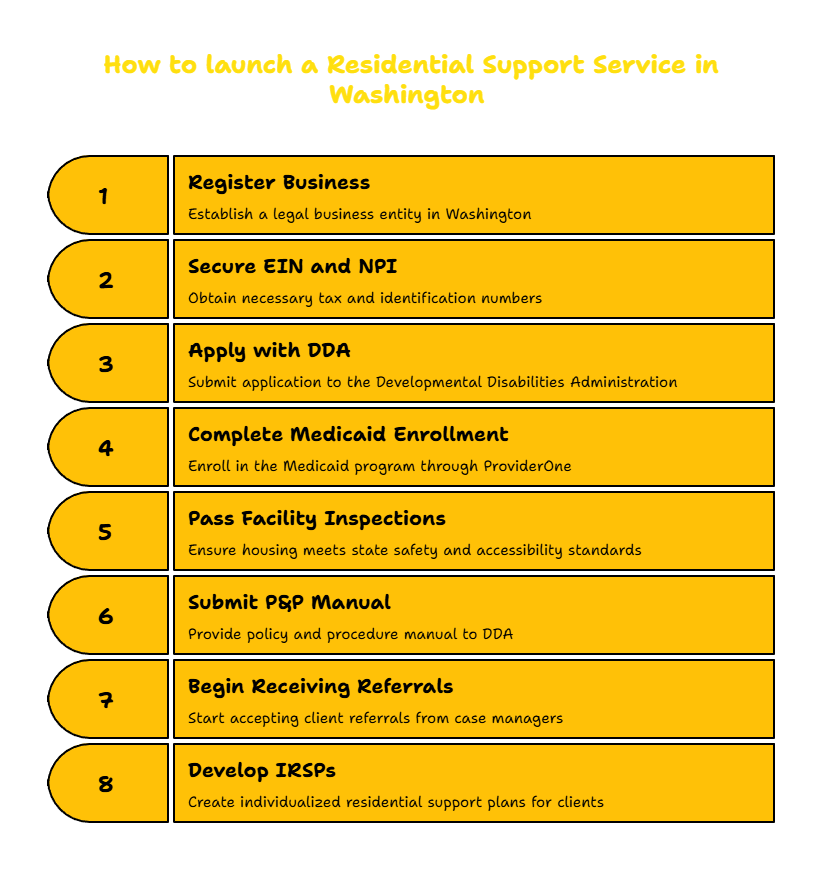
The transition from a business concept to an operational agency follows a specific sequence intended to ensure all regulatory obligations are met before any resident moves in. The process begins with business registration and securing the necessary federal identifiers, followed by submitting a formal application to the DDA. Once DDA status is secured, the organization must complete Medicaid enrollment through the ProviderOne portal to ensure eligibility for reimbursement.
Following administrative enrollment, the agency must focus on operational readiness. This involves passing facility inspections, establishing a robust Policy & Procedure (P&P) manual, and recruiting staff who meet the required credentialing standards. The timeline generally spans several months, with the initial licensing phase taking 2–4 weeks, followed by 2–3 months for DDA certification and 1–2 months for facility and staff preparation. Once all hurdles are cleared, the provider is ready to begin receiving referrals and collaborating with case managers to develop specific IRSPs for new residents.
Staffing, Training, and Essential Documentation
The success of a residential program hinges on the competence and reliability of the Direct Support Professionals (DSPs). All DSPs must pass thorough DSHS background checks and complete mandatory training, such as the 75-hour caregiver curriculum or other DDA-approved programs. Beyond initial training, staff must maintain certification in CPR and First Aid, and demonstrate ongoing proficiency in medication administration, fire safety, and incident reporting protocols.
Documentation is a critical component of regulatory compliance. Every agency must maintain a comprehensive Policy & Procedure Manual that covers resident admission, service planning, grievance procedures, and HIPAA-compliant communication. Furthermore, the agency must maintain accurate records for staffing ratios, behavioral support plans, and daily shift documentation. These records are subject to audit and serve as the primary evidence that the agency is delivering services according to the participant’s individualized needs.
- Direct Support Professional (DSP): Focuses on ADL support and goal tracking.
- Residential Program Manager: Oversees compliance and case manager coordination.
- Behavioral Support Specialist: Manages specific Behavior Support Plans (BSPs).
- Core Mandatory Training: Includes HIPAA, abuse prevention, and emergency response.
Frequently Asked Questions
What is the difference between the Core Waiver and the Community Protection Program?
The Core Waiver is the primary funding mechanism for residential habilitation and support services for eligible DDA clients. The Community Protection Program (CPP) is a more specialized waiver program designed for individuals who require more intensive oversight or who have a documented history of risky behavior, necessitating a more controlled residential environment.
Can Basic Plus Waiver funds be used for 24-hour residential support?
No. While the Basic Plus Waiver may fund certain community support services, it is not designed to cover the costs associated with 24-hour residential settings. 24-hour residential services are typically accessed through the Core Waiver or the Community Protection Program.
What is the role of the ProviderOne portal in this process?
The ProviderOne portal is the centralized system used by the Health Care Authority to manage Medicaid enrollment, claims, and reimbursement for Washington state providers. All residential service providers must be active in this portal to receive payment for the supports they deliver to Medicaid-eligible individuals.
Key Takeaway
Establishing a residential support agency in Washington requires a disciplined approach to regulatory compliance, encompassing DDA certification, DSHS licensing, and Medicaid enrollment via the ProviderOne portal. By focusing on the development of a comprehensive Policy & Procedure manual, implementing robust staff training, and ensuring full alignment with the Individualized Residential Support Plan (IRSP), providers can build sustainable, high-quality programs that support independence for individuals with developmental disabilities.
Waiver Consulting Group (WCG) helps organizations launch certified residential programs that meet DDA, Medicaid, and safety standards. Our services include ProviderOne and DDA enrollment guidance, Residential Policy & Procedure Manual development, facility readiness checklists, IRSP template creation, and staff orientation toolkits. Last verified: 2024. The information provided in this article is for educational purposes only and does not constitute legal or professional advice. Always consult with the relevant state agencies (DSHS, DDA, HCA) or a qualified consultant before making business decisions.