RESIDENTIAL SUPPORT SERVICES PROVIDER IN VIRGINIA
By Fatumata Kaba · 2026-04-08 · 5 min read
Becoming a residential support services provider in Virginia is a significant undertaking that requires strict adherence to state regulatory frameworks designed to protect vulnerable populations. As a provider, your primary role is to create safe, supportive, and person-centered home environments that foster independence, dignity, and community integration for individuals with intellectual and developmental disabilities (ID/DD).
This path involves navigating a complex landscape of licensing through the Department of Behavioral Health and Developmental Services (DBHDS), Medicaid enrollment via the Department of Medical Assistance Services (DMAS), and ongoing coordination with local Community Services Boards (CSBs). By prioritizing compliance and quality assurance, new providers can successfully establish programs that meet the rigorous standards of Virginia’s Community Living (CL) and Family and Individual Supports (FIS) waiver programs.
Navigating the Regulatory Landscape and Oversight Agencies
The regulatory structure for residential support in Virginia is multi-tiered, requiring providers to maintain active relationships with several governing bodies. The DBHDS serves as the primary regulator, responsible for issuing licenses, setting operational standards, and conducting quality assurance inspections. Their Office of Licensing ensures that residential settings—whether group homes, sponsored residential homes, or supported living environments—meet all health, safety, and human rights requirements.
Beyond initial licensing, providers must operate under the purview of DMAS, which administers the Medicaid funding that sustains these services. Additionally, the CSBs act as the local gateway for services; they are responsible for assessing individual needs, authorizing service hours within an Individual Support Plan (ISP), and monitoring the quality of care provided to their constituents. Maintaining strong partnerships with these local boards is essential for receiving referrals and ensuring the long-term viability of your residential program.
Establishing Your Residential Support Service Model
Residential support services are delivered in various settings, and choosing the right model is a foundational decision for any new provider. These services provide 24-hour or scheduled assistance to help individuals master daily living skills. Common models include group homes (limited to four or fewer residents per home), sponsored residential homes where individuals live with a primary caregiver, and supported living arrangements where individuals reside independently or with roommates in provider-managed housing.
Regardless of the setting, the scope of services remains focused on the individual’s unique ISP. Essential support functions typically include:
- Assistance with activities of daily living (ADLs) and instrumental activities of daily living (IADLs), such as hygiene, meal preparation, and laundry.
- Medication administration and health monitoring, often overseen by qualified medical personnel.
- Supervision and safety support to ensure a secure living environment.
- Behavioral support and crisis response protocols tailored to the individual.
- Community participation, social integration, and transportation assistance.
- Consistent tracking of ISP goals to measure progress and adjust care plans as needed.
The Step-by-Step Provider Enrollment Roadmap
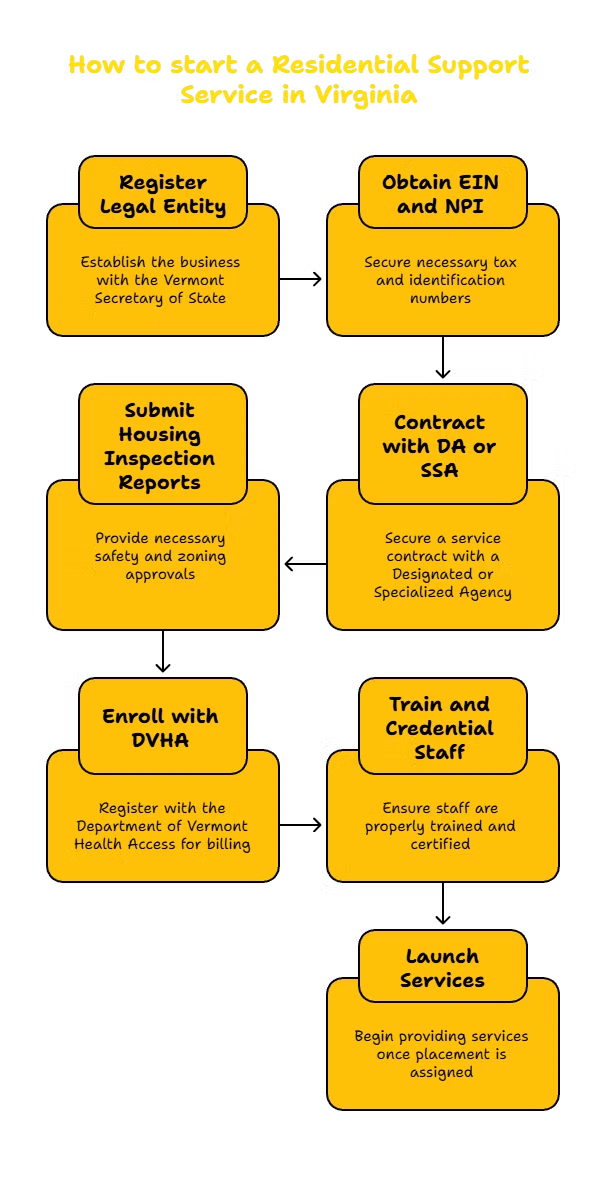
The transition from a business idea to an operational service provider follows a structured, sequential process. You must begin by establishing your business entity with the Virginia State Corporation Commission (SCC) and obtaining your EIN and Type 2 NPI. Once the legal structure is in place, the focus shifts to the DBHDS licensing application, which requires the submission of a comprehensive policy and procedure manual, proof of Human Rights Committee affiliation, and evidence of facility compliance, such as fire safety and occupancy reports.
After securing your license, the focus shifts to Medicaid enrollment. This is performed via the DMAS Medicaid Enterprise System (MES) portal. Once enrolled as a Medicaid provider, you must contract with the relevant CSBs in the regions where you intend to operate. These contracts, coupled with the submission of detailed staffing plans and site-specific documentation, effectively clear the path for your first client referrals and the implementation of authorized service plans.
Staffing Requirements and Quality Assurance Protocols
The quality of your residential service is directly dependent on the competence and training of your staff. Direct Support Professionals (DSPs) are the backbone of the organization and must possess a high school diploma, pass mandatory background and Central Registry (CPS) checks, and hold certifications in medication administration (MAT), CPR, and First Aid. Beyond basic certifications, staff must be thoroughly trained in person-centered planning, human rights protections, and the specific needs outlined in each client’s ISP.
Management-level roles, such as Program Managers or House Supervisors, are vital for ensuring ongoing compliance. These individuals are responsible for staff scheduling, quality control, and ensuring that all daily logs, incident reports, and goal-tracking documentation meet the standards required by DBHDS and DMAS. When medical needs are present, the inclusion of an RN is necessary to oversee health protocols and provide ongoing clinical training to direct care staff.
Frequently Asked Questions
What is the primary difference between the Community Living and FIS Waivers?
The Community Living (CL) Waiver is designed for individuals who require 24/7 or significant, round-the-clock residential support. The Family and Individual Supports (FIS) Waiver is typically utilized for individuals who need less intensive support, often supporting shared housing models or those requiring less than 24-hour care.
How long does the licensing and enrollment process typically take?
The timeline varies based on organizational readiness, but generally, business formation and licensing preparation take 2 to 3 months. Following this, Medicaid enrollment and CSB contracting typically require an additional 1 to 2 months. Staff hiring and site readiness usually add another 4 to 6 weeks before service launch.
What must be included in the Residential Services Policy & Procedure Manual?
Your manual must serve as a comprehensive operational guide. It must cover staffing and supervision protocols, medication administration procedures, emergency evacuation plans, incident reporting, client rights, HIPAA compliance, behavioral support strategies, and clear guidelines for maintaining daily shift notes and ISP goal tracking.
Launching and Sustaining Your Program
Waiver Consulting Group provides targeted assistance to new providers looking to launch licensed and compliant residential programs. Our scope of work includes guiding founders through the DBHDS licensing application, preparing for state inspections, navigating the complexities of Medicaid enrollment, and developing professional Policy & Procedure Manuals. We also provide templates for staff onboarding, incident response, and ISP implementation to ensure your program is ready for the rigors of state auditing from day one.
Key takeaway: Success in the Virginia residential support market is predicated on a commitment to person-centered care and meticulous adherence to the documentation and training standards mandated by DBHDS and DMAS. By building your agency on a foundation of regulatory compliance and strong CSB relationships, you ensure the sustainability of your program and the well-being of the individuals you serve.
Last verified: October 2023. This information is for educational purposes only and does not constitute legal or professional advice. Always consult with the Virginia Department of Behavioral Health and Developmental Services (DBHDS) or the Department of Medical Assistance Services (DMAS) for the most current regulatory requirements.