RESIDENTIAL SUPPORT SERVICES PROVIDER IN VERMONT
By Fatumata Kaba · 2026-04-09 · 5 min read
Residential Support Services in Vermont provide essential, individualized care for individuals with intellectual disabilities, developmental disabilities, or acquired brain injuries who require 24-hour or scheduled assistance to live successfully in the community. As a foundational component of Vermont’s Medicaid Home and Community-Based Services (HCBS) ecosystem, these services are managed by the Department of Disabilities, Aging and Independent Living (DAIL) and delivered through a network of Designated Agencies (DAs) and Specialized Service Agencies (SSAs) to ensure residents receive the support, supervision, and skill-building necessary for a stable, home-like environment.
How Are Residential Support Services Regulated and Authorized in Vermont?
The framework for residential support in Vermont is designed to ensure participant safety while fostering community integration and personal autonomy. Regulatory oversight is primarily the responsibility of the Department of Disabilities, Aging and Independent Living (DAIL), which monitors program compliance, establishes quality standards, and ensures that all services are delivered in a person-centered manner. Any provider operating within this space must adhere strictly to the rules set forth by DAIL to maintain their standing.
While DAIL provides the regulatory structure, the Department of Vermont Health Access (DVHA) is responsible for the financial administration of the program. This includes the enrollment of providers into the Medicaid system and the processing of payments for authorized services. Coordination on the ground is facilitated by Designated Agencies (DAs) or Specialized Service Agencies (SSAs). These entities act as the bridge between the state and the provider, managing Individual Support Plans (ISPs), authorizing specific placements, and performing ongoing quality assurance audits.
What Specific Services Does a Residential Provider Deliver?
Residential Support Services encompass a wide range of activities tailored to the unique needs identified in an individual’s ISP. These settings, which may include shared living homes, group homes, supervised apartments, or dedicated staffed residences, are designed to mirror the comfort of a private home while providing the necessary level of clinical and personal oversight.
The scope of these services is expansive, intended to cover both daily survival needs and long-term developmental goals. Providers must be prepared to offer:
- Comprehensive 24-hour supervision and direct care interventions.
- Consistent assistance with Activities of Daily Living (ADLs) and Instrumental Activities of Daily Living (IADLs).
- Clinical support, including medication administration and routine health monitoring.
- Nutritional planning, hygiene maintenance, and mobility support.
- Specialized behavioral support and documented crisis response protocols.
- Facilitation of community engagement, including transportation to day programs or social activities.
- Systematic goal setting, structured skill development, and meticulous ISP progress tracking.
What Are the Essential Requirements for Provider Approval?
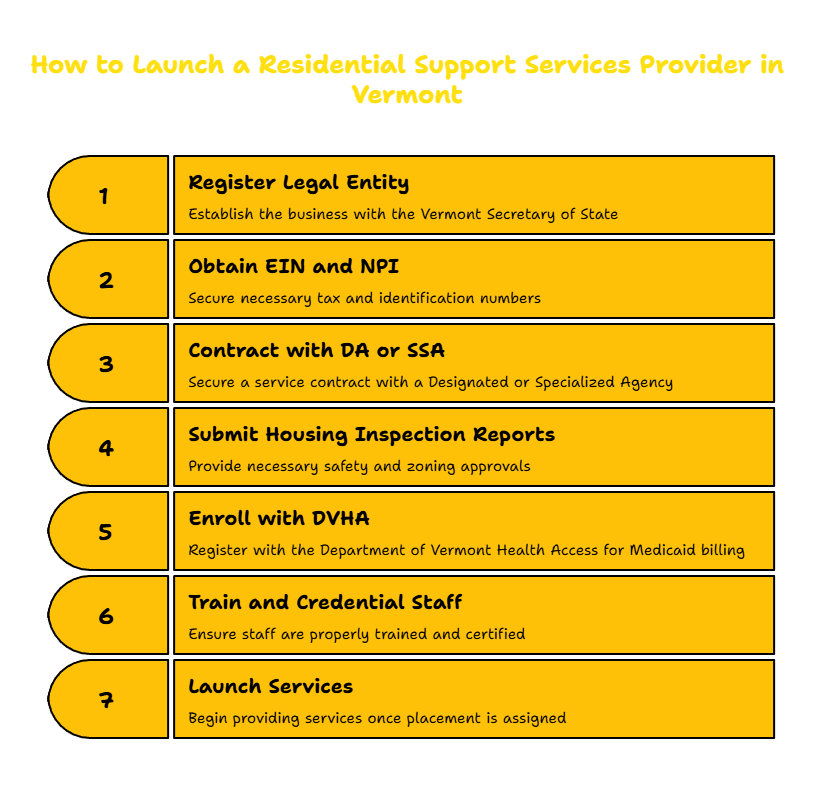
Becoming an approved residential provider requires a formal, multi-step process that verifies the provider's legal standing and capacity to deliver safe services. Potential providers must first establish a formal business entity, register with the Vermont Secretary of State, and obtain both an Employer Identification Number (EIN) and a Type 2 National Provider Identifier (NPI). These initial steps establish the provider as a recognized legal entity capable of entering into state contracts.
Beyond administrative setup, providers must navigate the specific contracting requirements mandated by the state. This involves developing a robust Residential Support Services Policy & Procedure Manual that outlines every aspect of service delivery, from staff responsibilities to incident reporting. Furthermore, providers must secure the necessary local zoning clearances and fire safety certifications, which are contingent upon the specific model of housing being utilized. The process culminates in obtaining approval from a DA or SSA, which serves as the gateway to accepting client placements.
How Do You Manage Staffing and Compliance Documentation?
The success of a residential program is heavily dependent on the competence and training of Direct Support Professionals (DSPs). All staff must meet foundational requirements, including the successful completion of a background check, valid CPR/First Aid certification, and a high school diploma or equivalent. Beyond these basics, DSPs must be thoroughly trained in person-centered care, HIPAA regulations, and the specific nuances of the ISP for each resident they support.
Administrative rigor is required for documentation and oversight. A Residential Coordinator or Supervisor must be appointed to oversee staff scheduling, maintain shift logs, and manage incident reporting. Essential documentation that every provider must maintain includes:
- Clearly defined supervision schedules and staff responsibility matrices.
- Formalized medication administration records and health monitoring logs.
- Documented emergency preparedness, fire evacuation, and disaster plans.
- Specific behavioral response, de-escalation, and privacy policy documents.
- Client rights and grievance procedure documentation for all residents.
- Systematic tools for ISP tracking and progress reporting.
Which Medicaid Waivers Cover Residential Services?
Residential Support Services in Vermont are funded through specific Medicaid waiver programs, each serving distinct populations with tailored needs. The Developmental Disabilities Services Waiver (DDSW) serves as the core mechanism for individuals requiring 24/7 residential support. Similarly, the Brain Injury Program is specifically designed for individuals with acquired brain injuries who require a structured, supervised living environment to manage their recovery and daily needs.
Other programs exist for more specialized populations. The Choices for Care (CFC) Waiver may cover certain group residence options for older adults requiring assistance, while High-Tech Pediatric and Transition Services are available on a case-by-case basis for medically complex youth. Regardless of the funding source, all services must be inextricably linked to the participant’s ISP and must demonstrate full compliance with Vermont’s HCBS residential setting requirements.
Frequently Asked Questions
What is the typical timeline to launch a new residential service?
The launch process is generally categorized into four phases: business setup and housing readiness (3–4 weeks), DA/SSA contracting and Medicaid enrollment (1–2 months), housing inspections and staff hiring (4–6 weeks), and final service launch, which commences upon the approval of an ISP and official resident placement.
Do I need to be licensed if I am contracting with a Designated Agency?
While you contract with a DA or SSA for the delivery of services, you must still adhere to DAIL residential care regulations, satisfy fire safety and egress requirements, and follow the rigorous policies and procedures mandated by both the state and the agency overseeing your contract.
What defines a "person-centered" residential environment?
A person-centered environment is one that honors the individual's preferences, choices, and autonomy while ensuring their health and safety. This requires that every aspect of the service, from daily routine to goal setting, is driven by the specific needs and desires outlined in the individual’s ISP.
Key Takeaway
Launching a Residential Support Services agency in Vermont requires a disciplined approach to administrative setup, strict adherence to DAIL and DVHA regulatory standards, and a unwavering commitment to person-centered care. By establishing strong partnerships with Designated Agencies and maintaining comprehensive, audit-ready documentation, providers can effectively support individuals with complex needs while contributing to a stable and inclusive community housing landscape.
Last verified: November 2024. This information is for educational purposes only and does not constitute legal or professional consulting advice. Requirements may change; please verify all regulations with the Vermont Department of Disabilities, Aging and Independent Living (DAIL) or the Department of Vermont Health Access (DVHA) before launching your agency.