RESIDENTIAL SUPPORT SERVICES PROVIDER IN OREGON
By Fatumata Kaba · 2025-10-07 · 6 min read
Residential Support Services in Oregon are Medicaid-funded programs designed to provide essential care, supervision, and skill-building for individuals with intellectual and developmental disabilities (IDD) within community-based settings. These services, authorized through Oregon’s Home and Community-Based Services (HCBS) Waivers and the K Plan, enable participants to live as independently as possible while receiving the precise level of support required to ensure health, safety, and meaningful community integration.
Operating a residential support program requires a rigorous commitment to person-centered care and strict adherence to state regulatory frameworks. By aligning business operations with the guidelines established by the Oregon Department of Human Services (ODHS) and the Office of Developmental Disabilities Services (ODDS), providers can create stable, high-quality environments that meet the complex needs of the individuals they serve.
What Are the Roles of Governing Agencies in Oregon Residential Services?
The regulatory landscape for residential providers in Oregon is a collaborative effort involving state and federal oversight bodies. The primary authority is the Oregon Department of Human Services (ODHS), specifically the Office of Developmental Disabilities Services (ODDS). ODDS is responsible for the certification of residential service providers, ensuring that all community-based settings meet quality standards. This is done in direct coordination with local Community Developmental Disabilities Programs (CDDPs), which serve as the frontline for local oversight and service authorization.
Complementing these efforts is the Oregon Health Authority (OHA), which administers the Oregon Health Plan (OHP). The OHA manages the mechanics of Medicaid enrollment, ensuring that provider billing practices and service delivery models remain in compliance with state-level Medicaid rules. Furthermore, the Centers for Medicare & Medicaid Services (CMS) sets the federal framework for these HCBS waivers, requiring that all state residential services uphold specific standards for community integration and autonomy.
Finally, prospective providers must interact with the Oregon Secretary of State (SOS) to formalize their business entity. Proper legal formation and business registration are non-negotiable prerequisites for seeking certification. Understanding the distinct roles of these agencies ensures that a provider can navigate the compliance lifecycle effectively from the point of incorporation through ongoing operational monitoring.
How Are Residential Support Services Structured for Individuals with IDD?
Residential services in Oregon are highly individualized, ranging from 24-hour group home settings to intermittent supported living arrangements. The goal is always to match the support intensity to the specific needs of the individual, as defined in their Individual Support Plan (ISP). Providers are expected to facilitate a home-like environment that fosters personal growth, self-advocacy, and social participation.
Common service models include:
- 24-Hour Residential Services: Providing around-the-clock supervision and support in group homes or staffed residences.
- Supported Living Services: Providing assistance to individuals living independently or with roommates in community-based apartments or houses.
- Host Homes and Adult Foster Care (AFH): Delivering care in a family-like, intimate environment through certified providers.
- Daily Living Support: Assisting with essential tasks such as bathing, cooking, dressing, shopping, and household financial management.
- Community Integration: Encouraging active participation in public life, including recreational activities and community outings.
- Health and Safety Monitoring: Managing medication administration, health documentation, and implementing behavior support plans where applicable.
What Are the Essential Requirements for Provider Licensing and Enrollment?
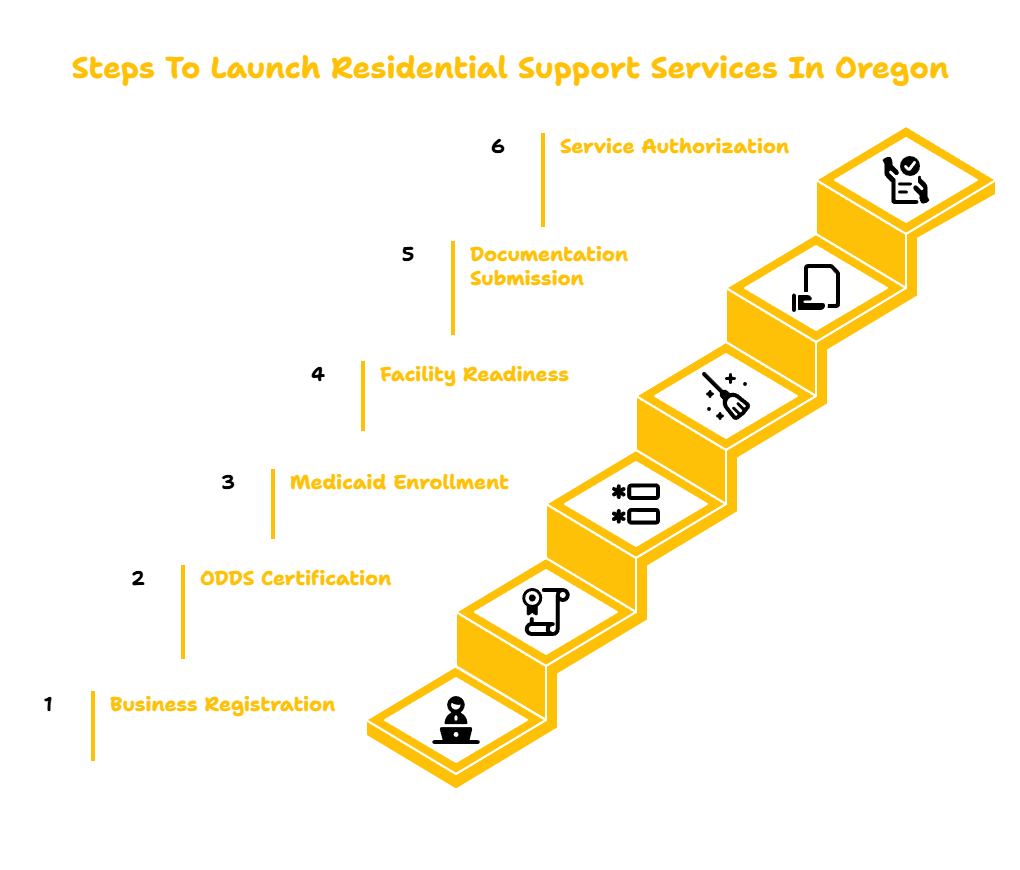
Becoming an approved residential provider is a multi-layered process that begins long before the first resident moves in. Founders must first secure the administrative foundations of their business, including obtaining an Employer Identification Number (EIN) from the IRS and a Type 2 National Provider Identifier (NPI). These identifiers are critical for all future interactions with the Oregon Health Plan Provider Portal.
Once the business is legally formed, the provider must engage with their local CDDP to initiate the ODDS certification process. This stage involves detailed inspections of the proposed residential setting to ensure that fire, safety, and accessibility requirements are met. It also necessitates the development of a comprehensive Residential Support Services Policy & Procedure Manual. This manual serves as the operational blueprint, detailing everything from resident rights and grievance protocols to emergency evacuation plans.
Insurance coverage is another critical pillar of the enrollment process. Providers must maintain robust policies, including general liability, workers’ compensation, and property insurance, to protect both the agency and the individuals receiving services. Failure to maintain these financial and administrative safeguards can lead to delays in certification or the inability to bill for Medicaid services effectively.
How Do You Manage Staffing and Compliance Requirements?
The quality of residential support is fundamentally tied to the competence and dedication of the staff. Whether hiring Direct Support Professionals (DSPs) or house managers, providers must ensure that every team member undergoes rigorous training. This includes state-mandated background checks, CPR and First Aid certification, and the completion of the ODDS core training curriculum.
Ongoing compliance is maintained through consistent documentation. This includes keeping detailed progress notes, tracking the implementation of Individual Support Plans (ISPs), and ensuring that all incident reports are filed promptly and accurately. Because these records are subject to audit, having a standardized system for documentation is essential for maintaining certification.
- Abuse Reporting and Safety: All staff must be trained in mandatory abuse reporting requirements and safety protocols.
- HIPAA Compliance: Strict adherence to privacy and confidentiality modules is required for all personnel.
- ISP Implementation: Staff must be proficient in reading, understanding, and carrying out the specific goals defined in each participant's ISP.
- Annual Competency Reviews: Providers must conduct regular in-service training and performance evaluations to ensure staff remain current with evolving state standards.
Frequently Asked Questions
What are the primary Medicaid waiver programs that cover these services?
Residential support is primarily funded through the Comprehensive Waiver (IDD), the Support Services Waiver (IDD), and the K Plan (1915(k)). Additionally, the Children’s DD Waiver provides specific support for family and foster care-based arrangements.
What is the typical timeline for launching a new residential provider agency?
The launch process generally takes several months: 1–2 months for business registration and manual preparation, 2–3 months for ODDS certification and Medicaid enrollment, and 30–60 days for staffing and training, followed by the coordination of client referrals.
What happens if a provider fails a compliance audit?
Failure to meet standards during an audit can result in the issuance of a corrective action plan (CAP). It is vital to maintain accurate shift logs, medication documentation, and incident reports to ensure that the agency can demonstrate consistent adherence to Oregon Administrative Rules (OARs) when requested by regulators.
Waiver Consulting Group’s Start-Up Assistance
WCG provides specialized support for providers in Oregon seeking to establish high-quality, person-centered residential programs. Our services cover the full spectrum of the launch process, including business formation, Medicaid enrollment, and ODDS certification. We assist in the development of customized Policy & Procedure Manuals, staff onboarding and training trackers, and the creation of robust systems for incident reporting and ISP delivery documentation. By leveraging professional guidance, providers can navigate the complexities of regulatory requirements more efficiently, ensuring their focus remains on supporting the individuals served.
Key takeaway: Achieving long-term success as an Oregon residential support provider requires a balance of administrative rigor, strict adherence to ODDS and OHA guidelines, and an unwavering commitment to the health and independence of the individuals receiving support. By building a solid foundation in the early stages of business development, providers ensure the sustainability and quality of their residential programs.
Last verified: January 2024. This information is intended for educational purposes and does not constitute legal or financial advice. Regulations regarding Oregon Medicaid waivers are subject to change. Always consult the official Oregon Department of Human Services (ODHS) and Oregon Health Authority (OHA) documentation for the most current guidance on provider requirements.