RESIDENTIAL SUPPORT SERVICES PROVIDER IN NEW MEXICO
By Fatumata Kaba · 2025-09-05 · 9 min read
Establishing Residential Support Services in New Mexico requires navigating a specific set of state and federal regulations to ensure the delivery of safe, high-quality care for individuals with disabilities and chronic conditions. These services, authorized under New Mexico Medicaid Home and Community-Based Services (HCBS) Waiver programs, are designed to foster independence, enhance personal growth, and promote meaningful community integration for participants.
Understanding the Regulatory Landscape for New Mexico Residential Support Services
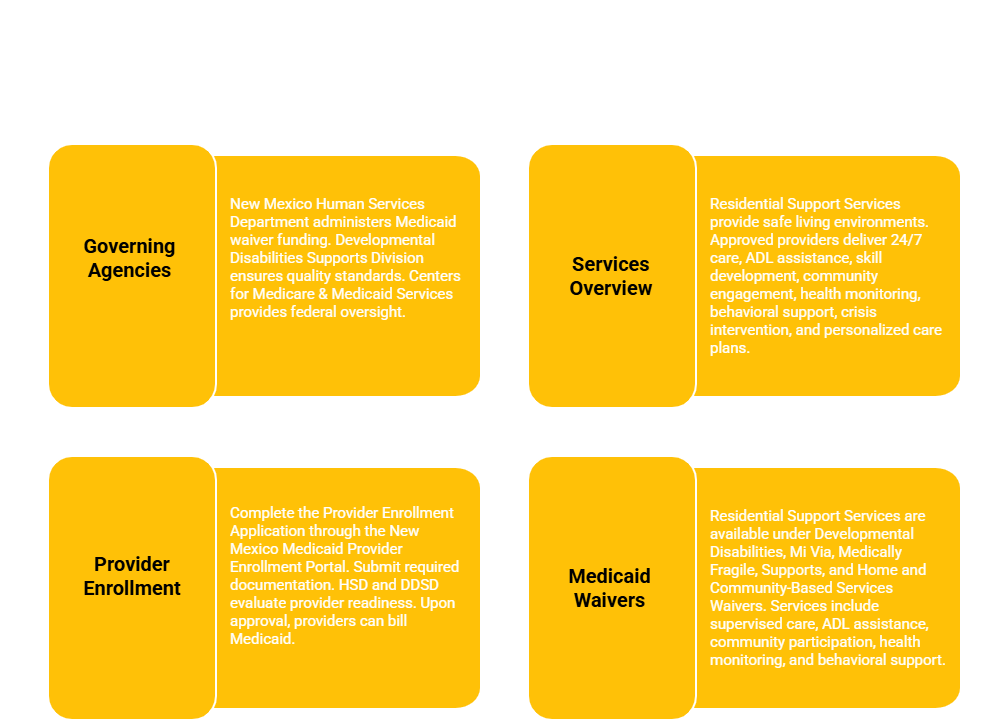
In New Mexico, the provision of Residential Support Services is overseen by a collaborative framework involving key state and federal agencies. The New Mexico Human Services Department (HSD) plays a central role in administering Medicaid waiver funding, managing the enrollment process for providers, authorizing services, and processing reimbursements. Complementing HSD's administrative functions is the Developmental Disabilities Supports Division (DDSD), which is dedicated to upholding quality standards, ensuring effective service delivery, and maintaining compliance with all regulations pertaining to Residential Support Services under HCBS waiver programs. At the federal level, the Centers for Medicare & Medicaid Services (CMS) provides overarching guidance and oversight, ensuring that all Medicaid-funded services, including those in New Mexico, adhere to established HCBS quality principles, person-centered planning requirements, and participant protection standards. This multi-tiered regulatory structure ensures a comprehensive approach to the delivery of these vital supports.
The successful operation of a Residential Support Services provider hinges on a deep understanding of the roles and responsibilities of each of these governing agencies. HSD's involvement ensures that services align with Medicaid policies and financial structures, while DDSD's focus on quality assurance and service delivery guarantees that participants receive appropriate and effective care. CMS's federal oversight provides a consistent benchmark for quality and participant rights across the nation. Providers must maintain open communication and proactive engagement with all three entities to ensure ongoing compliance and access to program funding.
What Services Do New Mexico Residential Support Providers Offer?
Residential Support Services in New Mexico are designed to offer a spectrum of care within safe and structured living environments, catering to individuals who require assistance with daily living and community integration. Approved providers are authorized to deliver comprehensive support tailored to the unique needs of each participant, all guided by an Individualized Service Plan (ISP).
- 24/7 Residential Care: These arrangements provide continuous supervision and support from trained staff, ensuring a safe and stable living environment around the clock.
- Assistance with Activities of Daily Living (ADLs): Services include hands-on help with personal care tasks such as bathing, dressing, grooming, toileting, as well as mobility support and essential health monitoring.
- Skill Development: Providers focus on teaching and reinforcing crucial daily living skills, encompassing areas like meal preparation, household management, financial literacy, and personal organization.
- Community Engagement: Active facilitation is provided to encourage and support participant involvement in social gatherings, recreational activities, educational pursuits, and other community-based opportunities.
- Health and Safety Monitoring: Continuous vigilance is maintained to ensure the living environment is secure and supportive, and that participants' health and well-being are prioritized.
- Behavioral Support: For individuals who may experience challenging behaviors, providers offer specialized assistance and strategies to promote positive coping mechanisms and adaptive behaviors.
- Emergency and Crisis Intervention: Immediate and effective support is readily available to address any emergent situations or crises that may arise, ensuring participant safety.
- Personalized Care Plans: A cornerstone of these services is the development of individualized plans that are meticulously crafted to address the specific residential and support needs of each participant.
The overarching goal of these services is to empower individuals to live as independently as possible within their communities, fostering dignity, self-determination, and a high quality of life.
Navigating Licensing and Provider Approval Requirements in New Mexico
To become an approved Residential Support Services provider in New Mexico, prospective agencies must meet a stringent set of prerequisites designed to ensure program integrity and participant safety. The initial steps involve establishing a legal business entity and obtaining necessary federal identification. Subsequently, providers must formally enroll with the New Mexico Medicaid program and secure the appropriate residential facility licensure, which may come from HSD, DDSD, or the New Mexico Department of Health (NMDOH), depending on the specific service model.
- Business Entity Registration: The business must be officially registered with the New Mexico Secretary of State.
- Federal Identification: An Employer Identification Number (EIN) from the IRS and a National Provider Identifier (NPI, Type 2) are mandatory.
- Medicaid Provider Enrollment: Formal enrollment as a Medicaid Waiver Residential Support provider is required through the New Mexico Medicaid Provider Enrollment Portal.
- Facility Licensure: Depending on the type of residential setting, a license from HSD, DDSD, or NMDOH may be necessary.
- Insurance Coverage: Providers must maintain adequate general liability and professional liability insurance to mitigate risks.
- Policy Development: Comprehensive policies and procedures must be developed covering all aspects of residential care, including safety protocols and staff training.
- Staff Qualifications: All staff must undergo rigorous background checks, health screenings, and receive specialized training pertinent to residential care.
Adherence to these requirements is critical for initial approval and for maintaining ongoing compliance with state and federal regulations governing HCBS programs.
The New Mexico Provider Enrollment Process for Residential Support Services
The journey to becoming an approved Residential Support Services provider in New Mexico involves a structured enrollment process managed through the New Mexico Medicaid Provider Enrollment Portal. This process is designed to verify that agencies meet all necessary operational, financial, and quality standards before they can begin providing services and billing Medicaid.
The initial phase involves expressing interest and submitting a comprehensive Provider Enrollment Application. This application serves as the formal request to participate in the Medicaid program as a provider of Residential Support Services under the HCBS waivers. Following this, providers must meticulously assemble and submit a substantial amount of required documentation. This typically includes official business formation documents, such as Articles of Incorporation, proof of EIN and NPI, copies of all necessary residential facility licenses, certificates of insurance, and detailed policy and procedure manuals.
Once the application and documentation are submitted, a thorough Program Readiness Review is conducted by representatives from HSD and DDSD. This evaluation assesses the provider's operational readiness, including the safety and suitability of their facilities, the qualifications and preparedness of their staff, and the robustness of their care protocols. Upon successful completion of this review and approval by the relevant agencies, the provider is officially enrolled in the New Mexico Medicaid program and authorized to bill for Residential Support Services using the designated billing codes. This marks the final step before commencing service delivery.
Essential Documentation for Residential Support Providers
Successfully navigating the provider enrollment process for Residential Support Services in New Mexico necessitates the meticulous preparation and submission of a comprehensive set of documents. These requirements are in place to ensure that providers are legally established, financially sound, and operationally capable of delivering high-quality care in compliance with all state and federal mandates.
- Business Formation Documents: Official proof of business registration, such as Articles of Incorporation or a Business License issued by the New Mexico Secretary of State, is required.
- Federal Tax Identification: Confirmation of the IRS Employer Identification Number (EIN) and the National Provider Identifier (NPI) are essential for billing and identification purposes.
- Facility Licensing: If the service involves a residential facility, the relevant license issued by HSD, DDSD, or NMDOH must be provided.
- Insurance Verification: Proof of current general and professional liability insurance coverage is mandatory to protect both the provider and the participants.
- Residential Support Services Policy & Procedure Manual: A detailed manual is a critical component, outlining the agency's operational framework. This manual must comprehensively address:
- Participant intake, assessment, and individualized care planning procedures
- Health and safety monitoring, medication management, and emergency preparedness
- Staff credentialing, background checks, and ongoing training records
- Documentation standards for residential care tracking and Medicaid billing
- HIPAA compliance, participant rights, and grievance handling procedures
- Safety protocols, emergency response, and crisis intervention measures
- Quality assurance and compliance monitoring processes
Thoroughness and accuracy in assembling these documents are paramount to a smooth and successful provider enrollment experience.
Key Staffing Requirements for Residential Support Services
The effective delivery of Residential Support Services in New Mexico relies heavily on a qualified and well-trained staff. Specific roles have defined educational and experiential requirements, and all personnel must undergo comprehensive training to ensure they can meet the diverse needs of participants while adhering to program standards.
- Residential Support Program Director: This leadership role typically requires a Bachelor's or Master's degree in a relevant field such as human services, social work, or healthcare administration, along with prior supervisory experience in a care setting.
- Direct Support Professionals (DSPs): The frontline caregivers must possess at least a high school diploma or GED. Essential certifications include CPR/First Aid. They require specific training in personal care, ADL support, and must pass a background clearance.
- Residential Care Supervisors: These individuals need demonstrated experience in managing residential care operations and supervising staff. A background clearance is also mandatory for this role.
- Behavioral Support Specialists: For providers offering behavioral interventions, specialists often need certification in areas like behavioral health support or applied behavior analysis (ABA), in addition to a background clearance.
Beyond role-specific qualifications, all staff members must complete a standardized set of training modules. These include training in residential safety and emergency protocols, HIPAA compliance and participant rights education, infection control and wellness monitoring, and crucial behavioral intervention and crisis management techniques. Regular competency evaluations and ongoing professional development are also mandated to ensure staff remain proficient and up-to-date with best practices.
New Mexico Medicaid Waiver Programs Offering Residential Support
Residential Support Services are an integral component of several New Mexico Medicaid Home and Community-Based Services (HCBS) Waiver programs, providing essential living assistance and community integration opportunities for eligible individuals. The specific waiver a participant is enrolled in will determine the scope and availability of these services, ensuring that support aligns with their diagnosed needs and care goals.
- Developmental Disabilities (DD) Waiver: This waiver serves individuals with intellectual and developmental disabilities, offering comprehensive residential support to promote independence and community inclusion.
- Mi Via Waiver: Designed for individuals with significant needs, Mi Via offers a self-directed approach, allowing participants more control over their services, including residential support options.
- Medically Fragile Waiver: This waiver is for individuals with complex medical needs who require specialized residential care and ongoing health monitoring.
- Supports Waiver: This waiver provides a range of services, including residential support, for individuals with various disabilities and chronic conditions who need assistance to live in the community.
- Home and Community-Based Services (HCBS) Waiver: This is a broader waiver category under which Residential Support Services can be authorized, encompassing a wide array of supports aimed at preventing institutionalization and promoting community living.
Services commonly provided across these waivers include 24-hour supervised residential care, assistance with personal care and ADLs, support for community participation and social skill development, health and wellness monitoring, and specialized behavioral support and crisis intervention.
Frequently Asked Questions for Residential Support Providers in New Mexico
What is the primary goal of Residential Support Services in New Mexico?
The primary goal of Residential Support Services in New Mexico is to provide safe and supportive living environments that promote independence, personal growth, and community integration for individuals with disabilities, chronic conditions, or age-related challenges.
Who oversees Residential Support Services in New Mexico?
Residential Support Services in New Mexico are overseen by a combination of the New Mexico Human Services Department (HSD) for administration and funding, the Developmental Disabilities Supports Division (DDSD) for quality assurance and compliance, and the Centers for Medicare & Medicaid Services (CMS) for federal oversight.
What types of individuals are eligible for Residential Support Services?
Individuals eligible for Residential Support Services are typically those who have disabilities, chronic conditions, or age-related challenges that require assistance with daily living and who are enrolled in specific New Mexico Medicaid HCBS Waiver programs, such as the DD Waiver, Mi Via Waiver, Medically Fragile Waiver, or Supports Waiver.
Key Takeaway
Launching and operating a Residential Support Services agency in New Mexico is a complex undertaking that demands meticulous attention to regulatory compliance, robust operational planning, and a steadfast commitment to participant well-being. By thoroughly understanding and adhering to the requirements set forth by HSD, DDSD, and CMS, providers can establish sustainable services that significantly enhance the lives of individuals seeking supportive community living arrangements.
Last verified: May 15, 2024. This information is for general guidance purposes only and does not constitute legal advice. Providers should consult official state and federal resources and legal counsel for specific requirements.