RESIDENTIAL SUPPORT SERVICES PROVIDER IN NEW JERSEY
By Fatumata Kaba · 2025-09-05 · 6 min read
Residential Support Services in New Jersey represent a critical component of the state’s Home and Community-Based Services (HCBS) framework, offering individuals with disabilities, chronic conditions, or age-related challenges the ability to live in safe, inclusive, and professionally supported environments. For provider agencies, entering this sector requires a rigorous commitment to state-mandated quality standards, person-centered care planning, and administrative compliance with the New Jersey Department of Human Services (DHS) and the Division of Developmental Disabilities (DDD).
What Are the Governing Regulatory Agencies for Residential Support Services?
The regulatory landscape for residential care in New Jersey is defined by a multi-tiered oversight system designed to ensure participant safety and the responsible expenditure of Medicaid funds. The primary governing body at the state level is the New Jersey Department of Human Services (DHS), which manages Medicaid waiver funding and oversees the logistical processes of provider enrollment, service authorization, and reimbursement. Within the DHS, the Division of Developmental Disabilities (DDD) holds the essential role of ensuring that service delivery aligns with HCBS quality standards, maintaining the integrity of care provided within residential settings.
On a federal level, the Centers for Medicare & Medicaid Services (CMS) provides the overarching regulatory framework. CMS oversight ensures that all New Jersey Medicaid-funded Residential Support Services remain strictly compliant with HCBS requirements, specifically those related to person-centered planning and participant protection. Providers must demonstrate ongoing adherence to these federal standards to maintain eligibility for reimbursement, making it vital for agency administrators to keep current with both state-specific mandates and federal quality assurance guidelines.
The New Jersey Department of Community Affairs (DCA) also plays a role, particularly concerning the physical safety and zoning standards for the facilities themselves. Understanding the intersection of these agencies is essential for any organization seeking to operate as a residential service provider, as compliance audits are frequent and rigorous.
What Services Do Residential Support Providers Deliver Under HCBS Waivers?
Residential Support Services provide structured, safe living environments tailored to individuals who require varying levels of assistance to maintain independence. These services are not one-size-fits-all; rather, they are dictated by the participant’s Individualized Service Plan (ISP), which outlines the specific supports required to maximize the individual's autonomy and community integration. Providers must be prepared to offer a high degree of adaptability to meet these personalized needs.
Approved providers typically deliver a comprehensive suite of services, ranging from daily living assistance to behavioral and crisis support. These interventions are designed to bridge the gap between institutionalized care and true community living. The scope of service delivery generally includes the following:
- 24/7 Residential Care: Supervised living arrangements that provide continuous support and monitoring.
- Assistance with Activities of Daily Living (ADLs): Direct aid with personal care, mobility, and essential health monitoring.
- Skill Development: Structured training in functional daily tasks such as cooking, household maintenance, and financial budgeting.
- Community Engagement: Proactive facilitation of social, educational, and recreational participation within the local community.
- Health, Safety, and Crisis Intervention: Routine wellness monitoring, management of behavioral challenges, and immediate support during emergency situations.
How Do Providers Navigate the Licensing and Enrollment Requirements?
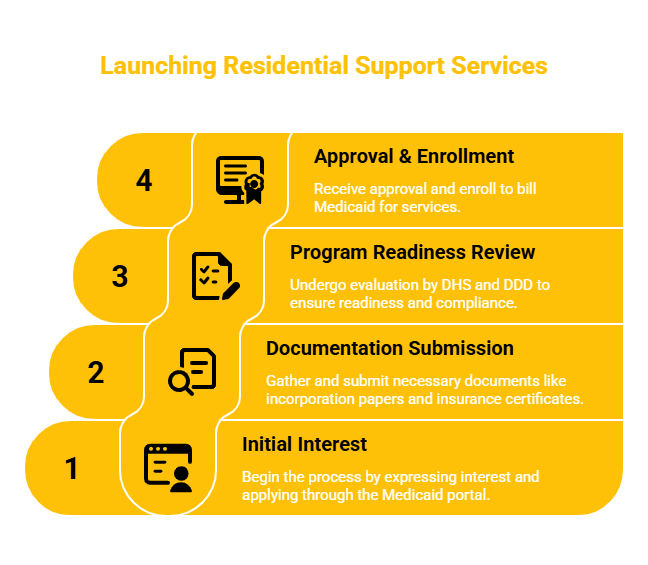
The path to becoming a recognized Medicaid waiver provider in New Jersey is a sequential process that necessitates both business registration and clinical/residential readiness. Before seeking enrollment, an agency must be a legally established business entity with the New Jersey Division of Revenue and Enterprise Services and must obtain both an IRS Employer Identification Number (EIN) and a Type 2 National Provider Identifier (NPI). This foundational step ensures the agency is recognized by state and federal health authorities.
Beyond basic business registration, agencies must secure the appropriate residential facility licensure through the DHS, DDD, or the DCA, depending on the specific model of residential support provided. Once the physical and legal infrastructure is in place, the agency must enroll through the New Jersey Medicaid Provider Enrollment Portal. This application is comprehensive, requiring proof of insurance—specifically general and professional liability coverage—and a thorough review of the agency's internal policies, safety protocols, and staff training modules.
What Documentation Is Required for Successful Provider Enrollment?
A successful enrollment application hinges on the quality and completeness of the agency's administrative documentation. Reviewers at the state level are looking for evidence of a robust system of accountability. Agencies must compile a comprehensive Policy & Procedure Manual that addresses all aspects of residential operations, from the moment a participant enters the program through their day-to-day care and eventual transitions.
This documentation must be organized and easily accessible for audit purposes. Required components include:
- Corporate Documentation: Current Articles of Incorporation or state-issued business licenses, and official confirmation of EIN and NPI numbers.
- Operational Manuals: Detailed procedures regarding participant intake, assessment, individualized care planning, and the management of HIPAA compliance.
- Staff Management: Well-documented records for background checks, initial credentialing, and ongoing training programs.
- Safety and Quality Assurance: Clear protocols for emergency response, crisis intervention, medication management, and continuous quality improvement monitoring.
What Are the Mandatory Staffing and Training Standards?
The efficacy of a residential program is dependent upon the competency and professionalism of its staff. New Jersey mandates specific roles for residential operations, ranging from the Residential Support Program Director—who is expected to hold a degree in a relevant human services field and possess supervisory experience—to Direct Support Professionals (DSPs) and Behavioral Support Specialists. Every role requires the appropriate background clearance and, where applicable, specific certifications in ABA or behavioral health.
Staff must be equipped with more than just a job description; they must be trained to navigate the complexities of residential safety and participant rights. Every employee, regardless of their specific role, is typically required to complete training in:
- HIPAA Compliance: Strict adherence to participant privacy laws.
- Emergency Preparedness: Training in crisis management, behavioral intervention, and infection control protocols.
- Professional Development: Annual competency evaluations to ensure the maintenance of high-quality care standards.
- Wellness Monitoring: The ability to recognize and report changes in a participant's health status immediately.
Frequently Asked Questions
How long does the entire provider startup process typically take?
The timeline varies based on the agency's readiness, but generally, the process takes between 8 and 14 months. This includes 1–2 months for business formation, 2–3 months for facility licensing, 2–3 months for hiring and training, 60–90 days for Medicaid enrollment, and 30–45 days for final billing setup.
Which Medicaid waiver programs cover Residential Support Services in New Jersey?
These services are covered under several programs, including the Community Care Program for the Elderly and Disabled (CCPED), the Supports Program Waiver, the Acquired Brain Injury (ABI) Waiver, the Personal Care Assistant (PCA) Waiver, and the general Home and Community-Based Services (HCBS) Waiver.
Can an agency provide these services without a physical residential facility license?
Generally, no. Residential Support Services, particularly those involving 24-hour care, require specific facility licensure from the Department of Human Services, the Division of Developmental Disabilities, or the Department of Community Affairs to ensure that the living environment meets all safety and accessibility codes mandated for waiver participants.
Key Takeaway
Becoming an approved provider of Residential Support Services in New Jersey is an investment in both infrastructure and rigorous regulatory compliance. By aligning business operations with the standards set forth by DHS, DDD, and CMS, agencies can successfully navigate the enrollment process and deliver high-quality support that fosters independence and community integration for the individuals they serve.
Last verified: October 2023. This information is for educational purposes and does not constitute legal or financial advice. Please consult with the New Jersey Department of Human Services or professional advisors regarding specific regulatory requirements.