RESIDENTIAL SUPPORT SERVICES PROVIDER IN NEW HAMPSHIRE
By Fatumata Kaba · 2025-07-27 · 5 min read
Residential Support Services in New Hampshire offer a critical pathway for individuals with disabilities, chronic illnesses, or long-term care needs to maintain independence within structured, community-based environments. These services, authorized under various New Hampshire Medicaid Home and Community-Based Services (HCBS) waiver programs, provide essential daily supervision and person-centered care that enables participants to live safely in the community rather than in institutional settings.
Operating as a Residential Support Services provider requires a deep understanding of the regulatory landscape managed by the New Hampshire Department of Health and Human Services (DHHS) and the Bureau of Elderly and Adult Services (BEAS). Success in this sector depends on strict adherence to Medicaid compliance, robust staff training, and a commitment to high-quality service delivery as defined by the Centers for Medicare & Medicaid Services (CMS).
Who are the Governing Agencies for Residential Support Services?
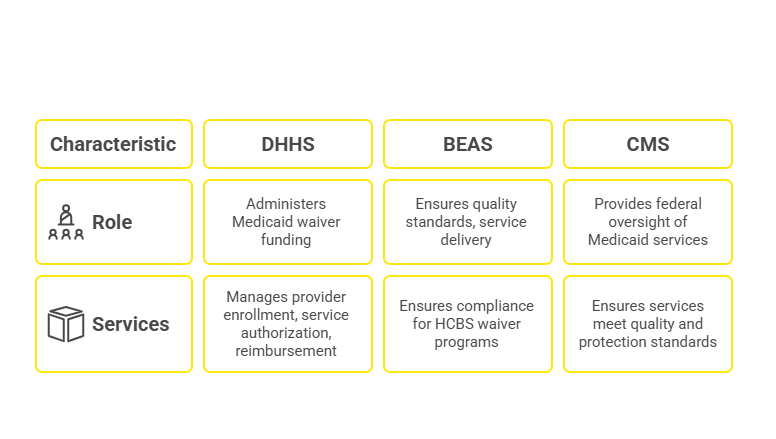
The regulatory structure for Residential Support Services in New Hampshire is hierarchical, involving both state-level departments and federal oversight. The New Hampshire Department of Health and Human Services (DHHS) serves as the primary governing agency, responsible for administering Medicaid waiver funding, managing provider enrollment, and ensuring that all reimbursement processes align with state requirements.
Within the DHHS, the Bureau of Elderly and Adult Services (BEAS) plays a direct role in maintaining the integrity of these programs. BEAS is responsible for ensuring quality standards, overseeing service delivery, and conducting monitoring to ensure providers remain in compliance with HCBS waiver rules. Simultaneously, the Centers for Medicare & Medicaid Services (CMS) provides federal oversight, setting the foundational standards for person-centered planning, participant protection, and the overall quality of care required for all Medicaid-funded HCBS initiatives.
What Services Do Residential Support Providers Deliver?
Residential Support Services offer a structured living arrangement designed to meet the unique needs of each participant. These services go beyond basic housing, focusing on health, safety, and personal growth. By utilizing an Individualized Service Plan (ISP), providers ensure that care is tailored to the specific goals and requirements of the participant, promoting dignity and autonomy.
Approved providers are typically responsible for a comprehensive suite of daily support activities, including:
- 24/7 Supervision and Support: Maintaining a safe, staffed environment to ensure participant well-being around the clock.
- Personal Care Assistance: Providing hands-on help with Activities of Daily Living (ADLs), such as bathing, dressing, grooming, and toileting.
- Medication Administration and Health Monitoring: Ensuring medications are administered correctly according to the care plan and performing routine health checks to manage chronic conditions.
- Skill Development and Community Integration: Assisting participants with household tasks like cooking and cleaning while encouraging participation in community life.
- Transportation Assistance: Providing or arranging rides to medical appointments, work, and essential social activities.
How Do You Navigate the Provider Enrollment Process?
Becoming an authorized provider is a multi-stage process that begins with establishing the business entity. Before submitting an application to the New Hampshire Medicaid Provider Enrollment Portal, a provider must register with the New Hampshire Secretary of State and secure all necessary business credentials, including an EIN from the IRS and a Type 2 NPI. If the residential setting falls under specific categories, a Residential Care Facility or Group Home license from the DHHS is also a mandatory prerequisite.
The formal enrollment process involves submitting documentation that proves organizational readiness. This includes proof of insurance, detailed policy manuals, and evidence of staffing protocols. Once an application is submitted, the DHHS and BEAS conduct a program readiness review. This review evaluates whether the agency has the capacity to deliver care safely, maintain accurate documentation, and uphold the rights of participants. Only after this rigorous evaluation and subsequent approval can an agency begin billing for services using the designated Medicaid billing codes.
What Documentation Is Required for Compliance and Audit Readiness?
Maintaining a comprehensive and accurate set of records is the cornerstone of a successful Residential Support Services agency. Providers must maintain a robust Policy & Procedure Manual that serves as the foundation for daily operations. This manual must explicitly outline protocols for intake, assessment, individualized care planning, and the specific daily care activities provided to participants.
Beyond standard operational procedures, providers must maintain rigorous documentation regarding staff and safety. This includes:
- Evidence of staff credentialing, background checks, and documented ongoing training records.
- HIPAA compliance protocols and clearly defined participant rights and grievance procedures.
- Emergency response plans, including infection control measures and disaster safety protocols.
- Quality assurance logs that track incident reports, health monitoring outcomes, and billing accuracy.
- Documentation standards that align with Medicaid billing requirements to facilitate successful audits and financial oversight.
What Are the Key Staffing Requirements?
The quality of residential support is directly linked to the qualifications and training of the staff. Agencies must employ a Residential Program Director who possesses a bachelor’s degree in a healthcare or human services field, combined with proven supervisory experience. This individual is responsible for overseeing the clinical and administrative health of the program.
Direct Support Professionals (DSPs) are the primary caregivers, requiring at least a high school diploma or GED, alongside specialized training in personal care and community integration. All personnel, including Residential Care Coordinators, must be trained in person-centered care, HIPAA compliance, and crisis management. Continuous professional development, including annual competency evaluations and ongoing training in safety practices, is required to ensure staff remain prepared to address the complex needs of the individuals they support.
Frequently Asked Questions
Which Medicaid Waivers cover Residential Support Services in New Hampshire?
Residential Support Services are provided under several waivers, including the Choices for Independence (CFI) Waiver, the Developmental Disabilities (DD) Waiver, the Acquired Brain Disorder (ABD) Waiver, the In-Home Support (IHS) Waiver for Children, and the broader Home and Community-Based Services (HCBS) Waiver program.
What is the typical timeline for launching a provider agency?
The journey from business formation to the launch of services typically spans several months. Business formation and compliance preparation usually take 1–2 months, followed by 2–3 months for staffing and credentialing. The formal Medicaid enrollment and readiness review phase generally requires 60–90 days, with an additional 30–45 days required for final billing system setup.
How can a new provider ensure they meet state quality standards?
Providers ensure compliance by strictly adhering to the standards set by BEAS and CMS. This involves establishing clear internal quality assurance systems, conducting regular internal audits of resident care documentation, and ensuring that all staff are fully trained in the most current health, safety, and person-centered care protocols as required by state statutes.
Key Takeaway
Successfully operating a Residential Support Services agency in New Hampshire requires meticulous attention to both administrative detail and clinical quality. By strictly adhering to the requirements set forth by DHHS and BEAS, maintaining detailed records, and investing in a highly trained staff, provider agencies can build stable, compliant, and impactful residential programs that significantly improve the lives of participants within the state's HCBS waiver system.
Last verified: 2024. This content is for informational purposes only and does not constitute legal or financial advice. Readers are encouraged to consult with the New Hampshire Department of Health and Human Services (DHHS) or qualified legal counsel regarding specific state regulations and compliance requirements.