RESIDENTIAL SUPPORT SERVICES PROVIDER IN NEVADA
By Fatumata Kaba · 2025-09-04 · 5 min read
Residential Support Services in Nevada provide a vital framework for individuals with disabilities or chronic health conditions to live with dignity and autonomy within their own communities. These services, authorized under Nevada Medicaid Home and Community-Based Services (HCBS) waivers, provide personalized care, skill development, and necessary supervision to ensure that participants can maintain their independence while safely navigating daily life.
What Are the Roles of Governing Agencies in Residential Support?
The delivery of Residential Support Services in Nevada is subject to multi-layered oversight to ensure that Medicaid funding is utilized effectively and that participants receive high-quality care. The Nevada Department of Health and Human Services (DHHS) serves as the primary governing entity, managing the administration of waiver funds, overseeing the provider enrollment process, and establishing the standards for service reimbursement.
In tandem with DHHS, the Aging and Disability Services Division (ADSD) is responsible for the operational oversight of Residential Support Services. ADSD monitors provider compliance with state regulations, manages service delivery standards, and conducts quality assurance reviews to ensure that providers remain in good standing under the HCBS framework. On a federal level, the Centers for Medicare & Medicaid Services (CMS) provides the overarching regulatory structure, ensuring that Nevada’s Medicaid-funded programs adhere to rigorous standards concerning person-centered planning, participant protections, and the overall quality of care delivered in community settings.
How Does the Residential Support Services Model Function?
Residential Support Services act as a bridge to independent living, offering long-term support for individuals who require assistance to participate fully in community life. These services are not one-size-fits-all; instead, they are structured around an Individualized Service Plan (ISP) that identifies the unique needs, preferences, and goals of each participant. By focusing on personal autonomy, providers empower individuals to manage their lives with appropriate professional backing.
Approved providers generally deliver a comprehensive suite of services that address both health and lifestyle needs. Core service components often include:
- Personal Assistance: Support with Activities of Daily Living (ADLs) including bathing, dressing, meal preparation, and medication management.
- Skill Development: Coaching in areas such as effective communication, budgeting, and household management.
- Community Integration: Facilitating active social, recreational, and civic engagement within the local community.
- 24/7 Supervision: On-site staff presence in group homes or supervised apartments to ensure environmental safety and consistent care.
- Healthcare Coordination: Managing medication reminders and facilitating regular communication with primary healthcare providers.
What Are the Licensing and Enrollment Prerequisites for Providers?
Establishing a business as a Nevada Medicaid Residential Support provider requires careful adherence to both state business laws and Medicaid-specific requirements. Before beginning the enrollment process, a provider must register their business entity with the Nevada Secretary of State and obtain an Employer Identification Number (EIN) from the IRS. Additionally, a Type 2 National Provider Identifier (NPI) is mandatory for billing purposes.
Beyond basic business formation, providers must secure appropriate facility licensure from the DHHS if they intend to operate group living environments. Providers are also required to maintain both general and professional liability insurance to protect against risks associated with direct care. A critical step is the development of a comprehensive Policy and Procedure Manual, which must outline the agency’s approach to participant intake, individualized care planning, emergency response, health and safety protocols, and rigorous documentation standards.
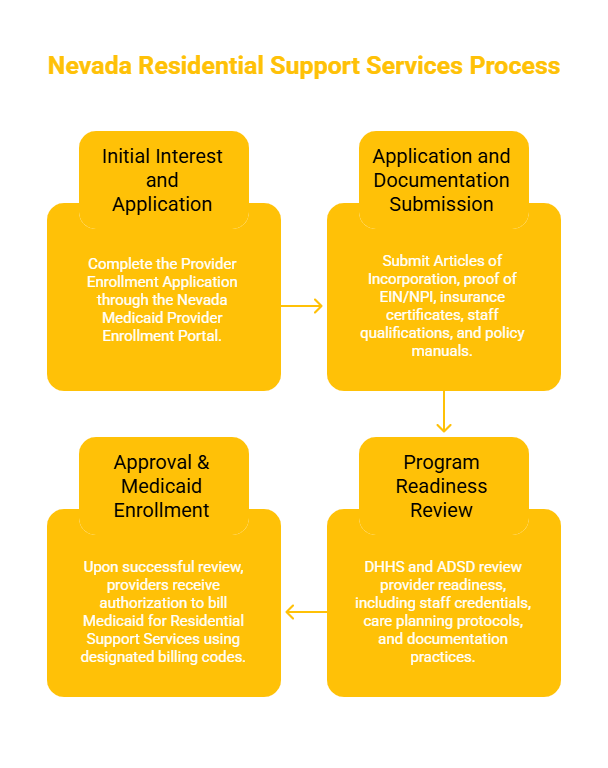
What Is the Sequence of the Nevada Provider Enrollment Process?
The journey to becoming a certified provider is systematic and requires strict attention to detail during the documentation phase. The process begins with the submission of a provider enrollment application via the Nevada Medicaid Provider Enrollment Portal. During this stage, the applicant must supply essential documents, including Articles of Incorporation, proof of NPI/EIN, insurance certificates, and detailed staff qualification records.
Once the application is submitted, DHHS and ADSD conduct a program readiness review. This review evaluates the provider’s operational foundation, including staff credentials, care planning protocols, and the ability to maintain accurate documentation. Upon a successful review, the provider is officially authorized to bill Medicaid for Residential Support Services using the state’s designated billing codes, marking the final stage of the setup process.
How Are Staffing and Training Requirements Managed?
High-quality service delivery is entirely dependent on the competence and reliability of the staff. The Residential Services Program Director or Supervisor is a pivotal role that typically requires a Bachelor’s degree in a social service or healthcare field, along with prior supervisory experience and specialized training in residential care management. This individual is responsible for ensuring that all agency operations align with state regulations.
Direct Support Professionals (DSPs) are the frontline staff and must hold a minimum of a high school diploma or GED, possess current CPR/First Aid certification, and undergo thorough background clearances. All personnel, regardless of their specific role, must complete mandatory training programs that cover:
- Health and Safety: Training on infection control, wellness monitoring, and emergency response procedures.
- Participant Rights: In-depth education on HIPAA compliance, privacy, and grievance handling.
- Crisis Management: Specialized training in behavioral support and conflict resolution.
- Ongoing Competency: Annual performance evaluations and continuous education to stay abreast of best practices.
Frequently Asked Questions
Which Medicaid waiver programs cover Residential Support Services in Nevada?
Residential Support Services are authorized under several waivers, including the Home and Community-Based Services for the Frail Elderly (FE) Waiver, the Intellectual and Developmental Disabilities (IDD) Waiver, the Physical Disabilities Waiver, the Traumatic Brain Injury (TBI) Waiver, and the specialized HCBS-IDD Waiver.
What is the typical timeline for launching a new provider agency?
The timeline is generally structured into four phases: business formation (1–2 months), staff hiring and program development (2–3 months), provider enrollment and readiness review (60–90 days), and final billing setup (30–45 days).
What documentation is essential for the policy and procedure manual?
The manual must contain protocols for participant intake and assessment, medication management, safety and emergency procedures, staff credentialing, HIPAA compliance, and Medicaid billing documentation practices.
Key Takeaway
Launching a Residential Support Services agency in Nevada requires a meticulous approach to administrative compliance, staff training, and clinical documentation. By strictly adhering to the requirements set forth by DHHS, ADSD, and CMS, providers can ensure they meet the regulatory standards necessary to deliver sustainable, person-centered care that effectively supports the independence of Nevada’s vulnerable populations.
WCG supports agencies in launching Medicaid-compliant Residential Support Services in Nevada, offering: Business registration, Medicaid enrollment, and facility licensure assistance; Policy manual development tailored to residential care services; Staff credentialing, training program templates, and documentation guidance; Medicaid billing setup and audit-prepared financial management; Branding, website development, and community outreach strategies; Quality assurance systems for safety monitoring and incident reporting; Community networking for collaboration and client referrals.
Last verified: November 2023. Disclaimer: This article is for informational purposes only and does not constitute legal or professional medical advice. Always check the official Nevada Department of Health and Human Services (DHHS) and Medicaid websites for the most current regulations and program requirements.