RESIDENTIAL SUPPORT SERVICES PROVIDER IN NEBRASKA
By Fatumata Kaba · 2025-08-08 · 5 min read
Becoming a Residential Support Services Provider in Nebraska
Residential Support Services in Nebraska empower individuals with disabilities to live independently within their communities by providing personalized assistance with daily living, skill development, and social integration. As an essential component of the Nebraska Medicaid Home and Community-Based Services (HCBS) framework, these services are designed to ensure health, safety, and autonomy for participants while strictly adhering to federal and state quality standards.
For healthcare entrepreneurs and agency administrators, establishing a Residential Support Services agency requires navigating a complex regulatory environment overseen by the Nebraska Department of Health and Human Services (DHHS). Successfully launching this service involves rigorous attention to licensure, staff credentialing, and compliance with the Individualized Service Plan (ISP) requirements mandated by the state's various Medicaid waiver programs.
What Are the Governing Agencies and Oversight Roles?
The regulatory landscape for Nebraska residential providers is structured to ensure that every participant receives high-quality, person-centered care. The Nebraska Department of Health and Human Services (DHHS) serves as the primary governing body. It is responsible for the administration of Medicaid waiver funding, the oversight of provider enrollment, the authorization of specific services, and the management of all reimbursement processes.
Complementing this, the Nebraska Medicaid and Long-Term Care (MLTC) Division focuses on the ongoing operational integrity of these services. Their role is to ensure that providers maintain compliance with HCBS standards and deliver care that aligns with the quality benchmarks established for the state. At the federal level, the Centers for Medicare & Medicaid Services (CMS) provides overarching guidance and oversight, ensuring that all Medicaid-funded residential support programs meet federal requirements for person-centered planning, participant protections, and community integration.
What Services Do Residential Support Providers Deliver?
Residential Support Services offer long-term, community-based assistance that helps individuals with disabilities maintain independence while participating fully in community life. Approved providers facilitate a variety of essential supports, all of which must be documented and executed in accordance with the participant’s Individualized Service Plan (ISP). This ensures that care is tailored to the specific needs, preferences, and goals of each individual served.
- Personal Assistance: Direct support with Activities of Daily Living (ADLs) including bathing, dressing, meal preparation, and medication management.
- Community Integration: Facilitation of social, recreational, and community engagement opportunities to promote inclusion.
- Skill Development: Training in essential life skills, including communication, self-care, budgeting, and effective household management.
- 24/7 Supervision: Provision of on-site staff support in group homes or supervised apartments to maintain safety and well-being.
- Healthcare Coordination: Assistance with medication reminders, routine health monitoring, and effective coordination with external healthcare providers.
What Are the Licensing and Provider Approval Requirements?
Entering the Nebraska market as a Residential Support Services provider requires a systematic approach to business formation and regulatory compliance. Before a provider can begin billing, they must register their business entity with the Nebraska Secretary of State, obtain a federal Employer Identification Number (EIN), and secure a Type 2 National Provider Identifier (NPI). This foundational step ensures that the agency is recognized as a legal entity authorized to conduct business.
Beyond basic business registration, agencies must secure appropriate facility licensure from the DHHS if they intend to operate group living environments. Providers must also maintain robust general liability and professional liability insurance to protect both the agency and the participants. The development of a comprehensive policy and procedure manual is non-negotiable; this document must detail participant intake protocols, care planning processes, emergency response measures, and strict internal health and safety standards.
How to Navigate the Enrollment and Readiness Process?
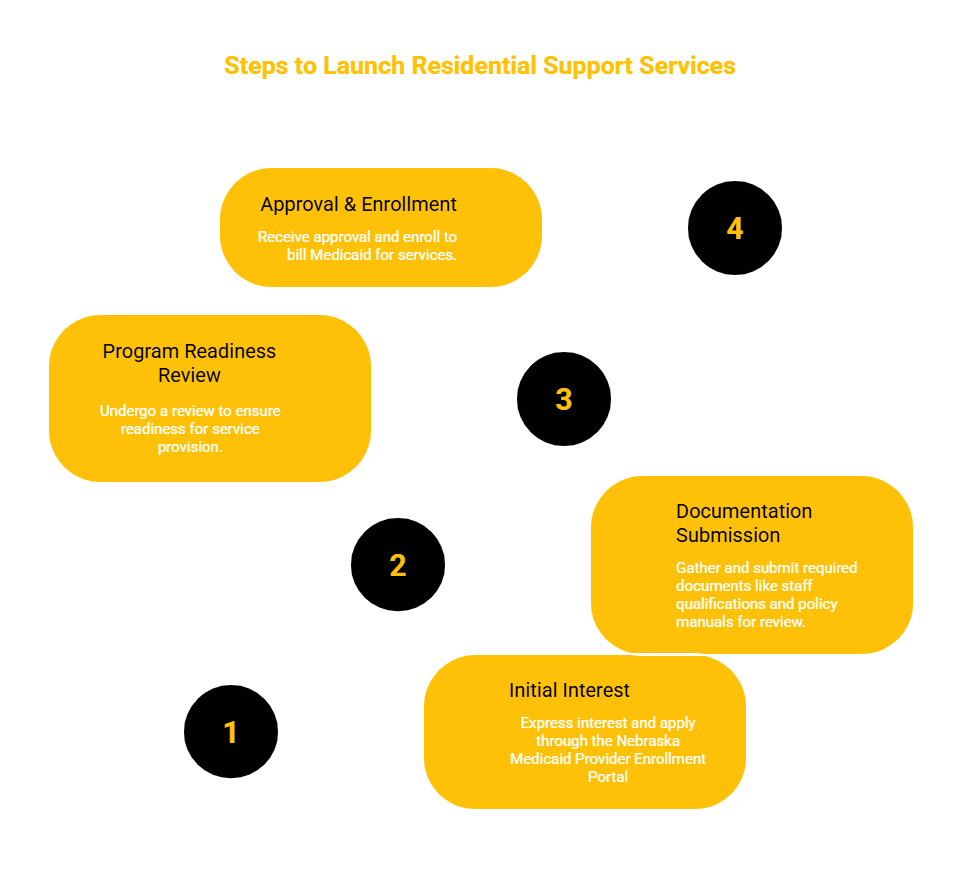
The transition from a business entity to an active Medicaid provider involves a structured application path through the Nebraska Medicaid Provider Enrollment Portal. Providers must submit a full suite of documentation, including articles of incorporation, proof of insurance, detailed staff qualification records, and internal policy manuals. Once submitted, the DHHS conducts a formal Program Readiness Review to evaluate the provider’s operational capacity.
During the readiness review, the state assesses the agency’s ability to execute care plans, maintain accurate documentation, and follow billing regulations. Once the DHHS confirms that the provider meets all requirements, the agency receives authorization to begin billing Medicaid for Residential Support Services using the state’s designated billing codes. This process ensures that every provider entering the network is prepared to maintain the high standards of care required by Nebraska’s HCBS waivers.
What Are the Mandatory Staffing and Documentation Standards?
Quality of care is heavily dependent on the caliber of the personnel involved. The Residential Services Program Director or Supervisor is typically required to hold a bachelor’s degree in a social services or healthcare-related field, paired with relevant supervisory experience and specialized residential training. Direct Support Professionals (DSPs) must at minimum possess a high school diploma or GED, maintain active CPR/First Aid certification, and pass comprehensive background checks.
Equally important is the ongoing professional development of the staff. All personnel must complete required training in safety, infection control, wellness, HIPAA, and participant rights. Furthermore, staff must be proficient in crisis intervention and behavioral support. Agency documentation must be meticulous, encompassing everything from initial intake and ongoing assessments to daily service notes and incident reporting, all of which are subject to audit by state officials.
Frequently Asked Questions
Which Medicaid waiver programs allow for Residential Support Services?
Residential Support Services are available under several Nebraska Medicaid waivers, including the Aged and Disabled (AD) Waiver, the Traumatic Brain Injury (TBI) Waiver, the Developmental Disabilities (DD) Waiver, the Children with Disabilities Waiver, and the broader Home and Community-Based Services (HCBS) Waiver.
How long does the launch process generally take?
The timeline varies based on organizational readiness, but generally spans from 1 to 2 months for business formation, 2 to 3 months for hiring and program development, 60 to 90 days for the Medicaid enrollment and readiness review, and 30 to 45 days for final billing setup.
What must be included in the Policy and Procedure Manual?
The manual must detail participant intake and assessment procedures, daily living support protocols, medication management, healthcare coordination, safety and emergency procedures, staff credentialing and training records, Medicaid billing/documentation practices, and HIPAA/grievance policies.
Key Takeaway: Successfully becoming a Nebraska Residential Support Services provider requires a dual focus on rigorous regulatory compliance and the implementation of high-quality, person-centered care systems. By adhering to the guidelines set forth by the DHHS and the MLTC, agencies can build sustainable operations that significantly improve the lives of individuals living with disabilities across the state.
Last verified: 2024. This information is for educational purposes only and does not constitute legal or professional advice. Always consult directly with the Nebraska Department of Health and Human Services (DHHS) or qualified legal counsel to ensure compliance with current state and federal regulations.