RESIDENTIAL SUPPORT SERVICES PROVIDER IN MONTANA
By Fatumata Kaba · 2025-08-06 · 5 min read
Establishing a Residential Support Services agency in Montana requires a rigorous commitment to person-centered care, regulatory compliance, and administrative excellence. Providers act as essential pillars within the state's Home and Community-Based Services (HCBS) framework, delivering the housing, supervision, and habilitation necessary for individuals with disabilities to thrive in their communities.
Navigating the Regulatory Landscape and Governing Agencies
The Montana Department of Public Health and Human Services (DPHHS) serves as the primary regulatory authority for residential services. Within DPHHS, the Developmental Disabilities Program (DDP) manages the 1915(c) DD waiver, while the Senior and Long Term Care Division (SLTC) oversees programs like the Big Sky Waiver and Community First Choice. Understanding the jurisdictional boundaries between these divisions is the first step toward successful enrollment.
Federal oversight is provided by the Centers for Medicare & Medicaid Services (CMS). CMS establishes the overarching requirements for HCBS compliance, ensuring that every residential setting promotes community integration and protects participant rights. Agencies must demonstrate alignment with these federal standards, as well as specific state-level licensing requirements, to maintain eligibility for Medicaid reimbursement.
- DPHHS: Central authority for provider enrollment and licensing.
- DDP: Manages residential support authorizations for individuals with IDD.
- SLTC: Oversees services for seniors and individuals with physical disabilities.
- CMS: Sets national standards for Medicaid-funded HCBS programs.
Understanding Core Residential Support Service Models
Residential Support Services encompass a spectrum of care, ranging from 24-hour residential habilitation in group settings to intermittent supported living in an individual’s own home. The goal is to provide the precise level of supervision needed—whether for medical monitoring, behavioral support, or daily skill-building—without compromising the individual’s independence or community participation.
Approved providers are responsible for delivering comprehensive care that addresses Activities of Daily Living (ADLs), such as cooking, hygiene, and financial management. Beyond basic care, providers must coordinate transportation, manage medical appointments, and implement structured behavioral supports where necessary. The delivery of these services requires meticulous documentation, including service delivery logs, incident reports, and ongoing care plan updates to satisfy Medicaid audit requirements.
Establishing Your Agency: Licensing and Enrollment Prerequisites
Before an agency can begin providing services, it must establish a formal business structure and obtain all necessary certifications. This process begins with registering the business with the Montana Secretary of State and securing an Employer Identification Number (EIN) and a Type 2 National Provider Identifier (NPI). These foundational steps allow the agency to enter the formal procurement process with the state.
Licensing and certification act as the "gatekeepers" for service delivery. Prospective providers must develop robust policy manuals that cover emergency protocols, medication management, and staff supervision. Furthermore, maintaining current liability insurance and workers’ compensation coverage is mandatory. Failure to satisfy any one of these administrative requirements during the application phase can lead to significant delays in gaining authorization to bill Medicaid.
- Register business with the Montana Secretary of State.
- Obtain IRS EIN and NPI (Type 2).
- Apply for provider enrollment through the DPHHS Provider Services Portal.
- Secure licensing/certification as a Residential Habilitation or Community Services Provider.
- Develop comprehensive policy manuals and emergency procedures.
Managing Staffing and Clinical Requirements
Staffing quality is the most critical factor in maintaining compliance and ensuring participant safety. A successful agency requires a qualified Program Administrator to oversee operations, a dedicated House Manager for site-level supervision, and skilled Direct Support Professionals (DSPs) to deliver daily care. If the agency provides services that involve medication administration or skilled nursing, Licensed Nurses (RNs or LPNs) must be on staff or properly contracted to oversee health tasks.
All personnel must undergo rigorous training before providing direct care. This includes mandatory background checks, CPR/First Aid certification, and specialized training based on the specific needs of the individuals served. Ongoing professional development is equally vital; agencies must maintain detailed training logs and perform regular performance evaluations to ensure staff remain proficient in crisis prevention, de-escalation, and HIPAA compliance.
The Roadmap from Application to Program Launch
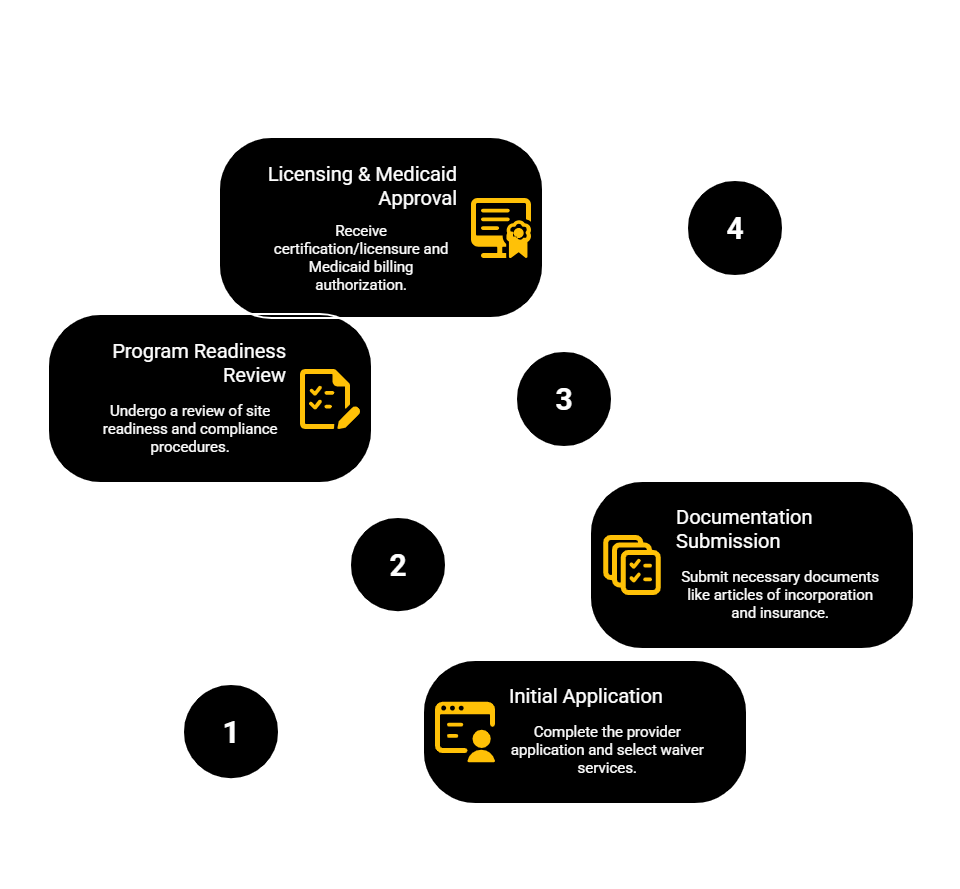
Launching a residential agency is a phased process that typically spans six to nine months. Phase one focuses on business formation and the creation of internal policies. Once the structural framework is in place, the agency moves into hiring and staff training. This period is critical, as the agency must demonstrate that all employees are prepared to meet the specific health and safety needs of the population they intend to serve.
The final phases involve the DPHHS Provider Services Portal submission and the subsequent Program Readiness Review. During this on-site review, state representatives will assess the facility’s compliance with safety standards and the adequacy of the agency’s administrative records. Only after successfully clearing this review and receiving Medicaid billing authorization can an agency begin providing billable residential support services.
Frequently Asked Questions
What is the difference between Supported Living and Residential Habilitation?
Supported Living typically involves scheduled, intermittent assistance provided in an individual’s own home or apartment. Residential Habilitation usually refers to 24-hour supervision provided in a licensed group setting, often involving more intensive staffing and clinical support.
How does an agency become authorized to bill Medicaid in Montana?
Authorization requires successful enrollment through the DPHHS Provider Services Portal and completion of the Program Readiness Review. Once the agency is fully licensed and certified, the state issues authorization to bill Medicaid for the approved waiver services.
What documentation is essential for maintaining compliance?
Agencies must maintain meticulous records, including staff training logs, service delivery logs, incident reports, individualized care plans, and clear documentation of medication administration. These records must be readily available for state audits and quality assurance reviews.
Key Takeaway: Success as a residential support provider in Montana hinges on strict adherence to DPHHS administrative standards, the recruitment of trained professional staff, and the consistent documentation of person-centered care. By maintaining a robust compliance framework, agencies can focus on their primary mission of improving the quality of life for individuals with disabilities across the state.
WCG supports agencies launching Medicaid-compliant Residential Support Services in Montana, including business formation, DPHHS enrollment, and Medicaid certification. We provide policy manual creation, staff credentialing tools, and guidance on quality assurance systems to ensure your agency is audit-ready from day one. Contact our team to explore how our consulting services can support your operational goals.
Last verified: October 2023. Disclaimer: This information is for educational purposes and does not constitute legal or professional medical advice. Always consult with DPHHS and current state regulations for the most up-to-date program requirements.