RESIDENTIAL SUPPORT SERVICES PROVIDER IN MINNESOTA
By Fatumata Kaba · 2025-08-13 · 6 min read
Residential Support Services in Minnesota provide essential housing and care solutions for individuals with disabilities, chronic health conditions, or those transitioning from institutional settings. By operating under Minnesota’s Home and Community-Based Services (HCBS) Waivers, these providers enable participants to live with independence and dignity while receiving personalized support in a stable, community-integrated environment.
Navigating the Regulatory Landscape for Residential Support
Success in the Minnesota residential support market requires a deep understanding of the intersection between federal oversight and state-level enforcement. The regulatory framework is designed to ensure participant safety and the consistent delivery of high-quality care, necessitating compliance with multiple layers of governance.
The Centers for Medicare & Medicaid Services (CMS) provides the foundational federal oversight, ensuring that Minnesota’s waiver programs adhere to national standards for community integration and participant rights. Within the state, the Minnesota Department of Human Services (DHS) serves as the primary administrator for Medicaid programs, overseeing the disbursement of waiver funds and the authorization of service providers.
Complementing this, the Minnesota Department of Health (MDH) is responsible for the rigorous licensing and regulation of residential facilities and group homes. Providers must demonstrate ongoing compliance with MDH standards to maintain their legal operating status. A failure to synchronize operations with the requirements set forth by both the DHS and MDH can result in delayed enrollments or the loss of certification.
- Minnesota Department of Human Services (DHS): Administers Medicaid programs, including residential support under HCBS Waivers.
- Minnesota Department of Health (MDH): Licenses and regulates residential facilities and group homes.
- Centers for Medicare & Medicaid Services (CMS): Provides federal oversight and ensures waiver compliance.
Designing Person-Centered Residential Support Services
Residential support is not a "one-size-fits-all" model; it is defined by the unique needs of each individual. Providers are tasked with translating a participant's Individual Service Plan (ISP) or Person-Centered Plan (PCP) into daily, actionable routines that foster both personal growth and health stability.
At the core of these services is the requirement for 24/7 supervision and personal care. This environment is designed to be supportive rather than restrictive, focusing on the development of independent living skills. By integrating health monitoring with social engagement, providers create a holistic experience that addresses the physical, emotional, and social needs of the residents.
Operational excellence depends on meticulous documentation. Every interaction, health metric, and milestone achieved in the residential setting must be captured to justify Medicaid billing and to ensure that the care plan remains aligned with the participant's evolving goals. Staff must be trained not only in clinical care but also in the values of person-centered support.
- 24/7 residential supervision and personal care.
- Assistance with activities of daily living (ADLs).
- Health monitoring and medication administration.
- Meal planning and nutritional support.
- Community engagement and recreational activities.
- Skills training for independent living.
Licensing and Provider Approval Requirements
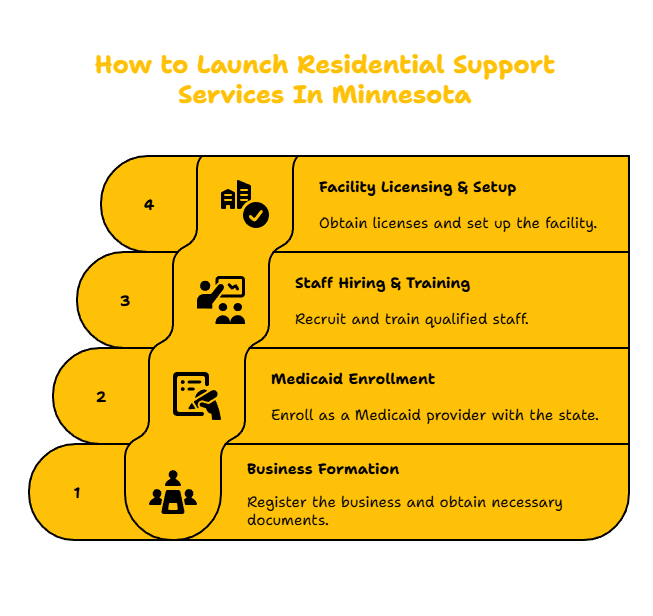
The transition from a business concept to a Medicaid-approved provider involves a multi-step verification process. Before a provider can bill for services, they must establish their corporate identity, secure the appropriate health licensing, and successfully complete the Medicaid enrollment process through the DHS.
Key prerequisites include registering the business with the Minnesota Secretary of State and obtaining a federal Employer Identification Number (EIN). Furthermore, agencies must secure a National Provider Identifier (NPI), specifically a Type 2 NPI, which is required for organizations. The acquisition of a Comprehensive Home Care License from the MDH serves as a critical gateway; without this license, an agency cannot legally operate a residential support program in the state.
Beyond legal registration, agencies must maintain robust liability insurance and detailed staff documentation. These records are subject to audit and represent the provider’s baseline commitment to mitigating risk and maintaining professional standards for both staff and residents.
The Operational Pathway to Medicaid Enrollment
The enrollment timeline is a deliberate process requiring coordination across several state departments. Providers should view this as a structured journey: starting with pre-application inquiries, moving to formal document submission, and ending with the final assignment of a Medicaid provider number.
The process typically begins with a pre-application contact with the DHS to clarify specific provider requirements for the chosen waiver program. Following this, the agency must submit a comprehensive application package. This includes proof of business registration, the MDH Comprehensive Home Care License, active liability insurance, and detailed service descriptions that align with state waiver guidelines.
Once the application is submitted, the agency enters a period of verification. The state will confirm the validity of the license and assess the agency’s capacity to deliver services. Upon successful verification, the provider will receive their Medicaid number, which officially authorizes the delivery of services and the submission of claims for reimbursement.
Staffing, Training, and Organizational Compliance
The quality of a residential support program is a direct reflection of its staff. Administrators must prioritize the recruitment of qualified personnel, starting with a Residential Program Manager who possesses experience in residential care, social services, or healthcare administration to ensure the facility remains compliant and well-managed.
Direct Support Professionals (DSPs) serve as the frontline for service delivery. Requirements for these roles include a high school diploma, active CPR/First Aid certification, and successful completion of background checks and TB clearances. Agencies are also mandated to ensure that all staff members undergo comprehensive training modules before assuming duties.
Training curricula should cover client safety, crisis intervention techniques, personal care standards, and accurate record-keeping. Furthermore, cultural competence training is essential to ensure that the staff can effectively interact with a diverse client base, fostering an environment of respect and inclusivity within the residential setting.
Utilizing Minnesota’s HCBS Waivers
Residential Support Services are delivered through several Medicaid HCBS waivers, each tailored to specific populations. Understanding which waiver is applicable to a specific client is vital for billing and service authorization. These programs include the 1915(c) HCBS Waiver for Individuals with Disabilities, the Community Access for Disability Inclusion (CADI) Waiver, and the Brain Injury (BI) Waiver.
These waivers authorize the delivery of essential services including round-the-clock care, support for ADLs, and the promotion of independent living skills. By leveraging these specific funding streams, providers are able to offer the consistent, high-level support necessary for participants to thrive within their communities.
Frequently Asked Questions
What is the primary difference between the CADI and BI Waivers?
The CADI waiver is designed to support individuals with disabilities who would otherwise require institutional care, while the Brain Injury (BI) waiver is specifically structured to meet the unique, long-term support needs of individuals who have a diagnosis of a brain injury.
How long does the provider enrollment process typically take?
The Medicaid provider enrollment process is estimated to take between 60 and 90 days, though this timeline can fluctuate based on the completeness of the documentation submitted and the responsiveness of state processing units.
What core policies must be included in a provider's manual?
An agency's policy and procedure manual must cover, at a minimum, client intake and care planning protocols, safety and supervision guidelines, health monitoring and medication administration procedures, documentation of daily activities, incident reporting, and staff training/supervision logs.
Key Takeaway: Establishing a successful Residential Support Services agency in Minnesota requires a methodical approach that prioritizes rigorous licensing, meticulous staff training, and strict adherence to DHS and MDH regulatory standards throughout the Medicaid enrollment lifecycle.
Last verified: October 2023. This information is for educational purposes only and does not constitute legal or professional consulting advice. Always refer to the official Minnesota Department of Human Services and Minnesota Department of Health websites for the most current regulatory updates and requirements.