RESIDENTIAL SERVICES PROVIDER IN OHIO
By Fatumata Kaba · 2025-09-17 · 5 min read
CREATING SUPPORTIVE HOMES FOR INDIVIDUALS TO LIVE SAFELY, INDEPENDENTLY, AND WITH DIGNITY
Residential Services in Ohio provide individuals with disabilities or chronic health conditions a structured, supportive, and safe living environment integrated into the community. These services are authorized under Ohio Medicaid Home and Community-Based Services (HCBS) waiver programs and are designed to facilitate autonomy while ensuring that health, safety, and personal care needs are consistently met through professional support.
Understanding the Governing Agencies and Regulatory Framework
Operating a residential services agency in Ohio requires navigation of a multi-tiered regulatory system. The Ohio Department of Medicaid (ODM) maintains ultimate authority over the state's Medicaid program, managing the funding, reimbursement, and overarching billing policies that allow providers to receive compensation for HCBS waiver services. Providers must align their operations with the specific requirements set forth by ODM to ensure compliant claims submission and audit readiness.
For services specifically targeting individuals with intellectual and developmental disabilities (IDD), the Ohio Department of Developmental Disabilities (DODD) acts as the primary certifying body. DODD is responsible for the rigorous certification process, ongoing monitoring, and ensuring that providers adhere to state standards for quality care. Furthermore, at the federal level, the Centers for Medicare & Medicaid Services (CMS) provides the overarching framework for HCBS, mandating that all funded residential settings adhere to strict person-centered planning requirements and community integration standards.
Defining the Scope of Residential Care and Support Services
Residential services encompass a broad spectrum of daily living support, ranging from shared living arrangements and group homes to supported living apartments. The central objective is to transition individuals from restrictive settings into the community, where they can receive the individualized care necessary to maintain their health and well-being. Providers are expected to deliver services that are both consistent and highly responsive to the unique needs of each participant.
Providers authorized to deliver these services generally manage a comprehensive suite of daily activities and interventions, including:
- 24/7 Supervision: Maintaining continuous monitoring to ensure resident safety and emotional support.
- Personal Care Assistance: Providing professional support with activities of daily living, including bathing, dressing, toileting, grooming, and mobility.
- Medication Management: Ensuring adherence to prescribed regimens through reminders, dispensing, or delegated administration.
- Skill Building: Instructing participants in essential life skills such as meal preparation, budgeting, household upkeep, and self-care.
- Crisis Intervention: Implementing de-escalation strategies and immediate support during behavioral or medical emergencies.
- Community Integration: Actively encouraging and facilitating participation in local events, recreation, and volunteerism.
Navigating Licensing, Certification, and Enrollment Prerequisites
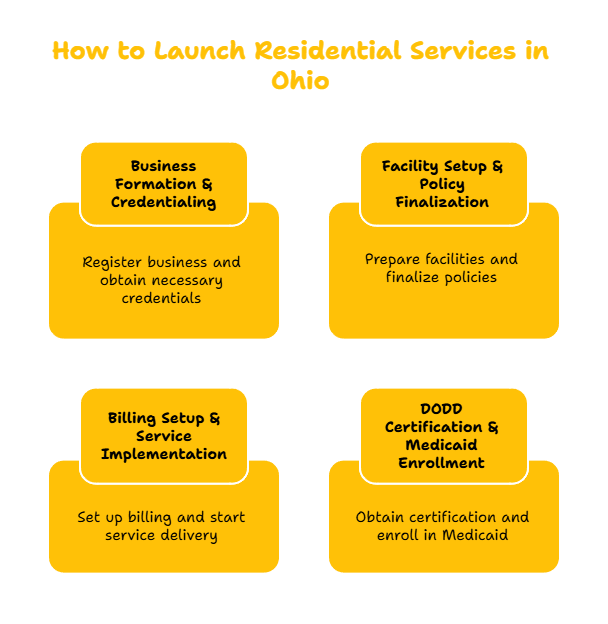
The journey to becoming a certified residential services provider begins with establishing a formal business entity registered with the Ohio Secretary of State. Once the business is established, the provider must secure an Employer Identification Number (EIN) from the IRS and a Type 2 National Provider Identifier (NPI). These administrative milestones are necessary before entering the formal enrollment phase with state departments.
Facility-based providers must also ensure their physical locations are fully compliant with local fire, zoning, and safety regulations. Before the state grants certification, the prospective provider must compile a comprehensive policy manual that outlines all care procedures, participant rights, and emergency protocols. Staffing requirements are equally stringent; providers must verify that all personnel have undergone thorough background checks, possess current CPR/First Aid certifications, and have completed specific training modules tailored to waiver-compliant residential support.
The Provider Enrollment and Readiness Review Process
The enrollment process is structured to verify that a provider is operationally prepared to deliver high-quality care. For those serving the IDD population, the process begins via the DODD Provider Certification Portal. Applicants must submit a full suite of required documentation, including staff training logs, proof of insurance, and detailed safety plans for their residential sites. These documents serve as the foundation for the state’s assessment of the provider's ability to maintain a safe environment.
Following the document submission phase, the agency will undergo a readiness review. This stage often involves interviews with management, physical inspections of the residential sites, and a thorough review of the provider’s internal procedures. Once DODD determines that the agency meets all state and federal guidelines, the provider will receive their official certification, paving the way for the assignment of a Medicaid billing number and the commencement of authorized services under the specified waivers.
Operational Standards for Staffing and Documentation
Successful residential programs depend on a qualified and well-trained workforce. The Residential Program Administrator, who typically holds a degree in human services or equivalent management experience, is responsible for overall agency compliance. Supporting them are the House Managers and Direct Support Professionals (DSPs), who handle the day-to-day delivery of care. All staff must complete DODD-mandated training, which covers essential topics such as Major Unusual Incident (MUI) reporting, participant rights, and person-centered planning.
Documentation is the primary mechanism for proving that the care delivered meets the requirements of the participant's Individualized Service Plan (ISP). Every shift must be logged, with progress notes clearly illustrating how the services provided helped the individual meet their personal goals. Maintaining accurate, contemporaneous documentation is critical for both the health of the participant and the protection of the provider during subsequent state audits.
Frequently Asked Questions
What are the primary Medicaid waiver programs that cover residential services in Ohio?
Residential services are primarily funded through the Individual Options (IO) Waiver, the SELF Waiver, and the Level One Waiver (which offers more limited support), all administered via DODD. Additionally, non-DD populations may receive residential support through the Ohio Home Care Waiver, and dual-eligible adults may access services through MyCare Ohio.
How long should a provider expect the start-up process to take?
The total timeline varies based on agency preparedness, but it generally spans six to nine months. This includes 1–2 months for business formation, 2–3 months for facility and staff readiness, 60–90 days for DODD certification, and 30–45 days for final billing activation.
What is the role of the Residential Program Administrator?
The Administrator is responsible for overseeing the entire program's regulatory compliance, managing staff training, and ensuring that all residential care delivery meets the standards mandated by ODM and DODD. They act as the primary point of contact for case managers and regulatory auditors.
Key Takeaway: Establishing a residential services agency in Ohio is a complex, highly regulated undertaking that requires meticulous attention to administrative, clinical, and safety requirements. By prioritizing a person-centered culture and maintaining rigorous documentation practices, providers can successfully navigate the DODD and ODM certification paths to deliver vital, waiver-funded care to individuals in the community.
Last verified: May 2024. This information is intended for educational purposes and should not be considered legal or professional advice. Requirements for Medicaid providers are subject to change; always refer to the latest guidance provided by the Ohio Department of Medicaid and the Ohio Department of Developmental Disabilities.