RESIDENTIAL HABILITATION SERVICES PROVIDER IN UTAH
By Fatumata Kaba · 2026-04-01 · 6 min read
Residential Habilitation services in Utah provide essential 24-hour or extended-period support for individuals with intellectual and developmental disabilities (ID/DD), focusing on skill development and community integration within structured residential settings. Administered by the Utah Department of Health and Human Services (DHHS) through the Division of Services for People with Disabilities (DSPD), these programs are designed to foster independence while ensuring safety and person-centered care for every participant.
What are the Core Components of Residential Habilitation Services?
Residential Habilitation is a multifaceted service model that goes beyond basic supervision, aiming to empower individuals to live as independently as possible. By providing assistance in group homes, supervised apartments, or host homes, providers help residents navigate daily life, manage personal health, and engage meaningfully with their local communities. This service is intrinsically tied to the Individualized Support Plan (ISP), which ensures that every intervention is tailored to the specific goals and needs of the participant.
The scope of care is comprehensive, encompassing both physical support and developmental coaching. Whether it involves managing medication, learning how to budget, or navigating community resources, Residential Habilitation acts as the foundational support system for many individuals enrolled in Utah’s Home and Community-Based Services (HCBS) waivers. The service is delivered by qualified Direct Support Professionals (DSPs) who are trained to balance safety requirements with the dignity of risk and client choice.
- Personal care assistance, including bathing, grooming, and toileting.
- Skill-building activities such as meal preparation, budgeting, and self-advocacy.
- Medication administration and management under proper delegation by a Registered Nurse.
- Behavioral supports and crisis intervention, strictly as authorized within the individual’s ISP.
- Transportation, community integration activities, and socialization support.
How is the Residential Habilitation Program Regulated in Utah?
The regulatory framework for Residential Habilitation in Utah is a dual-layered system involving state oversight and federal compliance. At the state level, the DHHS and DSPD maintain rigorous standards for provider enrollment, service delivery, and ongoing quality assurance. They ensure that all services billed to Medicaid meet the criteria defined within the approved waiver documents. This includes conducting regular quality reviews to verify that participants are receiving the level of care outlined in their ISPs.
At the federal level, the Centers for Medicare & Medicaid Services (CMS) oversees the administration of Utah’s HCBS waivers. CMS sets the fundamental requirements for quality management, provider eligibility, and the protection of participant rights. Compliance is not merely a one-time enrollment milestone; it is an ongoing obligation. Providers must consistently document service delivery and remain audit-ready to satisfy both state and federal oversight agencies, ensuring the long-term sustainability of their program.
What Steps are Required to Launch a Residential Habilitation Business?
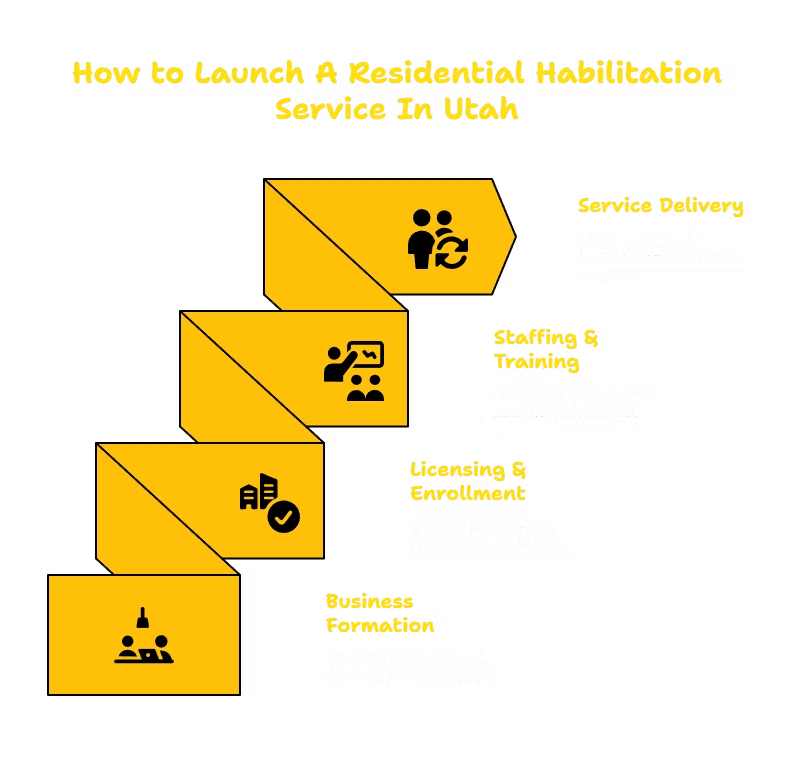
Starting a Residential Habilitation provider agency requires a structured approach to licensing, enrollment, and operational readiness. The process begins with establishing the legal business entity through the Utah Division of Corporations. Once the business is formed, founders must obtain a federal Employer Identification Number (EIN) and a Type 2 National Provider Identifier (NPI). These are the prerequisites for all subsequent Medicaid and DSPD applications, serving as the professional identity of the agency in all official systems.
Following business formation, the agency must navigate the licensing and enrollment requirements specific to the intended residential model. If the agency plans to operate group homes or host homes, they must secure the necessary Residential Support license through the Office of Licensing (OL). This involves rigorous site inspections, fire safety checks, and the submission of comprehensive floor plans. Finally, the agency must complete the MySupport training modules and submit a formal application to the DSPD for contract approval, which is the final gateway to accepting client referrals.
- Business registration with the Utah Division of Corporations.
- Securing an EIN and Type 2 NPI.
- Obtaining Residential Support licensure through the Office of Licensing (OL).
- Developing a comprehensive Residential Habilitation Services Policy & Procedure Manual.
- Completing DSPD provider enrollment and finalizing the service contract.
What Documentation and Policies are Necessary for Compliance?
Operational success relies on a robust internal documentation system that demonstrates adherence to state and federal standards. A central component of this is the Residential Habilitation Policy & Procedure Manual. This document serves as the "source of truth" for the agency, detailing how staff must handle daily operations, emergency responses, and client rights. It must clearly articulate the protocols for medication administration, including delegation processes from an RN, and describe the specific methods for documenting ISP goal progress.
Beyond the policy manual, providers must maintain meticulous records for every client and staff member. For the agency, this includes maintaining current business documentation and insurance coverage. For individual participants, it requires detailed daily progress notes, incident reports, and data collection forms that correlate directly with the goals identified in the participant’s ISP. Failure to maintain these documents in an organized and accessible manner is a primary finding in many state audits and can lead to recoupment of funds or contract suspension.
What are the Staffing and Training Requirements for Providers?
The quality of Residential Habilitation services is directly tied to the competency and training of the staff. Every Direct Support Professional (DSP) must meet baseline requirements, including being at least 18 years of age, passing a thorough background check, and maintaining current CPR and First Aid certifications. More importantly, staff must be proficient in Abuse, Neglect, and Exploitation Prevention (ANEP) and receive specific, documented training on the unique ISP goals and needs of each individual they support.
Management staff, including Residential Managers, carry the responsibility of oversight, ensuring that staff scheduling, goal tracking, and incident reporting are performed accurately. Furthermore, for agencies assisting with medication, the presence of a Registered Nurse is required for oversight and delegation. Training is a cyclical process; it is not enough to train a staff member at the time of hire. Agencies must ensure that HIPAA compliance, fire safety, and behavior support training are updated regularly, ensuring that the team remains capable of responding to evolving client needs.
Frequently Asked Questions
Which Medicaid waiver programs cover Residential Habilitation in Utah?
Residential Habilitation is primarily covered under the Community Supports Waiver (CSW) for adults with ID/DD. It may also be authorized under the Acquired Brain Injury (ABI) waiver and the Physical Disabilities Waiver (PDW), provided the service is justified and authorized by the DSPD based on the individual’s specific support needs.
How long does the provider enrollment process typically take?
The timeline varies based on the scope of the program, but generally, business formation and policy development take 1–2 months, followed by 2–4 months for licensing and Medicaid enrollment. Staffing and training usually require an additional 45–60 days before the agency is fully prepared to begin service delivery upon client referral.
What is the role of the Utah Office of Licensing (OL)?
The Office of Licensing is responsible for regulating the physical sites where residential services are provided. They conduct necessary inspections, such as fire safety checks and facility reviews, to ensure that the living environment meets all safety and regulatory standards required for residential support programs.
Key Takeaway
Becoming a Residential Habilitation provider in Utah requires a strict commitment to regulatory compliance, documentation, and the provision of person-centered care. Success is built upon a foundation of thorough preparation, from securing the correct licensure and NPIs to developing robust operational policies that satisfy the stringent standards of the DSPD and CMS. By maintaining clear records and investing in high-quality staff training, providers can create sustainable programs that effectively support the safety, independence, and integration of individuals within their communities.
Last verified: 05/20/2024. This content is provided for informational purposes only and does not constitute legal or professional advice. Always consult with the Utah Department of Health and Human Services (DHHS) and the Division of Services for People with Disabilities (DSPD) for the most current regulatory guidance.