RESIDENTIAL HABILITATION SERVICES PROVIDER IN TENNESSEE
By Fatumata Kaba · 2025-10-22 · 5 min read
Understanding Residential Habilitation in Tennessee
Residential Habilitation services in Tennessee provide 24-hour support and comprehensive life skills training for individuals with intellectual and developmental disabilities (I/DD). These services are a foundational component of the Employment and Community First (ECF) CHOICES program and the 1915(c) Waiver programs, ensuring that participants receive the necessary assistance to live independently within licensed homes or supported apartment settings.
As a provider of these services, your agency becomes a critical partner in the continuum of care. The role involves more than just providing supervision; it requires active engagement in a person-centered model that helps participants acquire daily living skills, achieve personal milestones, and foster meaningful connections within their local communities. Success in this sector requires strict adherence to federal and state mandates to ensure the safety, dignity, and autonomy of the individuals served.
Regulatory Oversight and Program Governance
Navigating the administrative landscape of Tennessee Medicaid is essential for any aspiring Residential Habilitation provider. The program is overseen by a collaborative framework of state and federal entities, each playing a distinct role in ensuring compliance and quality of care. The Tennessee Division of TennCare functions as the lead agency, administering the Medicaid program and providing high-level oversight for both ECF CHOICES and 1915(c) waiver services.
The Department of Intellectual and Developmental Disabilities (DIDD) acts as the primary regulatory body for providers on the ground. DIDD is responsible for the licensing, certification, and ongoing monitoring of residential homes. Furthermore, the federal Centers for Medicare & Medicaid Services (CMS) establishes the overarching federal Home and Community-Based Services (HCBS) waiver requirements. Providers must maintain alignment with these agencies to remain in good standing.
- TennCare: Administers the Medicaid program and manages waiver service authorization.
- DIDD: Licenses facilities, certifies providers, and conducts periodic site monitoring.
- CMS: Sets the federal HCBS standards that govern all residential service delivery.
Core Components of Residential Habilitation
Residential Habilitation is defined by 24/7 supervised care, where the primary objective is to maximize participant independence through consistent, hands-on support. Services are tailored to meet the unique needs of each individual as outlined in their Person-Centered Support Plan (PCSP) or Individual Support Plan (ISP). Staff must be adept at balancing the need for safety with the importance of promoting personal autonomy.
The service array is broad, covering everything from basic personal care to complex community integration. Whether assisting with medication administration or facilitating self-advocacy, staff must be trained to implement plans that are both clinical and compassionate. The goal is to move the participant toward greater self-reliance through structured, goal-oriented daily activities.
- Daily Living Support: Direct assistance with bathing, grooming, toileting, and nutritional support.
- Household Management: Training in budgeting, laundry, cleaning, and home safety.
- Community Integration: Facilitating participation in volunteer work, shopping, and social events.
- Health and Safety: Medication administration, health monitoring, and behavior support implementation.
- Skill Development: Coaching in communication, social interaction, and self-advocacy strategies.
Navigating the Provider Enrollment and Licensing Process
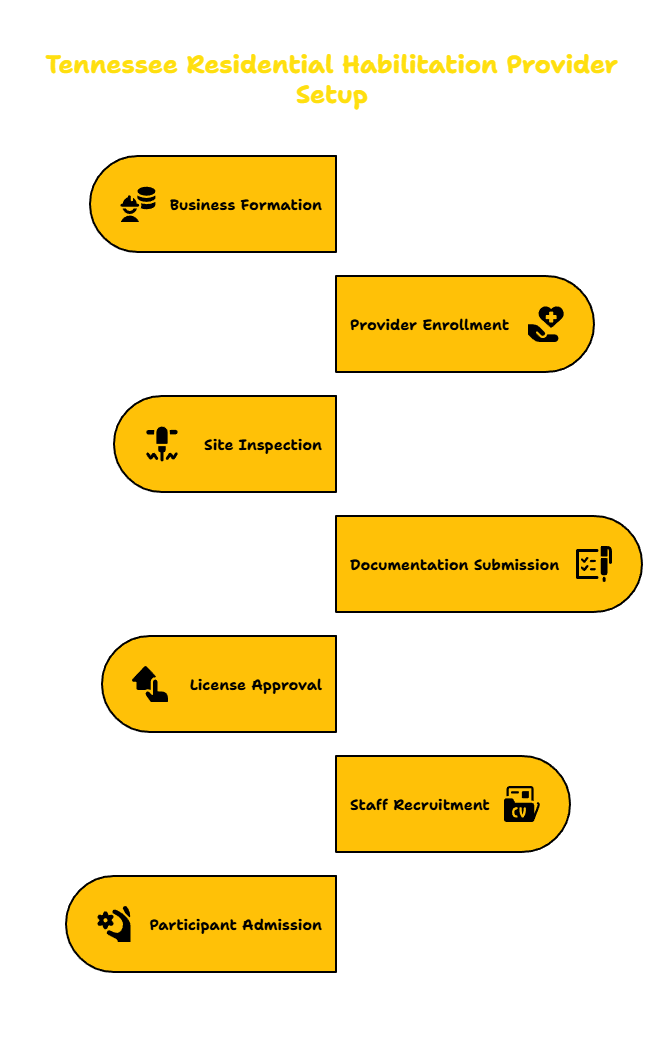
The path to becoming a licensed provider involves a rigorous sequence of business registration and program enrollment. Prospective agencies must first establish a formal business entity with the Tennessee Secretary of State and secure a Type 2 NPI and EIN. These foundational steps allow your organization to be identified correctly within the TennCare and DIDD systems.
Following registration, providers must apply for enrollment through the appropriate channels for ECF CHOICES and the 1915(c) waivers. This process includes securing a specific DIDD residential license for every home location. Compliance with the HCBS Final Settings Rule is non-negotiable; each site must be evaluated to ensure it meets community integration and privacy standards before the home can be opened to participants.
- Register business and obtain EIN and Type 2 NPI.
- Apply for provider status through DIDD and TennCare enrollment portals.
- Obtain a DIDD residential license for each physical location.
- Complete site inspections and staffing reviews mandated by DIDD.
- Ensure all policy manuals and emergency protocols are fully documented.
Staffing Requirements and Clinical Competency
The quality of your residential program is directly linked to the competency of your staff. Direct Support Professionals (DSPs) are the heartbeat of the agency, requiring a high school diploma or GED, a clean background check, and mandatory certifications in CPR and First Aid. Beyond entry-level requirements, staff must undergo specific training modules provided or approved by DIDD.
Supervisory staff, such as Residential House Managers, must possess both experience and a deep understanding of HCBS regulations to oversee daily operations. In cases where participants have complex medical needs, Licensed Nurses (RN or LPN) must be involved to handle delegated medical tasks or specialized health monitoring. Continuous professional development is mandatory to ensure all staff remain updated on incident reporting, behavioral safeguards, and emergency procedures.
- Core Training: Completion of all DIDD mandated training modules.
- Person-Centered Support: Deep knowledge of ISP implementation and daily progress tracking.
- Safety and Compliance: Regular training in infection control, incident reporting, and HCBS settings rule adherence.
Frequently Asked Questions
What is the typical timeline to launch a residential program?
The timeline varies based on organizational readiness, but generally, business formation and NPI registration take 1–2 months. Provider enrollment and DIDD site licensure typically require 3–4 months. Staff recruitment and training follow, spanning an additional 30–60 days before the agency is ready for participant admissions.
How does the HCBS Settings Rule affect residential providers?
The HCBS Settings Rule ensures that individuals receiving waiver services have full access to the benefits of community living. Providers must ensure that their homes do not isolate individuals from the broader community and that participants have control over their personal schedules, privacy, and social interactions within the home.
What documentation is essential for initial licensure?
Providers must maintain comprehensive documentation, including Articles of Incorporation, proof of liability insurance, and worker’s compensation. Furthermore, a robust Policy and Procedure Manual is required, covering emergency fire safety plans, participant rights, medication logs, and detailed ISP implementation protocols.
Key Takeaway for Residential Providers
Establishing a Residential Habilitation agency in Tennessee requires a systematic approach to regulatory compliance, staff training, and quality assurance. By focusing on the rigorous standards set by TennCare and the DIDD, providers can ensure they are well-positioned to deliver high-quality, person-centered support that transforms the lives of individuals with I/DD. Success depends on maintaining meticulous records, investing in a skilled workforce, and upholding the integrity of the HCBS waiver framework throughout every phase of service delivery.
Last verified: 2024. The information provided is for educational purposes only and does not constitute legal or professional consulting advice. For specific regulatory guidance or assistance with the provider enrollment process, please contact the Tennessee Department of Intellectual and Developmental Disabilities (DIDD) or the Tennessee Division of TennCare directly.