RESIDENTIAL HABILITATION SERVICES PROVIDER IN SOUTH DAKOTA
By Fatumata Kaba · 2025-10-15 · 5 min read
Navigating Residential Habilitation Services in South Dakota
Residential Habilitation Services in South Dakota provide essential 24/7 support for individuals with intellectual and developmental disabilities (IDD) to foster independence, skill acquisition, and meaningful community integration. Operating primarily under the CHOICES Waiver and managed by the South Dakota Department of Human Services (DHS) Division of Developmental Disabilities (DDD), these services are delivered in structured, provider-operated residential settings like group homes or supervised apartments.
For organizations looking to become approved providers, the process involves rigorous compliance with both state-specific regulatory frameworks and federal Home and Community-Based Services (HCBS) standards. Success requires a robust commitment to person-centered planning, comprehensive staff training, and the development of sophisticated operational policies that ensure participant health, safety, and autonomy.
Understanding the Governance and Regulatory Landscape
The South Dakota provider landscape is shaped by the interaction between state agencies and federal mandates. The primary governing authority is the South Dakota Department of Human Services (DHS) – Division of Developmental Disabilities (DDD). This division is responsible for the authorization and monitoring of all Residential Habilitation providers, including the implementation of quality reviews, licensing oversight, and ongoing compliance monitoring within the CHOICES Waiver framework.
In addition to the DDD, the South Dakota Department of Social Services (DSS) may provide regulatory guidance, particularly concerning facility-specific standards or funding coordination for individuals with complex needs. At the federal level, the Centers for Medicare & Medicaid Services (CMS) sets the overarching expectations for HCBS compliance. Providers must align their service delivery with CMS mandates regarding person-centered planning, ensuring that the residential environment promotes individual choice and community inclusion rather than institutionalization.
Defining the Scope of Residential Habilitation Services
Residential Habilitation is designed to support individuals who require around-the-clock supervision and intensive training in daily living tasks. The service is not merely about oversight; it is an active, goal-oriented process where staff engage participants in skill-building activities. This includes assistance with activities of daily living (ADLs), such as personal hygiene and grooming, while simultaneously teaching the participant how to perform these tasks independently whenever possible.
The service model requires providers to implement individualized behavior support plans and maintain detailed documentation of progress. This ensures that the care provided is not stagnant but evolves alongside the participant’s growing capabilities and changing needs. Approved providers deliver a comprehensive suite of supports, including:
- 24-Hour Supervision and Support
- Assistance with ADLs and Personal Hygiene
- Meal Preparation and Nutrition Monitoring
- Behavioral Support Plan Implementation
- Skill-Building Activities: Cooking, money management, cleaning, and more
- Community Participation and Transportation Support
- Medication Management (non-skilled)
- Plan of Care Implementation and Documentation
Establishing Your Agency and Meeting Enrollment Requirements
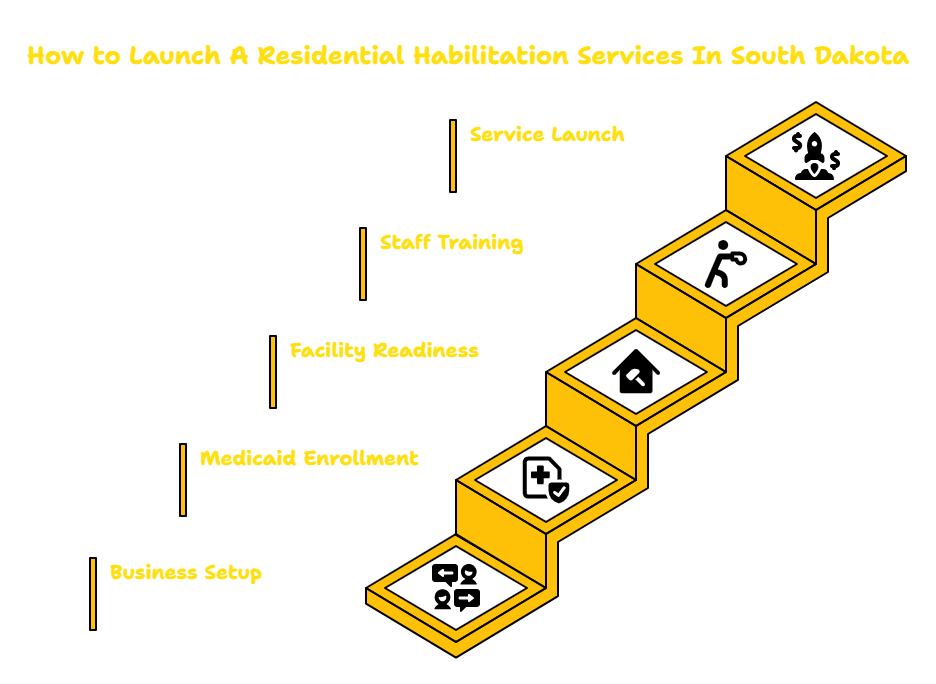
Becoming an approved Residential Habilitation provider is a methodical journey that begins with formal business formation. Prospective agencies must register as a legal entity with the South Dakota Secretary of State and obtain an Employer Identification Number (EIN) and a Type 2 National Provider Identifier (NPI). These foundational steps are necessary before submitting an application to the DHS-DDD for enrollment under the CHOICES Waiver.
Beyond the paperwork, providers must demonstrate operational readiness. This involves sourcing and outfitting a facility that meets strict health and safety codes, developing a comprehensive Residential Habilitation Policy & Procedure Manual, and securing necessary business insurance, including general liability, workers’ compensation, and participant risk coverage. The DHS-DDD will conduct site visits and readiness reviews to ensure the physical environment and the agency's infrastructure meet the stringent demands of 24/7 care.
Structuring Staffing and Clinical Support
The quality of Residential Habilitation is defined by the competency of the direct support staff. The Direct Support Professional (DSP) is the backbone of the program, requiring rigorous training in CPR, first aid, abuse prevention, and DHS-mandated protocols for ADL support and participant safety. Because DSPs provide 24/7 care, they must be proficient in emergency response, documentation accuracy, and the implementation of individualized plans of care.
Management structures are equally critical. A House Manager or Site Coordinator must oversee the daily operations, ensuring that DSPs are adhering to established protocols and that incidents are reported correctly according to state mandates. If the population served has complex behavioral needs, a Behavior Support Professional may also be required to design and oversee interventions. All personnel must engage in ongoing in-service education, including HIPAA compliance training and periodic skills verification to ensure they remain current with best practices in residential support.
Managing the Implementation Timeline
The path from business formation to service delivery typically spans several months. The initial phase of business and facility setup generally takes 2–4 months, during which the agency must secure a physical location and align its business model with state requirements. Following this, the Medicaid provider enrollment and site readiness assessment phase usually requires an additional 3–5 months.
Once initial approvals are in sight, the agency must dedicate 1–2 months to the hiring and training of staff, ensuring that all personnel meet the background check and qualification standards required for working in a residential setting. Service launch occurs only after final authorization from the state, at which point the agency can begin accepting referrals from participant case managers. Throughout this timeline, meticulous record-keeping is vital, as the agency will need to provide evidence of its readiness during each inspection milestone.
Frequently Asked Questions
What is the primary role of the DHS-DDD in this process?
The Division of Developmental Disabilities authorizes and monitors Residential Habilitation providers, conducts quality reviews, and oversees licensing compliance within the CHOICES Waiver program.
What documentation is essential for a new provider agency?
Providers must maintain comprehensive business records, facility-specific health and safety checklists, medication logs, staff shift reports, and a thorough Policy & Procedure Manual that details incident reporting, HIPAA compliance, and participant rights.
How does the CHOICES Waiver impact service delivery?
The CHOICES Waiver is the primary mechanism for funding 24-hour residential support for adults with IDD in South Dakota; providers must align their service delivery with the specific rules of this waiver and person-centered planning regulations.
Key Takeaway
Launching a Residential Habilitation program in South Dakota requires a rigorous focus on administrative compliance, staff competency, and person-centered service delivery. By strictly adhering to the requirements set forth by the South Dakota DHS-DDD and aligning operational practices with federal HCBS guidelines, providers can create sustainable, high-quality residential environments that significantly enhance the lives of individuals with developmental disabilities. Success is built upon the foundational pillars of proper licensure, diligent documentation, and the continuous professional development of the direct support workforce.
WCG helps agencies build compliant and person-centered residential habilitation programs that empower individuals with disabilities to live fuller, more independent lives. Our scope of work includes Medicaid provider enrollment assistance, Residential Habilitation Policy & Procedure Manual development, facility readiness checklist and licensing support, DSP training templates, care documentation tools, participant transition forms, and ISP coordination worksheets. Our Client Portal offers a wealth of resources that you can explore related to various programs and state requirements.
Last verified: 2024. This information is provided for general informational purposes only and does not constitute legal or professional advice. Always consult the most recent South Dakota Department of Human Services manuals and federal CMS guidance to ensure compliance with current regulations.