RESIDENTIAL HABILITATION SERVICES PROVIDER IN NEW YORK
By Fatumata Kaba · 2025-09-04 · 5 min read
What are Residential Habilitation Services in New York?
Residential Habilitation Services in New York are specialized Medicaid-funded supports designed to empower individuals with developmental disabilities or other complex needs to live as independently as possible. These services are delivered within community-based, home-like environments, moving away from institutional models toward person-centered settings that foster autonomy, skill acquisition, and meaningful community integration. By focusing on individualized goals, these programs ensure that participants can maintain their personal well-being while actively participating in the social and economic life of their neighborhoods.
The core objective of these services is to facilitate the development and maintenance of essential life skills. Whether through direct personal care assistance or specialized training in household management, the support is always aligned with a participant’s Individualized Service Plan (ISP). This ensures that every intervention—from behavioral support to community outings—is tailored to meet the participant’s specific functional needs and long-term personal aspirations, providing a stable foundation for a life of self-determination.
Which Agencies Oversee Residential Habilitation in New York?
The regulatory landscape for Residential Habilitation in New York is multi-layered, involving state and federal oversight to ensure high standards of safety and care. The New York State Department of Health (NYSDOH) serves as the primary administrative body, managing Medicaid waiver funding, overseeing the provider enrollment process, and directing reimbursement protocols for these services. Every provider must interface with the NYSDOH to ensure their billing and operational practices remain compliant with state and federal regulations.
In addition to the NYSDOH, specific oversight is delegated based on the population served. The Office for People With Developmental Disabilities (OPWDD) provides rigorous oversight for programs targeting individuals with developmental disabilities, while the New York State Office of Mental Health (OMH) ensures compliance for facilities serving individuals with mental health conditions. Furthermore, the federal Centers for Medicare & Medicaid Services (CMS) maintains overarching authority, setting the national quality and person-centered care standards that all New York-based residential programs must uphold to remain eligible for Medicaid funding.
What Are the Core Service Components and Provider Responsibilities?
Approved providers of Residential Habilitation are tasked with delivering a comprehensive array of supports that extend beyond basic housing. These services are clinical and educational in nature, requiring providers to document progress against established goals continuously. Essential services include personal care assistance, such as grooming and meal preparation, alongside skill-building training in areas like financial management, cleaning, and cooking. These services are designed to bridge the gap between high-support needs and functional independence.
Beyond daily living tasks, providers must facilitate community integration and self-advocacy. This includes organizing recreational outings, providing necessary transportation support, and teaching self-determination skills. Safety is also a critical component, with staff required to provide ongoing training in emergency response and personal safety. All activities must be meticulously documented in the participant’s ISP, with progress reports serving as the primary evidence for Medicaid billing and clinical oversight.
- Personal Care Assistance: Support with grooming, dressing, hygiene, and meal preparation.
- Skill Building: Training in cooking, cleaning, and managing personal finances.
- Community Integration: Facilitating social interactions and community involvement.
- Health and Safety Training: Teaching emergency response and personal safety techniques.
- Behavioral Support: Implementing positive behavior support plans as needed.
- Self-Advocacy Skills: Encouraging decision-making and self-determination.
- Recreational Activities: Organizing community outings and group activities.
- Transportation Support: Assistance with accessing community services and events.
- Documentation: Maintaining records of individualized service plans (ISP) and progress reports.
How to Navigate the Licensing and Provider Enrollment Process
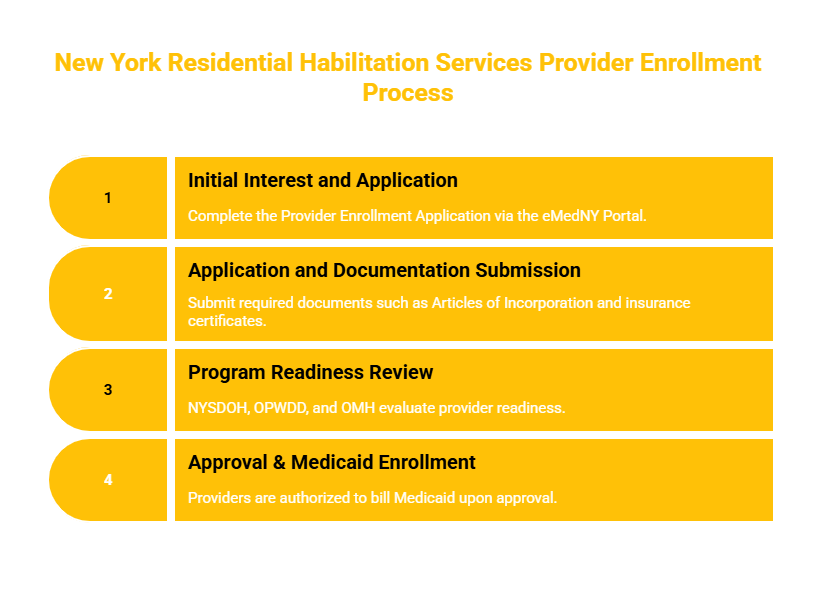
Launching a residential habilitation agency requires a disciplined approach to both business formation and state-level compliance. Before seeking Medicaid enrollment, entities must register with the New York Department of State and obtain a federal Employer Identification Number (EIN) and a Type 2 National Provider Identifier (NPI). These foundational steps allow the business to establish its legal identity before initiating the formal application process through the eMedNY Provider Enrollment Portal.
Once the business is legally established, the provider must move into the readiness review phase. This involves demonstrating to the NYSDOH, OPWDD, or OMH that the agency is prepared to meet all residential safety protocols, staff qualification requirements, and care standards. This process requires submitting detailed policies and procedures, proof of adequate insurance, and evidence of staff competency. Only upon successful completion of this rigorous review will the agency receive authorization to bill for services under the applicable HCBS waivers.
Staffing, Training, and Operational Compliance Requirements
The quality of a residential habilitation program rests on the caliber of its staff. The Program Director, a role requiring a bachelor’s or master’s degree in social work, human services, or healthcare administration, acts as the primary lead for program management and regulatory oversight. Supporting them are Direct Support Professionals (DSPs) and Habilitation Specialists, who perform the day-to-day work of skill-building and care delivery. All staff must undergo background screenings, health clearances, and continuous professional development.
Ongoing compliance is a daily operational requirement. Providers must maintain a robust Policy and Procedure Manual covering HIPAA, participant rights, grievance handling, and quality assurance. Furthermore, all staff must participate in mandatory training sessions covering person-centered planning, emergency response, and documentation best practices. Annual competency evaluations are required to ensure that staff members maintain the high level of clinical expertise necessary to serve individuals with diverse and complex support needs.
Frequently Asked Questions
Which Medicaid waivers cover Residential Habilitation in New York?
Residential Habilitation Services are currently authorized under the OPWDD Comprehensive Waiver, the Home and Community-Based Services (HCBS) Waiver, the Nursing Home Transition and Diversion (NHTD) Waiver, and the Traumatic Brain Injury (TBI) Waiver.
What is the typical timeline to launch a residential program?
The development timeline typically spans several months: 1–2 months for business formation, 2–3 months for hiring and program development, 60–90 days for the enrollment and readiness review, and 30–45 days for billing system setup.
What documentation is required for the enrollment application?
Applicants must provide Articles of Incorporation, proof of EIN and NPI, insurance certificates, a comprehensive Policy & Procedure Manual, staff training records, and evidence of compliance with safety and HIPAA regulations.
Key Takeaway
Becoming an approved Residential Habilitation provider in New York is a complex, high-stakes endeavor that requires strict adherence to the regulatory frameworks established by the NYSDOH, OPWDD, and OMH. Agencies that succeed prioritize meticulous documentation, rigorous staff training, and a deep commitment to the principles of person-centered care. By aligning business operations with the specific requirements of the state’s Medicaid waiver programs, providers can establish sustainable, high-quality services that significantly improve the lives of individuals with developmental and special needs.
Last verified: October 2023. Disclaimer: This article is for informational purposes only and does not constitute legal or professional advice. Requirements for Medicaid provider enrollment are subject to change; always consult the latest guidance from the New York State Department of Health and relevant regulatory agencies before initiating your application.