RESIDENTIAL CARE SERVICES PROVIDER IN WISCONSIN
By Fatumata Kaba · 2026-04-14 · 6 min read
OFFERING SUPPORTIVE, COMMUNITY-BASED HOUSING OPTIONS FOR INDIVIDUALS WHO NEED ASSISTANCE WITH DAILY LIVING WHILE PRESERVING AUTONOMY AND DIGNITY
Residential Care Services in Wisconsin provide essential housing and daily support for individuals with disabilities, chronic health conditions, or functional limitations who cannot live independently but do not require institutional nursing care. These services are designed to promote long-term stability, foster community integration, and enhance the overall quality of life for participants through licensed residential models like Adult Family Homes, Community-Based Residential Facilities, and Residential Care Apartment Complexes.
Providers operate within a strictly regulated framework overseen by the Wisconsin Department of Health Services (DHS). Funding for these services is primarily facilitated through state waiver programs, including Family Care, IRIS (Include, Respect, I Self-Direct), and the Children’s Long-Term Support (CLTS) waiver. To remain compliant, all service delivery must align with the participant’s Individual Service Plan (ISP) or Long-Term Care Functional Screen (LTCFS), ensuring that care is both person-centered and compliant with state and federal standards.
What Are the Governing Agencies and Licensing Requirements in Wisconsin?
The regulatory landscape for residential care in Wisconsin is anchored by the Wisconsin Department of Health Services (DHS). The DHS is the primary governing authority responsible for establishing rules regarding facility licensure and ensuring that all providers maintain consistent compliance with state health and safety standards. Within the DHS, the Division of Quality Assurance (DQA) serves as the frontline regulatory body for most residential models. The DQA is responsible for the issuance of licenses, the performance of initial surveys, and ongoing monitoring of compliance for Adult Family Homes (AFHs), Community-Based Residential Facilities (CBRFs), and Residential Care Apartment Complexes (RCACs).
Beyond state licensure, providers must engage with the financial and clinical arms of the Wisconsin Medicaid system. For participants enrolled in Family Care, Managed Care Organizations (MCOs) are responsible for authorizing funding and overseeing the care planning process. For those in the IRIS program, participants work with IRIS Consultant Agencies to manage their individual budgets. It is essential for providers to understand that licensing with the DQA is distinct from becoming an enrolled provider with these local MCOs or consultant agencies. Both steps are necessary to legally operate a facility and receive reimbursement for services provided to waiver participants.
Which Residential Care Models Are Available for Providers?
Wisconsin offers three primary residential models, each with distinct capacity limits and operational requirements. Adult Family Homes (AFHs) are licensed to serve between one and four residents. These settings provide a more intimate environment where residents receive assistance with activities of daily living (ADLs), meals, medication, and social activities. Because of their smaller footprint, AFHs are often the entry point for many new providers navigating the licensing process.
Community-Based Residential Facilities (CBRFs) are designed for larger groups, specifically serving five or more residents. These facilities must adhere to more rigorous staffing and physical plant requirements, as the increased capacity necessitates higher levels of supervision and infrastructure to ensure the safety and well-being of all occupants. For providers looking to offer a more independent living environment, the Residential Care Apartment Complex (RCAC) is an option. RCACs consist of independent apartment units where residents can access optional support services. Unlike AFHs and CBRFs, RCACs are regulated under a separate, specific certification process that focuses on the provision of services in a private residential unit.
- Adult Family Homes (AFH): Serve 1–4 residents; focus on personalized, home-like assistance.
- Community-Based Residential Facilities (CBRF): Serve 5+ residents; require extensive staffing and emergency preparedness planning.
- Residential Care Apartment Complexes (RCAC): Provide apartment-style living with flexible support service options.
How Do Providers Deliver Person-Centered Care and Support?
Residential settings are fundamentally built around 24/7 supervision and a tailored blend of personal care and habilitation. The core objective is to assist individuals in performing daily tasks they can no longer manage safely on their own, such as bathing, dressing, hygiene maintenance, and dietary accommodations. Beyond physical care, providers are expected to manage medication assistance or administration, ensuring that clinical protocols are followed with precision. Health monitoring and the implementation of emergency response plans are also non-negotiable requirements for any residential provider.
Quality of life extends beyond basic health needs. Effective residential programs incorporate robust social and recreational opportunities, life skills training, and transportation coordination to keep residents connected to their communities. If a resident requires specific behavioral support, the facility must be equipped to deliver these services in a manner that adheres to the participant’s individualized care plan. All service delivery must be performed in a person-centered environment that honors the resident’s dignity and rights, ensuring that the facility remains a home rather than an institution.
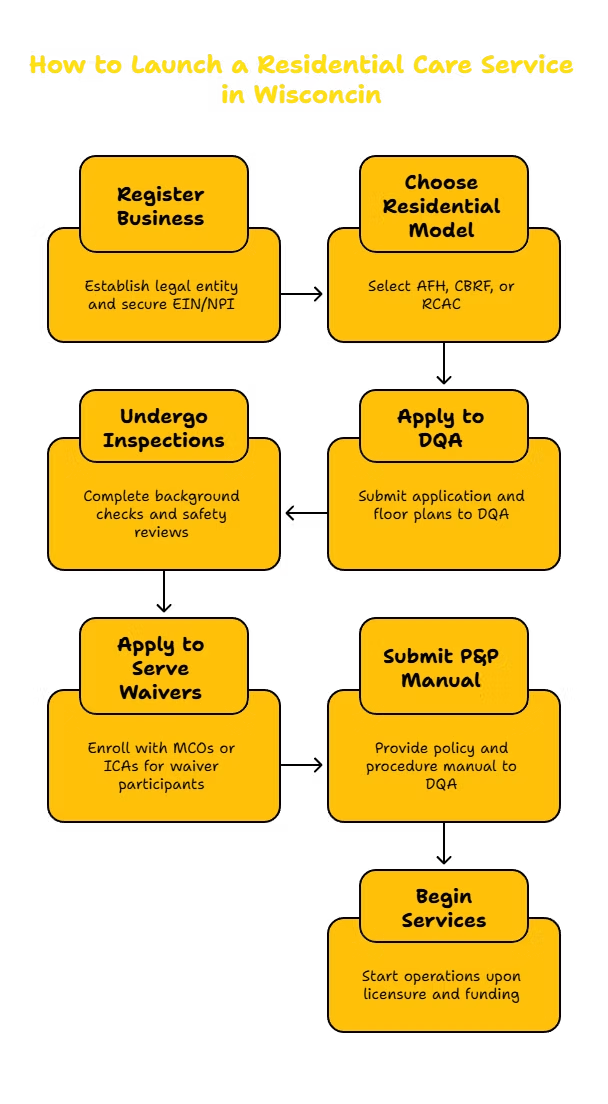
What Is the Step-by-Step Process for Facility Enrollment?
The journey to launching a residential care facility begins with solid administrative groundwork. Founders must first register their business with the Wisconsin Department of Financial Institutions (DFI) and secure a Federal Employer Identification Number (EIN). If the provider intends to bill Medicaid, they must also obtain a Type 2 National Provider Identifier (NPI). Once the legal entity is established, the provider must choose a model, develop a comprehensive Policy and Procedure (P&P) manual, and submit floor plans along with a detailed program statement to the DQA for review.
Following the submission of administrative documentation, the facility must undergo several rounds of inspections, including fire safety, sanitation, and background checks for all potential staff. After the DQA grants the license, the provider must initiate the process to enroll as an authorized service provider for the local MCOs (for Family Care) or the Fiscal Employer Agents (for IRIS). This process involves a readiness review to ensure the facility has the infrastructure and staffing in place to meet the needs of waiver participants. Only after the license is active and an MCO or ICA has authorized placement can the provider begin admitting residents.
How Do You Maintain Compliance and Manage Required Documentation?
Ongoing compliance is the bedrock of a successful residential care business. Providers must maintain a well-organized repository of documentation that reflects daily operations and staff accountability. This includes the DQA license certificate, floor plans, and a comprehensive P&P manual that covers every aspect of facility life. Key policies within the manual should detail admission, discharge, and transfer procedures; protocols for medication handling; and strict incident reporting standards that align with state expectations.
Staffing documentation is equally critical. All personnel must have verified credentials, including clear background checks, valid CPR/First Aid certifications, and completion of required training modules such as HIPAA compliance, person-centered care, and abuse/neglect prevention. For day-to-day operations, providers must maintain diligent records, including daily care logs, activity schedules, and shift coverage plans. All billing documentation must match the services authorized in the participant’s service plan, as this data will be scrutinized during periodic audits and compliance surveys.
Frequently Asked Questions
How is room and board typically funded in Wisconsin residential care?
While waiver programs like Family Care and IRIS cover the cost of supportive services, they generally do not cover room and board. These costs are typically funded privately by the individual, often using personal income or Social Security Income (SSI) / Social Security Disability Insurance (SSDI) benefits.
What is the typical timeline for launching a new facility?
The launch timeline varies based on preparation, but generally spans several months. Business registration and facility planning usually take 1–2 months, DQA licensing and staff credentialing take 2–4 months, and Medicaid/MCO enrollment and readiness reviews require an additional 30–60 days.
What are the mandatory staff training requirements?
All staff members must be at least 18 years old and undergo comprehensive background checks. Training must include First Aid, CPR, personal care, habilitation, HIPAA confidentiality, resident rights, and the prevention of abuse, neglect, and exploitation. Behavioral support homes may also require additional crisis intervention training.
Key Takeaway
Launching a residential care facility in Wisconsin requires a disciplined approach to licensing, regulatory compliance, and person-centered service delivery. By maintaining meticulous records, adhering to the standards set by the DQA, and fostering strong relationships with local MCOs and IRIS consultants, providers can build sustainable, high-quality environments that meet the long-term needs of vulnerable Wisconsinites.
Last verified: October 2023. Disclaimer: This article is for informational purposes only and does not constitute legal or professional advice. Always consult directly with the Wisconsin Department of Health Services or local authorities regarding specific program requirements and regulations.