RESIDENTIAL CARE SERVICES PROVIDER IN TEXAS
By Fatumata Kaba · 2026-03-30 · 5 min read
Residential care services in Texas provide essential 24/7 support and supervision for individuals with intellectual or developmental disabilities (IDD), behavioral health needs, or other long-term conditions that prevent independent living. These services, primarily authorized under 1915(c) Home and Community-based Services (HCBS) waiver programs such as HCS, TxHmL, and DBMD, are governed by the Texas Health and Human Services Commission (HHSC) to ensure quality care, safety, and community integration.
Understanding the Governing Framework for Texas Residential Providers
The regulatory landscape for residential care in Texas is anchored by two primary authorities: the Texas Health and Human Services Commission (HHSC) and the Centers for Medicare & Medicaid Services (CMS). The HHSC serves as the state’s regulatory body responsible for authorizing, monitoring, and reimbursing residential services for Medicaid waiver participants. It establishes the standards for service delivery, staff qualifications, and physical environment safety that every provider must meet.
At the federal level, CMS sets the overarching guidelines to ensure compliance with Medicaid HCBS regulations. These mandates focus on person-centered planning and community integration, ensuring that individuals receiving services are not merely housed, but are supported in ways that promote autonomy and participation in their local communities. Providers must align their operational procedures with these federal expectations to maintain their eligibility for Medicaid reimbursement.
The Spectrum of Residential Care Services and Setting Requirements
Residential services are provided in various environments, including licensed group homes, host homes, or supervised living arrangements. The primary goal is to provide a setting that supports the individual's specific objectives for independence, safety, and social inclusion. Whether the arrangement is a 3- or 4-person licensed home or a companion care model, the environment must be conducive to the participant’s unique support plan.
Service delivery typically encompasses a comprehensive range of supports designed to maintain the health and safety of the individual. These services include:
- 24/7 Supervision: Dedicated, awake staff available to ensure safety during all hours.
- Personal Assistance: Hands-on support with activities of daily living (ADLs) such as bathing, dressing, eating, and mobility.
- Health Management: Ongoing medication assistance, health monitoring, and coordination of medical appointments.
- Household Management: Assistance with daily chores, including cooking, cleaning, laundry, and grocery shopping.
- Skill Development: Coaching to enhance personal hygiene, daily routines, and decision-making capabilities.
- Behavioral and Community Support: Tailored interventions as outlined in the individual’s service plan to facilitate community inclusion and social stability.
Navigating the Provider Enrollment and Licensing Process
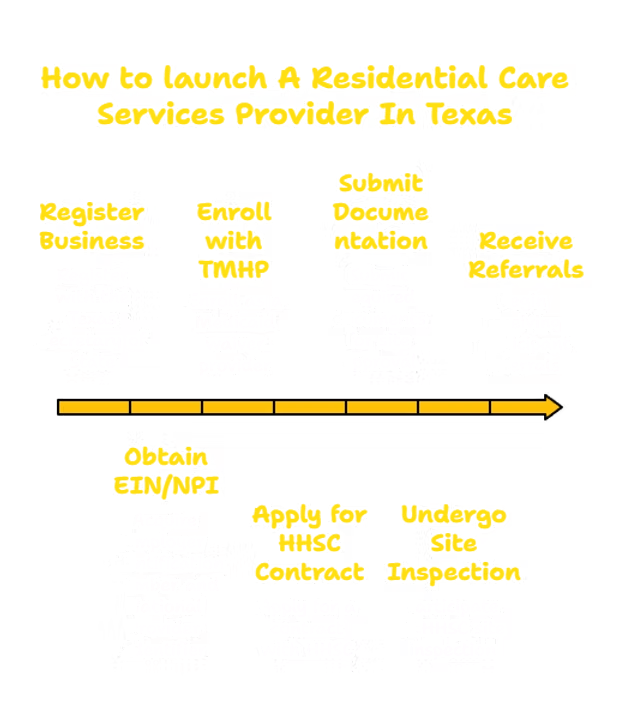
Launching a residential care agency requires a structured approach to registration and contracting. The process begins by establishing the legal business entity with the Texas Secretary of State, followed by obtaining an Employer Identification Number (EIN) and a Type 2 National Provider Identifier (NPI). These foundational steps allow the business to interact with federal and state systems officially.
Once the business is registered, the provider must enroll with the Texas Medicaid & Healthcare Partnership (TMHP). Following this, an application for a residential services contract under the HCS or DBMD programs must be submitted to the HHSC. This phase is critical, as it involves the submission of detailed physical site documentation, including floor plans, fire safety logs, and comprehensive emergency response procedures, all of which are subject to a rigorous readiness review and onsite inspection by state surveyors.
Required Documentation and Operational Compliance
Maintaining compliance is an ongoing task for residential providers. A robust administrative framework is necessary to pass recurring audits and ensure high-quality care. Providers must develop and maintain a comprehensive Residential Services Policy & Procedure Manual that addresses every aspect of daily operations. This document must be readily available and understood by all staff members.
Essential documentation and systems that must be maintained include:
- Participant Records: Detailed admission and orientation files for every resident.
- Operational Logs: Accurate shift scheduling, awake staff logs, and daily service notes.
- Clinical and Safety Records: Medication administration records (MARs), behavior support logs, and fire drill/emergency preparedness documentation.
- Quality Assurance: Systems for tracking incidents, grievances, and participant rights compliance.
- Financial Records: Accurate billing logs and progress summaries that reflect the services authorized in the Individual Service Plan (ISP).
Staffing Standards and Personnel Development
The quality of care in a residential setting is heavily dependent on the competence and training of the staff. Direct Support Professionals (DSPs) are the backbone of the agency; they must be at least 18 years old, pass comprehensive background checks, and be certified in CPR and First Aid. Beyond entry-level requirements, they must receive thorough training on waiver-specific protocols and the prevention of abuse, neglect, and exploitation.
Supervisory roles, such as the Residential Manager or House Supervisor, require individuals with specific experience in the IDD population and strong administrative capabilities. If the facility provides medication administration or delegated nursing tasks, a licensed Registered Nurse (RN) must be involved to provide clinical oversight. All staff must undergo continuous education regarding HIPAA privacy standards, incident reporting requirements, and person-centered service delivery to ensure alignment with state and federal regulations.
Frequently Asked Questions
What are the primary Medicaid waiver programs that support residential care?
Residential care is supported through the HCS (Home and Community-based Services) program, which covers group and host homes; the DBMD (Deaf Blind with Multiple Disabilities) program; and the TxHmL (Texas Home Living) waiver, which offers more limited residential support. Additionally, the YES Waiver provides support for youth in specific intensive community-based settings.
How long does the provider enrollment process typically take?
The timeline varies by applicant but generally involves 2–3 months for initial business formation and site preparation, 2–4 months for TMHP and HHSC contracting, and 1–2 months for final readiness reviews and staff preparation. Total startup time is usually calculated based on these cumulative phases.
What happens during an HHSC readiness review?
During a readiness review, HHSC surveyors examine the provider’s policy manuals, physical facility safety, staffing plans, and emergency protocols. The review ensures the agency is fully prepared to provide safe, compliant, and person-centered care before the provider begins accepting participant referrals.
Key Takeaway
Success as a residential care provider in Texas is built on meticulous preparation, adherence to HHSC and CMS regulatory standards, and a deep commitment to maintaining the documentation required for Medicaid reimbursement. By focusing on site safety, staff training, and rigorous operational policies, providers can establish stable environments that successfully promote the independence and well-being of individuals served under the state's various waiver programs.
Last verified: October 2023. Disclaimer: This article is for informational purposes only and does not constitute legal or professional advice. Requirements for Medicaid providers are subject to change. Readers should consult the official Texas Health and Human Services Commission (HHSC) and Texas Medicaid & Healthcare Partnership (TMHP) websites for the most current regulatory information and application guidance.